Category Archives: food+drink

Recipe: Rusticated Fruit Tart

An easy to make free-form fruit tart. The advantage here is that you don’t need a flan/quiche tin nor does the fruit have to be arranged in pretty patterns (though you could if you wish).

You can use almost any fruit. Gooseberries work well, as should any other berries. Rhubarb is also good; cut it into 1-2cm pieces. Stone fruit work well too, as would apples or pears. Citrus probably not so good, although YMMV.

I use puff pastry (and I can’t be bothered to make it) but you could use shortcrust or even filo pastry.

Serves: 6-8 as a sweet course
Preparation Time: 10 minutes
Cooking Time: 30 minutes

Ingredients

  • 500g packet of puff pastry
  • 600-750g fruit (more is better as it cooks down)
  • 2-3 tbsp ground almonds
  • 6 tbsp caster sugar (or a bit more depending how sweet you want the fruit)
  • 1 egg, beaten (or an equivalent amount of milk)

Instructions

  1. Preheat the oven to 220℃/200℃ fan/gas mark 7.
  2. Prepare a baking sheet and cover with baking parchment.
  3. Mix the ground almonds with an equal amount of sugar and set aside.
  4. Mix the beaten egg (or milk) with 2 tbsp sugar and set aside.
  5. Prepare the fruit. Top and tail any berries. Remove stones. Cut fruit into pieces (they don’t have to be pretty).
  6. Roll out the pastry to form a rough circle the size of the baking sheet (or slightly bigger; it doesn’t have to be precise) and transfer to the baking sheet.
  7. If the pastry has come out square-ish, snip off the corners to make something rounder, otherwise you end up with too many thick folds of pastry. Keep the pastry offcuts!
  8. Paint the pastry liberally with the egg/sugar mix.
  9. Sprinkle the ground almond mix in the centre of the pastry leaving a 3-4cm border around the edge.
  10. Pile the fruit on the almond mix – again it doesn’t have to look pretty – and sprinkle with another 1-2 tbsp sugar (to taste).
  11. Fold the edges of the pastry up and over the fruit to form a tart.
  12. Brush the edge of the tart with the egg mix and sprinkle over a little extra sugar.
  13. Bake for about 30 minutes until the pastry is crisp & golden and the fruit softened.
  14. Serve either hot or cold with cream or ice-cream.

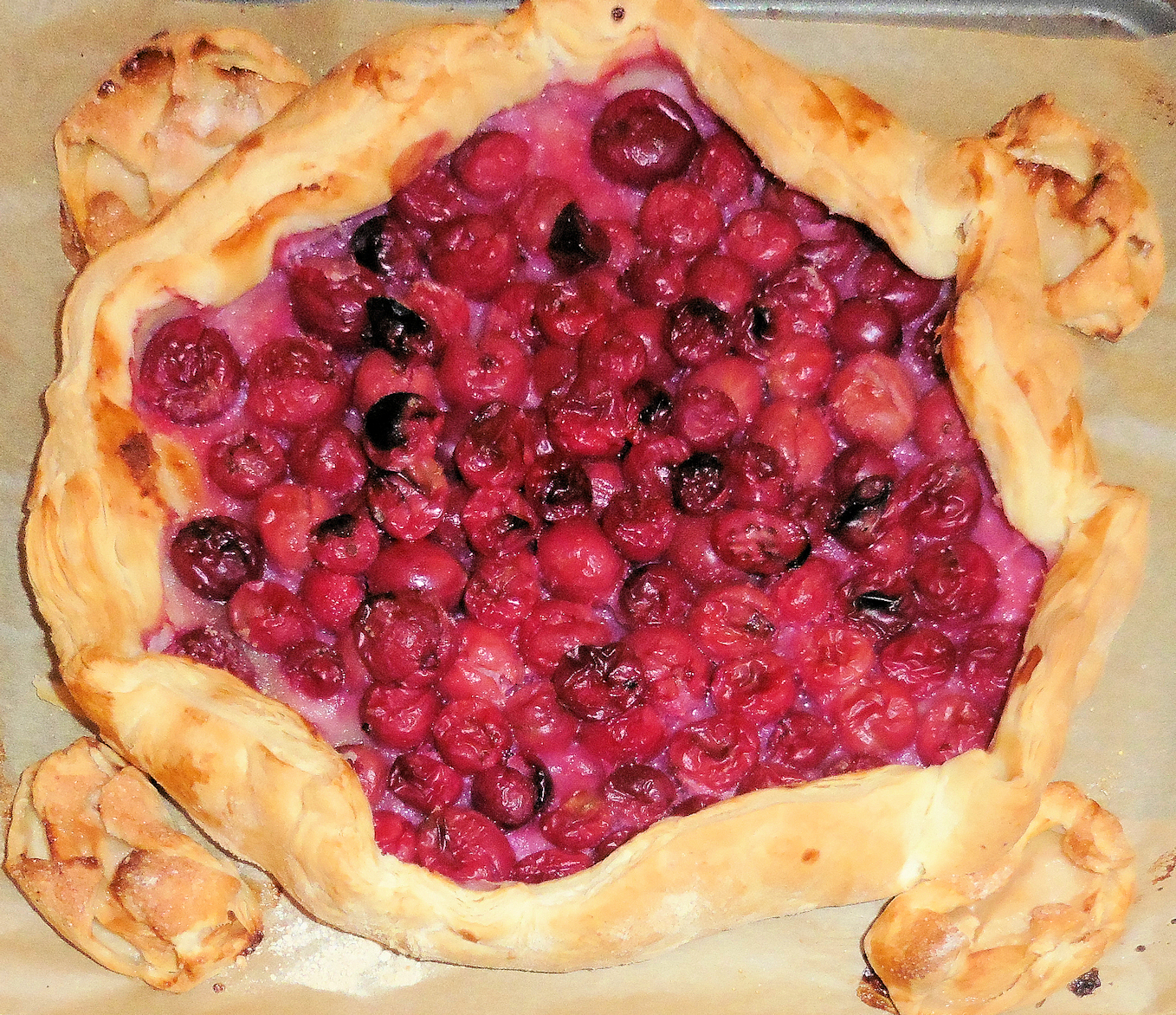
Here’s a (red) gooseberry tart I made earlier, still on the baking sheet and guarded by four mini rustic apple turnovers (more about that later!).

Gooseberry Tart

Tomorrow I’ll tell you how I made a yummy veggie version of this tart. And the day after that what to do with those pastry offcuts.

Monthly Links

Yet once more a month has passed and we come to my collection of links to items you may have missed and didn’t want to.


Science, Technology, Natural World

If we found extraterrestrials, why should we expect them to look like anything we know?

Rather surprisingly many genes are not necessary for survival, and some species have lost quite a few.

Plants have unexpected ways to communicate, problem solve and socialise – indeed a whole secret life!

Blue Tits in Germany are dying and no-one knows quite why.

What’s in an Antarctic lake? Travel down a borehole Lake Whillans.

We live on a planet. But just what is a planet?

With clearer skies and time on our hands, here are a few tips about stargazing from your backyard.


Environment

A speculative drill in Cornwall for a souyrce of lithium has uncovered a potentially important copper deposit.


History, Archaeology, Anthropology

The earliest known skull of Homo erectus has been found in South Africa.

Melting ice on a Viking-era mountain pass in Norway is revealing some spectacular artefacts.

In another story of ice, this time in the Alps, it seems that the record of lead pollution may reflect the murder of Thomas Beckett.

The mystery of the medieval sweating sickness.

Renaissance Europe was beset with paranoia about the pox leading to the rapid spread of guilt, scapegoats and wonder-cures.

And a bit more up to date, there has long been a puzzle over the early April sunrise shining through Brunel’s Box Tunnel near Bath.


Food, Drink

When do we need to adhere to expiry dates and when can they be flexed?


Lifestyle, Personal Development, Beliefs

Hints and tips on how to clean 10 annoying things around your home.

And finally, in our only concession to Coronavirus, here’s our favourite Zen master on dealing with what might happen – or it might not happen.


Be good, and stay safe!

Ingredients

Being idle as I am, I fell to thinking about food. Well who doesn’t?

Now there are very few things I really will not eat. Oysters and tripe are two which immediately spring to mind.

But there are quite a few things which, if you show me a recipe or a menu item containing them, I’ll pass on by. Pretty much top of the list are:

  • Sweet Potato
  • Butternut Squash

however they are rapidly followed by:

  • Pomegranate
  • Pumpkin
  • Gnocchi
  • Polenta
  • Tofu
  • Sourdough
  • Spelt
  • Cavalo nero

Those top 10 are followed by a few lesser horrors which will be considered under duress:

  • Beetroot
  • Goat’s cheese
  • Kale
  • Cranberry
  • Sweetcorn
  • Egg custard

And there are a few cuisine choices/combinations I will avoid:

  • Anything sweet with meat – I can’t abide jam with meat!
  • Anything which is unnecessarily vegan
  • Pretty much anything that I don’t know what it is – why do all chefs have to always include something which no-one has ever heard of?

And I am sure there are others I’ve forgotten.

But why is this? Well obviously it is in part because I actually don’t like many of them them and sometimes that is down to texture as much as taste. I’d eat them if I had to but I’ll never choose to if there is a half-decent alternative. But it is also partly because many (though not all) are/have recently been trendy and fashionable, which I find an immediate turn-off – I’m resistant to jumping on bandwagons and following the herd: thank you, I’ll decide what I eat, drink, like, think, believe; I don’t need you to decide for me!

I’m sure I’m not alone in this. What do other people refuse to eat not necessarily because they dislike it?

Recipe: Fruit & Frangipane Tart

Like many others during these times of woe I’ve been cooking more. Today was a baking day: as well as the headline Fruit & Frangipane Tart, we put together a small “jam” tart (using half a jar of very sticky mango compote), pineapple crumble (using fresh, rapidly ripening, fruit), and put some “spare” bananas in the dehydrator to dry. Anyway here’s the tart recipe …

Fruit & Frangipane Tart

This makes enough to fill a deep 23cm quiche tin (preferably one with a removable base) with a bit of pastry left over for the “jam” tart.

Ingredients: Pastry
400gm plain flour
200gm butter
50gm caster sugar
2 eggs, beaten
Milk
Pinch of salt

Ingredients: Fruit
1-2 coffee mugs full of pre-cooked “stewed” fruit of your choice (I used stewed rhubarb)
Extra sugar to taste

Ingredients: Frangipane
200gm ground almonds (I ground up some flaked almonds in a coffee mill)
200gm butter
180gm caster sugar
2 eggs, beaten
Zest of a lemon or orange
Generous tbsp vanilla essence

Method

  1. Heat the oven to 175°C.
  2. Make the sweet pastry according to your usual method adding the minimum amount of milk to make it bind together. Wrap in clingfilm and chill in the fridge for at least 30 minutes.
  3. Roll out the pastry and line the greased flan tin. Blind bake for 15 minutes.
  4. While the pastry case blind bakes, get the fruit and frangipane together.
  5. If necessary, drain any excess liquid from the fruit (I put mine in a sieve for 5 minutes and drained out an eggcup of juice) and sweeten to taste.
  6. To make the frangipane put all the ingredients in a bowl and beat together until they form a smooth paste. As I need the exercise I did this by hand (the end result will be quite stiff) but with the right attachment you could do this in a food processor.
  7. When the pastry case is ready, remove from the oven and allow to cool slightly before removing the baking beans. Turn the oven up to 180°C.
  8. Put a good layer of fruit in the pastry case and then a generous layer of frangipane (ie. all of it!).
  9. Return to the oven for 45-50 minutes until the frangipane is firm to the touch. If the frangipane is browning too much cover with a piece of foil.
  10. Remove from the oven and allow to cool before trying to remove the tart from the tin. Serve as either cake or pudding.

Notes

  1. As I’m not a good pastry cook (hot hands and not enough practice) you may wish to follow your own preferred method for the pastry.
  2. The jammier the fruit is the better it will set in the cooked tart.
  3. I found this made about 25-30% too much pastry. Use the extra to make jam tart(s).

Recipe: Aubergine Canoes

This is a typically Zen Mischief take on the much loved Imam Bayildi – although no self-respecting, Muhammad-fearing imam would touch my version!

As so often with my recipes, it is very forgiving and you can swap things in and out to a large extent – except maybe the aubergines! So it’s very much a “use what you have” dish and can easily be made vegetarian.

Oh, and sorry, no photo as it got eaten too quickly!

Serves 2 as a main course, or 4 as a starter

Ingredients
2 aubergines
1 small red onion, finely chopped
3 cloves garlic, chopped
3-4 medium sized mushrooms, roughly chopped
2-3 soft tomatoes, roughly chopped
2 slices thick cut ham (or 4 slices of thin), roughly chopped
1-2 handfuls pine nuts
2-3 handfuls breadcrumbs (I used 2 chunks of day-old bread, blitzed in the food processor)
1 egg, beaten
generous handful chopped herbs (mint is best)
half small glass white wine or dry sherry
1-2 handfuls cheese, finely grated (I used ends of parmesan and cheddar)
Olive oil
Salt & pepper to taste

Method
1. Pre-heat the oven to 200C.
2. Trim and wash the aubergines and cut in half lengthways. Scoop out a trough in the flesh (keep the flesh!) to make aubergine “dugout canoes” and brush with oil. Place in a greased ovenproof dish, cover with foil and put in the oven for about 20 minutes while you prepare the rest of the ingredients.
3. Sweat the onion and garlic in a little oil in a frying pan until the onion is translucent. Add the chopped flesh from the aubergines and cook for 2-3 minutes. Then add the mushrooms and cook for another 2-3 minutes. Finally add the chopped tomatoes and cook for a further 2-3 minutes. Add the pine nuts and continue cooking until the tomatoes are breaking down.
4. Tip the tomato mix into a mixing bowl and add the ham, breadcrumbs, egg, herbs and wine. Mix thoroughly and season.
5. Take the aubergines from the oven and fill the “canoes” with the stuffing mix. You can pile up the stuffing; if there’s still too much then pack it in the dish around the aubergines. Replace the foil and return to the oven for about 30 minutes.
6. Remove the foil, and check that everything is cooking well. Sprinkle the grated cheese on top and return to the oven, without the foil, for about a further 15-20 minutes until the cheese is melted and browning and the aubergine is cooked.
7. Serve hot with crusty bread (if you feel the need for more carbohydrate) and maybe some home-made tomato sauce.

Notes
1. Optional additions to the stuffing mix: Worcester sauce, chopped olives, chilli flakes (or finely chopped fresh chilli).
2. This will also eat well cold.

Horrible Times 4

Riddle me this …

If, as the government says, there is plenty of food in the supermarkets …
… how is it that today’s supermarket grocery delivery had half the items unavailable and most of the other half substituted?

We got no tomatoes, peppers, cauliflower, greens, potatoes, aubergine, fennel, parsley, onions. And that’s just the salad/veg.

Then there’s no bread, bread flour, baked beans, tinned kidney beans, milk, eggs.

But we did get chicken, duck, steak, sausages, smoked salmon, ham, butter, cheese and ice cream.

We’ll not starve, but so much for 5-a-day and a balanced diet!

Monthly Links

Once more, dear friends, unto our monthly collection of links to items you may have missed the first time. And we have a well stuffed list this month.


Science, Technology, Natural World

First off something to worry you (well maybe) … Scientific American looks at how easy it is to hack GPS, and the USA’s lack of a backup. [£££]

I’ve never liked the way we change the clocks twice a year, and it seems there is evidence that daylight saving time does affect our health.

Another of my bêtes noir is the way wasps get such a bad press and abuse. We need to learn to love them as they’re amazing pest-killers and useful pollinators. [£££]

Many more birds migrate than we realise. Now a Robin has been recorded doing 140 mile crossing of trhe North Sea in just four hours

And now for some good news … a mouse deer thought to be extinct (it’s not been seen for nearly 30 years) has been found alive in Vietnam.

Now you now we had to get to cats eventually! It seems that our cats are more attached to us than we thought. [£££]

A mysterious 300 million-year-old fossil known as the Tully Monster could be a vertebrate or an invertebrate: scientists are still trying to decide and the oddities keep multiplying.

Do animals speak to us? Dutch philosopher Eva Meijer says that they do but we don’t (know how to) listen to them.

Finally in this section, one not for the squeamish. A look at how forensic scientists are studying the microbiological decay of corpses using human bodies. [LONG READ]


Health, Medicine

In the 1950s, photojournalist Lennart Nilsson set out to capture photographs of foetuses, and his Foetus 18 Weeks may be the greatest photograph of the 20th century.

Why is measles such a dangerous illness, even after recovery? Because it appears to make the body forget how to fight infection.

Now here’s something very odd: apparently some left-handed women can smell normally despite having olfactory bulbs in their brain. And this is only left-handed women!

So are women’s experiences of menopause psychosomatic? It seems they may be (at least in part) as women’s experience of menopause appears to be related her family’s experiences.


Sexuality

So here are seven myths about fertility.

New in London: the world’s only Vagina Museum. Needless to say it’s dedicated to female genitalia. [LONG READ]


Environment

We aren’t nearly good enough at recycling, so here are 15 ways to reduce your plastic footprint.

The National Trust is set to release families of beavers at sites in Somerset and Sussex as part of plans to ease flooding and improve biodiversity.


Art, Literature, Language

Italian police have arrested over 20 people in connection with the trafficking of archaeological artefacts.

Now here’s another oddity. It appears that our (western) perception of musical octaves is learned and not hard-wired in the brain.

Art can be cathartic, as Laura Dodsworth discovers when talking to high security prisoners about her work.


History, Archaeology, Anthropology

Should the Iron Age really be called the Flax Age? [LONG READ]

The Ancient Egyptians mummified millions of sacred birds, but were they wild caught or captive bred?

So just why was the year 536 AD the worst year to be alive?

Researchers are linking the Catholic Church’s ban on cousins marrying (well, incest in general) to the emergence of western individualism. [£££]

We all know that inflation happens, but how much has the value of money changed over the centuries? It seems it depends on how you measure it, and that isn’t easy.

It is a wise child who knows its father. New research shows this is truer in cities than rural areas.


London

The Museum of London is planning to move into part of the old Smithfield Market. IanVisits looks inside the space before construction work begins.

Meanwhile London blogger Diamond Geezer gives us an A to Z of Kew Gardens.


Food, Drink

Ten of the world’s most environmentally controversial foods.

Zoe Williams in the Guardian contends that there’s a generation gap in food.


Lifestyle, Personal Development

Collective worship in schools must be provided for all pupils in an appropriate way for their beliefs, and not be single religion.

One woman tells the story of how she became an astrologer, what it was like, and why she stopped.

The patriarchy is not the natural human state, after all hunter-gatherer societies remain remarkable for their gender equality. [LONG READ]

Attachment: are you a secure, avoidant or anxious partner?

We all know about green space, but blue space? It appears that time spent near water is the secret of happiness.

So fifty fascinating facts about our friendly felines.


People

And finally … Who would have guessed that Rod Stewart has spent over 20 years building a mega model railway?


Another instalment in the dull days following Christmas! Have a good one.

Monthly Links

Another month comes to a close so it is time for links to items you may have missed, but which I didn’t and collected for you!

Science, Technology & Natural World

Some elements amongst the physics community are determined that an even bigger particle collider than the current LHC at CERN is an utter waste of money.

Oh dear! It seems that at the end of WW2 the Allies managed to lose a few cubes of uranium from Germany’s failed nuclear programme.

We know that plants’ growth shows a high degree of symmetry, but how many of use realised it was quite this complicated?

Scientists reckon that plants can hear bees buzzing – and they then make their nectar sweeter.

Talking of hearing … it turns out bats can tune their sonar very effectively by constantly wiggling their ears.

When is a cuttlefish like a human? When it has arms. Apparently all creatures’ arms/limbs are built from the same set of genes, regardless of how many there are.

Health & Medicine

This month’s medical column is all about girlie parts, but the boys will want to be educated too …

Women are now asking if it is possible to have a better period (depending on their value of “better”)

According to a couple of old articles in the sacred Cosmopolitan there are nine different types of boobs and seven different types of labia. The good news is that they are all perfectly normal and nothing to be ashamed of.

The story of one survivor who is campaigning against the brutality of FGM.

Environment

It is suggested that urban trees live fast and die young compared with those in rural forests

Social Sciences, Business, Law

The current incumbent seems to get embroiled on controversy, but what really is the role of the Speaker of the House of Commons?

Language

Not everyone agrees that language is a living, evolving entity, so here are 19 of the most contentious linguistic disagreements.

History, Archaeology & Anthropology

I never knew that some of the Lewis Chessmen were missing, but it seems that one of the missing few has recently resurfaced.

High quality viniculture is turning out to be a lot older than expected.

Historians across the ages cannot agree, but it seems that Druids are fairly skilled at metamorphosis – either that or the historians are making it all up as they go along!

Lifestyle & Personal Development

Somewhere, high on the Tibetan plateau, is a matriarchal culture where men are never in charge and where the women don’t know who is the father of their children.

Back in the western world, people are asking what it means to be genetically Jewish, but maybe not culturally so.

There is more accumulating evidence that a long working week really is bad for your health, and that a shorter working week isn’t necessarily less productive.

When might a big earthquake hit Tokyo, and how is Japan preparing itself?

Taxidermy is often seen as a rather unsavoury hobby, but a growing number of women are making their mark as taxidermists.

Brad Warner, our favourite Zen Master, takes a somewhat sideways look at the way all things are connected.

Food & Drink

The public health lobby are worried that too many people are getting home hygiene wrong.

And finally … Master of Wine, Caroline Gilby, looks at how long to keep an opened bottle of wine, and what you can do with it. (No, I know. What is this commodity “spare wine”?)

More in a month. Enjoy the summer.

Disaster. Result.

Well that was a very unexpected result from a bit of a disaster!

Sunday evening, about midnight. Noreen discovers the freezer is not working. I am summoned. I confirm the veracity of Noreen’s suspicion. No lights on the front panel at all; not a glimmer; and none of the buttons does anything. Socket checked: OK. Plug checked: OK. Fuse checked: OK but changed as a precaution. Obviously the kitchen ring main is OK, and there have been no power interruptions. Cable checked as far as possible: OK. How long has it been off? We don’t know; it could even be a day!

Bugger! Especially as the freezer is only 6 months old; an AEG bought from John Lewis. Unfortunately we’ve voided the warranty as we had to remove the moulded-on plug to wire it in. Fortunately it is packed solid. So leave the door shut and see what transpires.

Decision. Do not waste time on trying to get a repair; whether or not the warranty is valid it’ll take too long. Better to spend money and buy another new one as we can get next day delivery. Worry about the warranty later.

Not many people make free-standing, under-the-counter freezers these days; first choice Bosch don’t make them any longer. So at 1AM we’re ordering a new freezer from John Lewis (own brand this time); they’re trusted to do next day delivery. But we’re now in Monday so delivery will be Tuesday. Hmmm. Best we can do. We have neither time nor transport to try sourcing one locally in the morning.

Go to bed, hatching various plans for using the thawing contents.

Monday morning. John Lewis customer service confirm we’ve voided the warranty. Insurance company confirm loss of freezer food is covered on our insurance, but we have a £200 excess. Decide not worth contemplating a claim as contents unlikely to top £200. Still considering how to handle the freezer contents.

Monday lunchtime. Noreen extracts fish fingers from freezer for lunch (may as well use what we can). Reports everything still well frozen. Decide to leave freezer shut and wait until new one arrives tomorrow. Then we’ll consider what to use and what to bin.

Tuesday. New freezer delivered at lunchtime. We install it (without removing the moulded-on plug this time!) and leave it to settle, as instructed. Turn it on at about 5PM. By 8PM (after eating) the freezer’s getting well cold. Decide to unpack the old freezer. We divide contents into 4 categories:

  1. Definitely going to be binned as not immediately useable: ice lollies; bags of stock; bags of fresh pasta; odd portions of curry; couple of small packs smoked salmon (damn we’d even fed the cats, so the fox can have the benefit!); half bag of peas; the same of cauliflower. We knew this was going to be a lot.
  2. Thawing fast, needs using now: couple of boring nut roasts; bag of crumble topping. Is that all? – Not bad. Nut roasts go in the oven and will be OK cold for lunch tomorrow; large dish of fruit crumble also in the oven.
  3. Thawing but useable tomorrow, put in fridge: 3 packs of bacon; pack of sausages; some pork slices; small bag lamb’s liver; some garlic butter. Make casserole? No, a better idea: terrine.
  4. Still well frozen; keep frozen but use ASAP: all the meat in the centre of the freezer (small lamb joints; some bacon; turkey joints; a pheasant; couple of steaks; 2 large boxes fish fingers); pack of pastry; even a bag of ice cubes! And yes this stuff really was rock solid.

Wow! That’s a result! Around 50% of the contents of the freezer (and most of the expensive stuff) is saved. Amazing! We know one is always told a switched off freezer will be OK for 12-24 hours. But we really hadn’t expected to salvage anything much after almost 48 hours.

Yes, it would have been better to have the freezer fixed. But doing so would have taken time and probably lost the whole of the contents and cost for the repair. When added up would that have been greener that buying a new freezer? Maybe. Maybe not. But buying a new one was probably the more economic decision.

Oh, and that (large) terrine has just come out of the oven; now cooling and being pressed. Basically it is a variant of our Ennismore Terrine. It smells gorgeous!

Moral(s): Know when to leave well alone. Do quick risk analysis to enable quick decisions. And above all don’t panic!

Word: Quafftide

Quafftide

The time, or season, for a drink.
That time at the end of a long day when you can finally collapse and raise a glass.

Literally: drinking-time.

The OED says it is obsolete and rare with the first usage recorded in 1582. But what a superb word, which deserves better than being obsolete and rare, because … well, isn’t it always quafftide?

H/T @susie_dent