Category Archives: food+drink

Disaster. Result.

Well that was a very unexpected result from a bit of a disaster!

Sunday evening, about midnight. Noreen discovers the freezer is not working. I am summoned. I confirm the veracity of Noreen’s suspicion. No lights on the front panel at all; not a glimmer; and none of the buttons does anything. Socket checked: OK. Plug checked: OK. Fuse checked: OK but changed as a precaution. Obviously the kitchen ring main is OK, and there have been no power interruptions. Cable checked as far as possible: OK. How long has it been off? We don’t know; it could even be a day!

Bugger! Especially as the freezer is only 6 months old; an AEG bought from John Lewis. Unfortunately we’ve voided the warranty as we had to remove the moulded-on plug to wire it in. Fortunately it is packed solid. So leave the door shut and see what transpires.

Decision. Do not waste time on trying to get a repair; whether or not the warranty is valid it’ll take too long. Better to spend money and buy another new one as we can get next day delivery. Worry about the warranty later.

Not many people make free-standing, under-the-counter freezers these days; first choice Bosch don’t make them any longer. So at 1AM we’re ordering a new freezer from John Lewis (own brand this time); they’re trusted to do next day delivery. But we’re now in Monday so delivery will be Tuesday. Hmmm. Best we can do. We have neither time nor transport to try sourcing one locally in the morning.

Go to bed, hatching various plans for using the thawing contents.

Monday morning. John Lewis customer service confirm we’ve voided the warranty. Insurance company confirm loss of freezer food is covered on our insurance, but we have a £200 excess. Decide not worth contemplating a claim as contents unlikely to top £200. Still considering how to handle the freezer contents.

Monday lunchtime. Noreen extracts fish fingers from freezer for lunch (may as well use what we can). Reports everything still well frozen. Decide to leave freezer shut and wait until new one arrives tomorrow. Then we’ll consider what to use and what to bin.

Tuesday. New freezer delivered at lunchtime. We install it (without removing the moulded-on plug this time!) and leave it to settle, as instructed. Turn it on at about 5PM. By 8PM (after eating) the freezer’s getting well cold. Decide to unpack the old freezer. We divide contents into 4 categories:

  1. Definitely going to be binned as not immediately useable: ice lollies; bags of stock; bags of fresh pasta; odd portions of curry; couple of small packs smoked salmon (damn we’d even fed the cats, so the fox can have the benefit!); half bag of peas; the same of cauliflower. We knew this was going to be a lot.
  2. Thawing fast, needs using now: couple of boring nut roasts; bag of crumble topping. Is that all? – Not bad. Nut roasts go in the oven and will be OK cold for lunch tomorrow; large dish of fruit crumble also in the oven.
  3. Thawing but useable tomorrow, put in fridge: 3 packs of bacon; pack of sausages; some pork slices; small bag lamb’s liver; some garlic butter. Make casserole? No, a better idea: terrine.
  4. Still well frozen; keep frozen but use ASAP: all the meat in the centre of the freezer (small lamb joints; some bacon; turkey joints; a pheasant; couple of steaks; 2 large boxes fish fingers); pack of pastry; even a bag of ice cubes! And yes this stuff really was rock solid.

Wow! That’s a result! Around 50% of the contents of the freezer (and most of the expensive stuff) is saved. Amazing! We know one is always told a switched off freezer will be OK for 12-24 hours. But we really hadn’t expected to salvage anything much after almost 48 hours.

Yes, it would have been better to have the freezer fixed. But doing so would have taken time and probably lost the whole of the contents and cost for the repair. When added up would that have been greener that buying a new freezer? Maybe. Maybe not. But buying a new one was probably the more economic decision.

Oh, and that (large) terrine has just come out of the oven; now cooling and being pressed. Basically it is a variant of our Ennismore Terrine. It smells gorgeous!

Moral(s): Know when to leave well alone. Do quick risk analysis to enable quick decisions. And above all don’t panic!

Word: Quafftide

Quafftide

The time, or season, for a drink.
That time at the end of a long day when you can finally collapse and raise a glass.

Literally: drinking-time.

The OED says it is obsolete and rare with the first usage recorded in 1582. But what a superb word, which deserves better than being obsolete and rare, because … well, isn’t it always quafftide?

H/T @susie_dent

30-a-Week?

We all know that current medical wisdom is that we need at least five portions of fruit and veg a day for good (gut) health – although the definition of “portion” is often far from clear. There’s even a suggestion that 5-a-day isn’t enough and we should be eating 10-a-day!

However recently I came across the concept that as well as our 5-a-day we should be eating at least 30 different plants a week, for optimum gut health. Fortunately you don’t need to eat that mythical portion of each; “some” seems to be enough – although again no-one is being specific.

Now I reckon I’m pretty good at getting my 5-a-day; in fact there’s hardly a day when I don’t, and more often than not I’ll have seven, eight or even 10 a day. But do I get some of 30 plants every week? Can I get 30-a-week?


Being a scientist, of course I had to find out. So last week (Monday 18 March to Sunday 24 March, inclusive) I kept a note of what fruit and veg I was eating. This is what I found:

  • Cashews
  • Hazel nuts
  • Almonds
  • Pecans
  • Sunflower seeds
  • Sultanas
  • Dried cherries
  • Walnuts
  • Avocado
  • Grapes
  • Wheat (bread)
  • Pumpkin seed
  • Olives (green & black)
  • Tomato
  • Banana
  • Cabbage
  • Carrot
  • Onion
  • Garlic
  • Chicory
  • Cannellini beans
  • Mango (juice)
  • Turmeric
  • Cauliflower
  • Cucumber
  • Lemon
  • Butter beans
  • Mushrooms
  • Rice
  • Ginger
  • Chilli
  • Raspberries
  • Strawberries
  • Sweet Pepper
  • Fennel
  • Potato
  • Black Pepper
  • Blueberries
  • Whatever herbs & spices were in sauces, curry paste, etc
  • Other seeds in the bread

That’s 40; count them! I achieved this without any real effort, and without the ubiquitous apples and pears (both of which eat regularly) and oranges (which I almost never eat ‘cos these days they’re rubbish). It is also without counting things like tea, beer, G&T. There are lots of other things which I could easily have added easily, and which I often eat, had I wanted to: kidney beans, lime, aubergine, courgette, lettuce, spinach, nectarine …

I was surprised how easy this was, and with no special effort on my part; I certainly didn’t go looking for different things to boost the total.

You can find more about the 30-a-week suggestion at:

Enjoy your plants!

Experimental Food

This evening’s food was a bit by way of an experiment. We’d bought some ready-prepared ravioli (mushroom and ricotta, as you ask) and I decided we would have it with a tomato sauce, but ended up experimenting. So what I ended up with was …

Tomato, Olive and Port Sauce

I used …
medium Red Onion, finely chopped
3 clove Garlic, finely chopped
a few small Cherry Tomatoes, halved
small can Chopped Tomatoes (or more chopped fresh tomatoes)
2 tablespoons Tomato Paste
12 Black Olives, chopped
half wineglass of Port

Roughly what I did …
Sauté the onion and garlic in some (olive) oil until the onion is just beginning to brown.
Now throw in the fresh tomatoes and olives and sauté for another couple of minutes.
Add a couple of egg-cups of port and cook for a further couple of minutes.
Now add the tinned tomatoes if you’re using them, if not just let the fresh tomatoes cook down.
Season with a small pinch of salt and a generous amount of black pepper.
Let the whole lot cook for a few minutes to thicken and reduce; add more port if it gets too jam-like.
Towards the end add another couple of egg-cups of port and the tomato paste; the result should be nether jam-like nor too liquid but somewhere in between.

I ended up with a deep red, very robust, sauce which was quite tasty but rather too robust for the ravioli, but stood up well to a hearty Sicilian red wine. It would go well with braised rabbit, or pheasant, or maybe lamb. And it would work well with blackberries in place of port, when it would be especially good with rabbit (rabbit and blackberries is a favourite here!).

Experiments don’t always work, or at least not the way one thinks they might. But nonetheless this was an experiment worth doing, and worth eating!

Simple Sunday Kitchen (2)

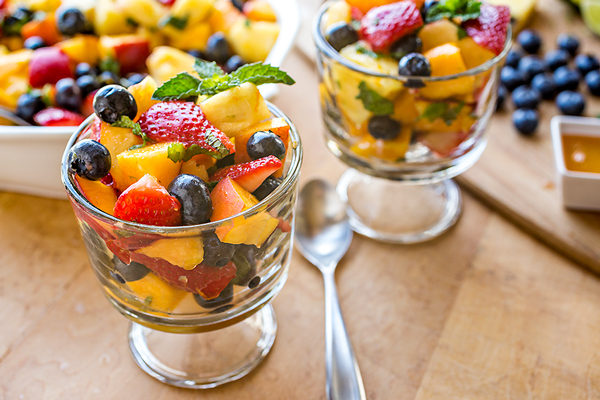
Following on from the Tangy Duck Salad, I put together another of our summer favourites: Alcoholic Summer Fruit Salad. This is another really simple, but surprisingly impressive recipe. In the case of yesterday I did it to use the first of the blackberries from our garden.

Alcoholic Summer Fruit Salad

You can do this with almost any mix of summer fruits you like, but you’ll want three or four different fruits for best effect. Choose from nectarines, peaches, apricots, plums, cherries, raspberries, strawberries, blackberries, blueberries, blackcurrants, loganberries, gooseberries. (Avoid orange, apple, banana, melon, kiwi, grapes. This isn’t a cheap hotel!)

You’ll want one small nectarine or peach per person, and similar quantities of each other fruit you’re using. I guarantee this will disappear like snow in summer, so don’t worry about making too much – but if you do have any left over it goes well on your breakfast cereal.

Put the berries in a salad bowl – halve or quarter any large strawberries or gooseberries.
If using cherries, stone and halve them. Add to the berries.
Stone the peaches, nectarines, apricots, plums and cut them into bite-sized pieces; add to the berries.

Add a few mint leaves or some lavender leaves if you wish – yes lavender really does work OK!
Optionally sprinkle with a couple of teaspoons of sugar.
Now add a small wine glass of liqueur of your choice. (Port works well, as do amaretto, peach schnapps, apricot brandy and cherry brandy – the choice is yours.)
Mix gently but well.

Lightly chill while you eat the preceding courses.
Serve plain, or with cream, and maybe a meringue nest.

(If you want a non-alcoholic version, use good fruit juice – apple or mango are good – instead of liqueur.)

Simple Sunday Kitchen (1)

A couple of very simple, but worthwhile interlopes into the kitchen today. Here’s the first.

Tangy Duck Salad

Actually you could do lots of things with this duck (either hot or cold), but we chose to make it into our trademark “all in one” salad.

You’ll need, for the duck …
1 duck breast per person
Tomato ketchup
Brown sauce (HP Sauce or equivalent)
Worcester Sauce

And for the salad …
Pasta (enough for each person, cooked and cooled), we used linguine
Tomatoes
1 small Onion
3-4 cloves Garlic
Can Kidney Beans
1 Fennel (or other salad ingredients of your choice; crisp lettuce would work well)

You need to start the day before, by cutting the duck breasts, crosswise, into 5mm slices. Put them in a plastic box with a large slug of tomato ketchup, brown sauce and Worc. Sauce. Mix well and leave in the fridge to marinade overnight.

On the next day, pan fry the duck (+ marinade) in a very small amount of oil until done (maybe 5 minutes). You might want to strain off most of the liquid halfway through so the duck has a chance to get nicely sticky. Set the duck aside and leave to cool. You should end up with slightly sticky and tangy, almost sweet and sour, duck.

When mealtime approaches, halve the duck pieces and mix together with the pasta; thinly sliced onion, tomato, fennel etc.; drained beans; and chopped garlic. Season lightly with salt and pepper and dress with white wine vinegar and olive oil (you can mix this together as dressing if you wish, but I never bother). Serve with a robust white wine.

Enjoy!

(You could do lots of variants on the marinade, maybe by including lemon juice, lime juice, soy sauce or even a dash of chilli.)

Rosé d’Amour!

Some while back I wrote about the Tavel Rosé, Richard Maby’s Prima Donna, I’d bought from the Wine Society. We continue to enjoy it. In fact it gets better as the supply has now moved on from the 2016, which is what I wrote about, to the 2017 vintage.

And yes, the 2017 is even better than the 2016. It is a little paler in colour, but if anything bursting with even more red berry fruits – especially raspberry.
Now the Wine Society have very recently got what was obviously a small parcel of Maby’s new Tavel, the 2016 Libiamo. I grabbed a case of six without hesitation.

At £17 a bottle Libiamo is significantly more expensive than the Prima Donna, at a mere £11. But if I thought the Prima Donna was good, Libiamo is just out of this world. It’s the same deep coloured rosé, with the same burst of red berry fruits. But oh! how the oak barrels in which it is aged come through: as a delightful ambiance of dry sherry. So much dry sherry that it almost feels like a fortified wine – which is brilliant. We were both stunned!

We’ve just drunk a bottle with a quite rich spaghetti with prawns in a sun-dried tomato pesto sauce. They went so well together; the richness of each complementing the other.

No wonder Libiamo is already sold out! I can only hope there will be further supplies!

Orthorexia

Orthorexia

Excessive concern with consuming a diet considered to be correct in some respect, often involving the elimination of foods or food groups supposed to be harmful to health.
A disorder characterized by a morbid obsession with eating only healthy foods.

The OED reports the first use to be as recent as 1997, viz.:

“Orthorexia nervosa refers to a pathological fixation on eating proper food.”
[Yoga Journal; September-October 1997]

“Orthorexia – like anorexia and bulimia – eventually reaches a point where it takes over the sufferer’s life … Raw food fans take this to the utmost extreme.”
[Cosmopolitan (UK edition); September 1998]

How to Use Less Plastic

We all know that plastic is not very biodegradable, and thus an environmental nightmare, as well as being over-used in many instances. Equally we all know how convenient it can be.

The other day I can across Less Plastic, and their poster of 9 Tips for Living with Less Plastic. Although it’s a couple of years old, I share them here with comments on how well I think we do.

  1. Bring your own shopping bag. Already do this and have done for some years.
  2. Carry a reusable water bottle. As we don’t carry water, we can’t do this. Although we could stop buying mineral water in plastic bottles for use at home.
  3. Bring your own cup. We almost never have take-out coffee etc., so not much point in this.
  4. Pack your lunch in reusable containers. Again we don’t carry packed lunch, so this isn’t appropriate.
  5. Say no to disposable straws and cutlery. Yep, always do if we can.
  6. Skip the plastic produce bags. Difficult if the supermarket offers no alternative to having 29 onions floating loose in your trolley – they can provide paper bags for bread so why not for other produce? Would they like us taking our own paper bags? And then there’s the question of what to use in the freezer.
  7. Slow down and dine in. We seldom eat out; maybe once or twice a month, on average.
  8. Store leftovers in glass jars. Yes, could do this although I’m ot sure about finding a good variety of different sized jars with out buying then specially. And anyway we have lots of plastic boxes and wouldn’t it be greener to use them to destruction first?
  9. Share these tips with your friends. That’s just what I’m doing!

So how well do you do?

Eating and Diets

Here’s an interesting article, originally from New York Magazine, by a couple of specialists on nutrition which explodes many of the myths around diets etc. In their preamble they say:

It’s beyond strange that so many humans are clueless about how they should feed themselves. Every wild species on the planet knows how to do it; presumably ours did, too, before our oversized brains found new ways to complicate things. Now, we’re the only species that can be baffled about the “right” way to eat.

Really, we know how we should eat, but that understanding is continually undermined by hyperbolic headlines, internet echo chambers, and predatory profiteers all too happy to peddle purposefully addictive junk food and nutrition-limiting fad diets. Eating well remains difficult not because it’s complicated but because the choices are hard even when they’re clear.

With that in mind, we offered friends, readers, and anyone else we encountered one simple request: Ask us anything at all about diet and nutrition and we will give you an answer that is grounded in real scientific consensus, with no “healthy-ish” chit-chat, nary a mention of “wellness”, and no goal other than to cut through all the noise and help everyone see how simple it is to eat well.

The article itself is a long read, but very illuminating.