
A couple more snippets on the EU referendum.
Tom Peck in yesterday’s Independent highlights that British public wrong about nearly everything to do with the EU according to a recent Ipsos MORI poll.
So it should be no surprise that, according to today’s Independent, 55% of people intend to vote LEAVE despite that warnings about the economic impact of Brexit appear to be hitting home. According to the ORB survey 80% of people think leaving the EU would pose some risk, while 19 per cent think it would pose no risk at all. Nevertheless a majority of both groups are still prepared to take the risk.
Meanwhile my friend Katy in a blog post yesterday likens getting people to understand the actual facts (as opposed to that they think the facts are) in the referendum debate to trying to teach children how to pick up marks in exams even if they eventually get the answers wrong. Having tried both she has found much sadness.
Which just goes to prove what I was highlighting the other day: that even thinking people do not understand risk and consistently under-estimate risks.
Gawdelpus!
Category Archives: current affairs
Brexit on, and on, and on …
Another article I picked up yesterday was UK and the EU (10) — What if it is Brexit? on the Law and Lawyers blog. As you might divine it is number 10 in a series which tries to shine some interesting lights on the legal ramifications of the upcoming referendum.
Yesterday’s article points out (without saying it in as many words) that a LEAVE vote on 23 June would present an interesting constitutional crisis. In summary:
- The present House of Commons has more MPs in favour of remaining in the EU than leaving it.
- Constitutionally sovereignty rests with Parliament so the referendum result cannot be legally binding on Parliament.
- But politically it would be very difficult for the government to ignore the referendum result.
- What the referendum does not address is what would be the UK’s relationship with the EU when the UK leaves at the end of the (presumably 2 year) exit negotiations.
- Ultimately, Parliament will have to legislate for whatever arrangement is negotiated. That legislative process is likely to be very complex and lengthy with the final legislation depending on the negotiated exit deal. And of course parliament may decline to pass the required legislation.
- This could be even messier if there is a REMAIN majority in Scotland but not in England. That could re-fuel demands for Scotland independence.
- The Prime Minister and most ministers have campaigned for REMAIN so how would they stand if the vote is for Brexit? Since the Fixed-term Parliaments Act 2011 it is not possible for the Prime Minister to simply ask the Queen to dissolve Parliament. The next election will be in May 2020 unless a general election is called through one of the two procedures set out in the 2011 Act. There is no other mechanism unless parliament itself repeals (or amends) the 2011 Act.
Interesting times we live in!
Zombie Trains
There was a very illuminating article by Simon Jenkins in yesterday’s Guardian under the banner
HS2: the zombie train that refuses to die
In it Jenkins writes the biography of the HS2 rail project — and how over the years it has been fiddled and fudged by governments and interested parties when there is basically no business case, or any other justification, for it.
Whether you agree with Jenkins or not, it doesn’t make very edifying reading.
My view has always been that HS2 is another classic example, like London’s proposed Garden Bridge, of an unjustified vanity project which has got completely out of hand and sucked in politicians who can’t now be seen to back down. Heathrow’s Third Runway isn’t too far behind either. These mega projects are seldom more than politicians “willy waving”.
They’re all projects which need to be killed off — FAST!
If we’ve got that amount of money to waste spend then it would be better spent on more useful infrastructure projects. Let’s start with a couple of nuclear power stations to reduce our dependence on imported coal and dirty oil with a reduction in CO2 emissions.
I despair of politicians, I really do. Doomed! We’re all doomed!
Despair, or not?
I’m beginning to get despondent — no, let’s have this right, I’m now getting ever more deeply despondent — about the EU Referendum on 23 June.
I’m worried that the great British public will vote to LEAVE the EU. They certainly will if the current opinion polls are anything to go by as most seem to be showing LEAVE several points ahead with relatively few undecided voters. Typically the polls I’ve seen in the last week seem to be showing roughly REMAIN on 42% and LEAVE on 44%.
What deepened my worries is the state of mind of the “unthinking masses”. There’s a group on Facebook for the town where I grew up — a town now predominantly populated by people I can only best describe as “Essex chavs” (although that does do an injustice to many). Someone bravely put a poll on the Facebook group asking what people would vote. When I looked a few minutes ago the figures were REMAIN 28, LEAVE 158.
WHAT! Yes, that’s right, almost 6:1 in favour of LEAVE. I find that really scary because it implies that the LEAVE campaign’s fear-mongering, mostly on immigration, has got through to the minds of the less critical masses.
I fear that Joe Public is going to vote according to his tribal and xenophobic, Daily Mail, mindset — just as in many other things he (and she) will always vote with their wallet. Even many immigrants, and children of immigrants, are saying they’ll vote LEAVE because of immigration.
Now don’t get me wrong. I’m OK with a LEAVE vote as long as it is based on some concrete foundations. However I know that Joe Public doesn’t work that way; he votes according to his fears and predilections, not because of good logic. Remember the old research which says that 5% of people can think and do; 5% of people cannot think; the other 90% can thing but just can’t be bothered — and that is partly because they have never been properly taught to do so.
It is going to take an awful lot of thinking citizens to overcome odds like that.
Part of the problem is that people cannot grasp that this whole thing is a big gamble; but a gamble where no-one knows what any of the odds are! This was summed up a couple of days ago by Martin Lewis of moneysavingexpert.com under the title How to vote in the EU referendum. His article is quite nicely balanced; Lewis points out the good and the bad with the EU. Here are a few key snippets:
It’s the biggest consumer decision any of us will ever make. It affects our economy, foreign policy, immigration policy, security and sovereignty. Our vote on whether the UK should leave the EU will reverberate through our lifetimes, and those of our children and grandchildren.
… … …
My mailbag’s been drowning with questions and concerns. The biggest being: “Please just tell us the facts, what’ll happen if we leave?” I’m sorry, but the most important thing to understand is: there are no facts about what happens next.
Anyone who tells you they KNOW what’ll happen if we leave the EU is a liar. Predicting exact numbers for economic, immigration or house price change is nonsense. What’s proposed is unprecedented. All the studies, models and hypotheses are based on assumptions — that’s guesstimate and hope.
Oh, and that applies equally to both sides of the debate! There are no facts; just guesses.
Lewis goes on to recommend that we “do some reading on useful independent sites that run through the issues” and suggests we start with The UK in a Changing Europe which is run by King’s College, London and pools balanced articles from all sides.
He then, quite rightly, points out …
… for most people this comes down to a risk assessment.
A vote for Brexit is unquestionably economically riskier than a vote to remain. Yet don’t automatically read risk as a bad thing. It simply means there’s more uncertainty …
Leaving the EU risks us being left on the sidelines …
Or we could in the long run become a nimble low-tax, low-regulation, tiger economy …
The likely truth is of course somewhere between the two. But most independent analysis suggests Brexit will be detrimental to the economy.
… … …
The volume of uncertainty means the only way to make the right decision is based on your political attitude to the EU, your gut instinct, and how risk-averse you are on each area that matters to you.
All I would say is please do this consciously, after carefully weighing the options, and don’t necessarily go just with your gut feelings (important though they are). In the words of Frank Zappa “a mind is like a parachute — it doesn’t work if it is not open“.
I happen to think that on balance leaving the EU would be the worse option — and heaven knows there’s so much about the EU I don’t like. But I could be wrong. We all could be wrong. As with all things there is no “RIGHT” answer.
And remember, again as Lewis comments, “the future is always a journey” but the path is crazy paving and you lay it yourself as you go along.
Good luck! We’re all going to need it whichever path we take.
Brexit on and on and on …
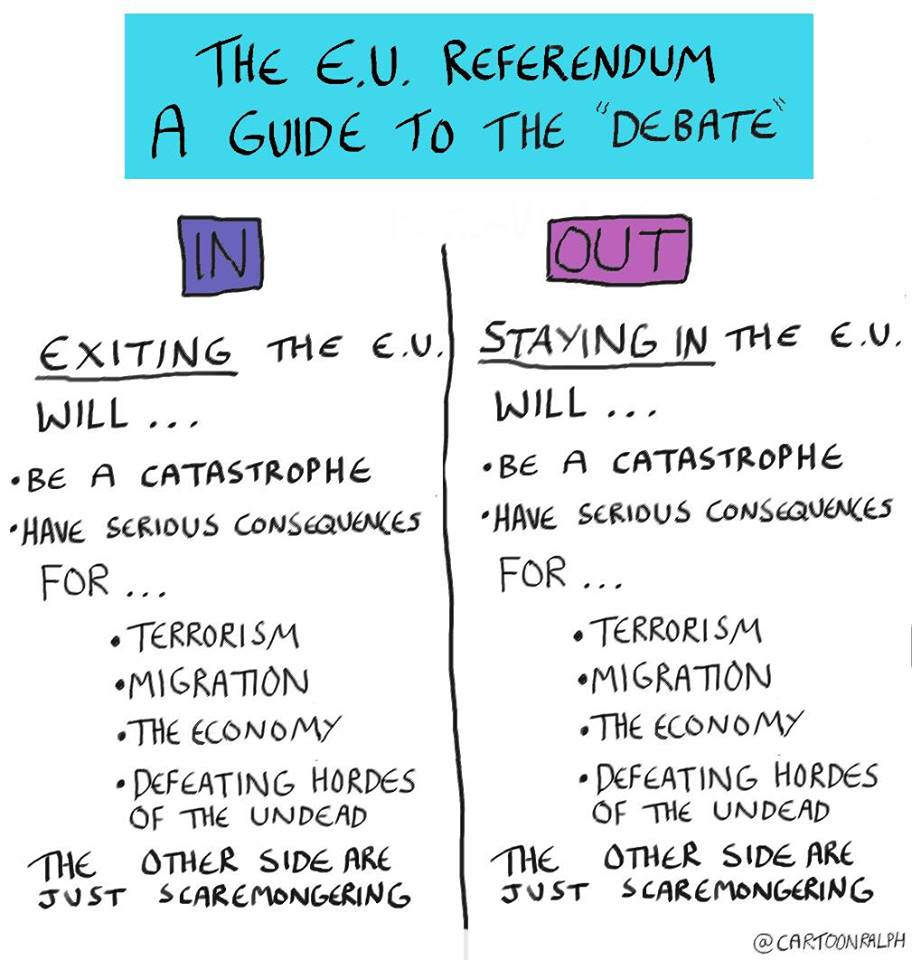
I think is, which I spotted yesterday ion Facebook, just about sums up the pathetic position of both the LEAVE and REMAIN camps.
More Brexit: 8 EU Myths
An update to the theme on the EU referendum …
There’s a graphic floating around the intertubes containing, more or less, the following text which refutes 8 of the top myths about the EU.
It is partisan — but then so is everything! — as it is published by the European Parliamentary Labour Party despite appearing on a Leeds University website.
Items 4 & 6 could be debated as I’ve not checked the data — though I’ve no good reason, other than a general mistrust, to disbelieve it. I doubted item 3 and did check the numbers; it turns out to be correct. The other 5 points also appear to be fairly accurate.
So here are 8 EU myths busted …
- Most of our laws come from Brussels. Just 13.2% of our laws have anything to do with Brussels according to the House of Commons Library. This figure includes everything that mentions the EU, even if it’s just for ‘passing reference’ or a definition.
- European laws are made by unelected bureaucrats. The European Commission only proposes laws. It is the directly elected European Parliament and the Council of the EU (Government Ministers) that debate, amend and ultimately pass European legislation.
- Norway and Switzerland enjoy all the benefits despite not being an EU Members. The Norwegians and Swiss must pay into the EU and also abide by EU Trade Regulations — without actually being able to influence any of them. Norwegians make roughly the same per capita contributions to the EU as Britons.
- EU migrants are a drain on the economy. EU migrants contribute more to the UK exchequer in taxes than they claim in benefits. Economists at University College London estimate that EU migrants contributed over £20bn to the UK economy between 2001 and 2011.
- The EU does nothing to help ordinary people. The EU has ensured safe working hours, introduced higher levels of annual leave and extended parental leave. It was also the EU that established the legal principle that men and women should receive equal pay for equal work.
- Our most important markets are China & the USA. The EU is the world’s largest single market. Half of Britain’s exports go there, accounting for some 3.5 million British jobs.** The UK sells more to the Netherlands alone than to the whole of China.
- European Court of Human Rights forces its will on UK. The European Court of Human Rights (ECHR) has nothing to do with the EU. It is part of the Council of Europe — an entirely separate institution that was setup by Britain after the Second World War.
- The British are different. All EU members states have their different languages, cultures, histories and laws. No one joins the EU to lose their identity. In fact, the EU’s motto is ‘United in Diversity’.
Make of it what you will.
** Though note that there is no suggestion all these jobs would disappear if we left the EU, merely that currently they are focussed on the EU.
Brexit Reprise
Following on from my earlier post To Brexit or Not to Brexit, there was an interesting article by Stephen Curry in the Guardian on Monday 23 May under the banner
Why I am wrong about Brexit, and you are too
The crux of his argument is that we can never actually be right, because there are too many variables and unknowns. Indeed it is as he quotes Kathryn Schulz: “the Heisenberg Uncertainty Principle of Error: we can be wrong or we can know it, but we can’t do both at the same time“.
In other words we can either “know we’re wrong” or “are wrong but think we’re right” so we have real problems making reliable judgements about anything. Which really goes back to what I’ve always maintained:
- You can never have all the information required to make a decision; if you had all the information it would be a fait accompli not a decision.
- No-one sets out to make a bad (aka. wrong) decision. We make the best decision we can with the information we have at the time. And that information includes the price of herrings, Granny’s favourite breakfast cereal and the predilections of your brain.
As Curry also says: “We are hardwired to make snap judgements based on limited information“.
Ah, you say, but we have experts to guide us. Well yes, up to a point Lord Copper. To quote Curry again:
I don’t have the time to figure all this stuff out for myself, and so I have to rely on the experts … The trouble with experts or authority figures is that people will tend to accept or reject those who are in sympathy with their prejudices … the real aim of [academic experts] is to argue from authority. The same goes for … business leaders … economists, and even … leading luvvies. These messages don’t challenge strongly held views. Rather they offer the comfort of expert blessing … for opinions that are inevitably formed from incomplete information. At best they will nudge a few undecideds from the fence but the rest of us simply feel validated and carry on undeflected.
So the bottom line is that you have to make up your own mind, on incomplete (or even misleading) information, and hope that you’re as little wrong as possible. And Curry helpfully suggests a few websites which appear (and I use “appear” deliberately) to be relatively impartial to help you decide on the facts. The most useful are probably:
Fullfact.org, a non-partisan fact-checking charity, and
the analysis produced by the Libraries of the House of Commons and the House of Lords.
Good luck … you’re going to need it!
To Brexit or Not to Brexit? — Updated
I have, as I promised I would, just added an update to my earlier To Brexit or Not to Brexit? post.
Tramps with Bazookas
There was a highly amusing, but actually quite serious, piece in the Guardian on Tuesday (17 May) from comedian Frankie Boyle. It went under the headline
Which tells you precisely what it is about.
It’s well worth reading.
To Brexit or Not to Brexit?
So should the UK stay in the EU or leave? This is the question we are being asked to decide at the referendum on 23 June.
Importantly there is the question of whether anyone can make anything other than an emotional decision. And I suspect the vast majority of the great British public — or at least those who bother to vote — will do just that: make an emotional decision.
How can they do otherwise? Because no-one actually knows the consequences of either staying or leaving, and all we’re hearing is speculation, guesswork and wishful thinking. I have yet to find anyone with a reliable crystal ball.
As I have an almost total mistrust of everything which comes from the mouths of politicians, I’ve been almost completely ignoring the hot air, waffle and rhubarb which is permeating our airwaves.
Nonetheless we do need to try to come to some sort of rational decision, so in the following table I’ve attempted to pull together what little we do know of the facts, for and against, staying and leaving the EU. It isn’t easy, and some of this is still undoubtedly emotionally biassed, although I’ve tried to avoid this.
So this is the state of play as I see it.**
| For | Against | |
| Stay in the EU |
|
|
| Leave the EU |
|
|
That looks to me like a good case for staying in the EU. But of course, you should all do your own research, decide how important you feel each of the factors to be and make up your own minds. All I ask is that you make a properly informed decision — the best decision you can, at the time, with the information you have (and that information includes the proclivities of your brain).
Sadly, though, I suspect the British public will be beguiled by the speculative arguments and sound bites of those campaigning to leave. If they are, it really will be a leap in the dark, because no-one knows what will happen. So gawdelpus!
20/05/2016 Update
I promised updates, so here is the first. In the last few days I’ve come across this graphic from Richard Murphy of Tax Research LLP.
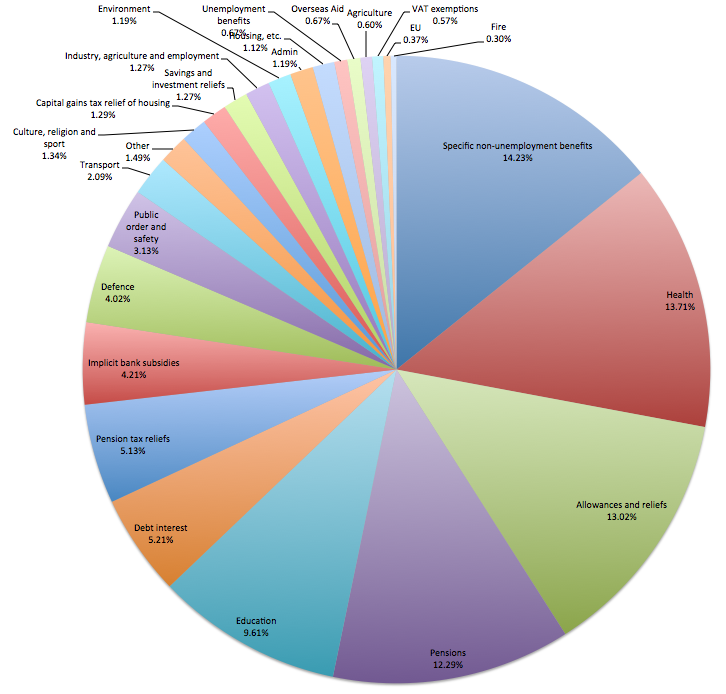
Click the image for a larger view
It appears to refer to the way in which the 2014 “tax take” was used by the government. If we assume the data is correct, then we pay just 0.37% of our taxes to the EU (yes, it’s that tiny figure at 12 o’clock on the pie chart). Now that strikes me as being eminently reasonable.
In fact extrapolating the figures from this recent Daily Telegraph article suggests that the net cost of the EU is in the region of £100 a year per person in the UK. Which again seems to me to be eminently reasonable.
** I will try to update this as we go along if any new evidence (as opposed to spin, myth and guesswork) appears.