OK, boys and girls, here’s the latest instalment of strangeness from out local auction house. Their latest sale isn’t large but generally surpasses itself in the quantity of truly hideous ceramics. But it does also contain a few lots to delight the lovers of oddity — both in terms of what people sell and what gets put together to make a lot. So, inter alia, and copied straight from the online catalogue, we have …
Two miniature Japanese carved flowers each opening to reveal an erotic scene.
 A Japanese ivory carved figure of a fisherman holding a fish with a buoy [sic] on his shoulders.
[Which I think is actually rather splendid.]
A 19th century ‘Acme’ — Henry Pear B polished brass and steel high quality padlock by E. Cotterill & co and a Birmingham with high quality multi lever key.
A Stationmasters substantial nickel-cased pocket watch, the enamelled dial painted M M & Co within a rare electrified leather covered case with original improved ever-ready dried battery number 12.
[I never knew you could get electrified leather.]
An Indian ivory vintage tusk carved with figures and animals amongst trees styled as a desk light on a wooden base.
[Trees as desk lights — an interesting idea.]
A shelf of wooden metal ware [sic] to include a pair of 19th century adjustable metal hearth stands, a cast iron trivet, an Antinomy [sic] box decorated with a dragon, various vintage cooking wares to include butter pats, pastry rollers, juice squeezers and a treen stacking spice box, Soda siphon with sparklets, a wooden bowl containing decorative eggs, brass candlesticks, two boxed scrolls dated 10th June 1958 for ‘The Gala performance’ at The Royal Opera House attended by The Queen, etc.
A pair of 19th century brass figural candlesticks of girls carrying food on top of bats.
Two Capodimonte figurines — Tramp on Bench and Sunday Mornings with certificates.
[Something else I never knew: Sunday mornings come with certificates. Clearly my education is sorely lacking.]
A collection of decorative silver plate and glass table items to include sectioned dishes, jam dishes, hors d’oeuvres dish on stand, a large silver plated tray, a pair of pressed glass decanters and stoppers, two novelty teapots — one figured as a police man and the second by Wade ‘Cat on a dustbin’, Stella Artois Cidre decanter.
A pair of 19th century flat pack [sic] figurines of a Highland couple on a heathland and a large 1930s figurine of a Stag.
A Jerry’s cocktail shaker in the form of a penguin.
A large quantity of items including a basket of china plates, figures including Branxam china polar bears, beaded wall lights, a large glass paperweight, a Watson & Sons electric medical machine, a quantity of Victorian irons, some for holding coal, a quantity of cameras, other items such as Carl Zeiss Jena binoculars and an Ambassador movie camera, a quantity of dentists implements including those to extract teeth, an 8mm movie projector by Bell and Howell, a large set of Mellins food vintage scales with weights and wicker basket, and Hoover ‘It beats’ vacuum cleaner and a cased canon camera.
An interesting stone axe head, probably basalt, bearing old label inscribed “Samoa”, together with a vintage Chinese pewter cylindrical jar with cover, engraved with floral panels, and a similar small spittoon.
An antique native primitive bow of natural branch form with gut bow-string, and two quivers, one in bamboo with plain leather binding, the other in decorated leather, each containing bamboo arrows with barbed iron heads.
And then there is a collection, over six lots, of stuffed birds …
Taxidermy: a turn-of-the-century barn owl on rocky base in wooden case.
Taxidermy: a turn-of-the-century Peregrine falcon by H N Pashley, Cley Next the Sea Norfolk in glazed wooden case
Taxidermy: a turn-of-the-century juvenile gannet and another of a fully grown gannet both on bases.
Taxidermy: two turn-of-the-century birds, one a common gull and the other a juvenile cormorant, base marked H A Lydd Dec 27th 1906.
Taxidermy: two turn-of-the-century birds, one a barn owl on a rocky base and the other a long-eared owl on tree trunk.
Taxidermy: three birds comprising a plover, a lapwing and a redshank, all on rocky bases.
But pride of place must go to something I’ve never seen in an auction before: what one might describe as a collection of birds ready for stuffing …
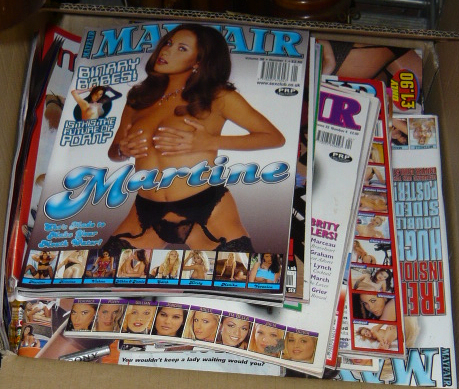
A large quantity of glamour magazines including Mayfair and Escort.

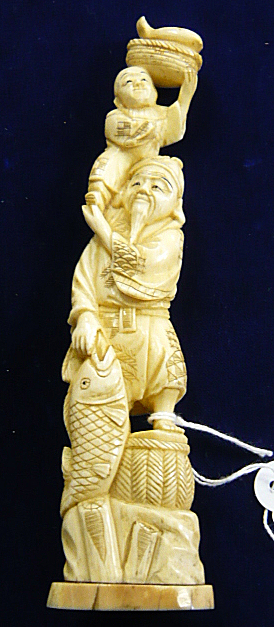 A Japanese ivory carved figure of a fisherman holding a fish with a buoy [sic] on his shoulders.