All posts by Keith

I’m a controversialist and catalyst, quietly enabling others to develop by providing different ideas and views of the world. Born in London in the early 1950s and initially trained as a research chemist I retired as a senior project manager after 35 years in the IT industry. Retirement is about community give-back and finding some equilibrium. Founder and Honorary Secretary of the Anthony Powell Society. Chairman of my GP's patient group.

Monthly Links

Welcome to another action packed edition of our monthly collection of links to items you may have missed the first time around.


Science, Technology, Natural World

On the uselessness of useful knowledge – or how AI is developing.

Do you have an inner voice that chatters away to you? Most people do in some form, but some don’t and some have bizarre inner voices.

So just why is 42 the answer to everything? [£££] [LONG]

And why is it that some organisms throw away large amounts of DNA during early development? [LONG]

It appears that our modern domestic horses originated in southwest Russia.

Recent years have produced a deluge of dinosaur fossils in China, and they’re totally changing the dinosaur history. Like T. rex with feathers?! [£££]

If that worried you, then go hide now. Because jumping spiders’ remarkable senses capture a world beyond our perception.


Health, Medicine

MessangerRNA is behind some of the very successful Covid-19 vaccines, but it is also now beginning to transform the way we treat many illnesses. [£££]


Sexuality

Yet more on the forbidden erotica of ancient Pompeii. [VIDEO]

And now for three items on the (hopefully normalisation and) liberation of female genitalia …
Labia liberation!, the movement to end vulva anxiety. [LONG]
Viva la vulva, ignorance about the basic biology is shockingly high. [LONG]
An interview with Jamie McCartney, creator of The Great Wall of Vagina.


Environment

We’re running out of fish shit, and it matters. [£££]

We’re also running out of species, as apparently almost half Britain’s biodiversity has gone in the last couple of hundred years.

Forty Hall in north London has been chosen as a site for a beaver release project.

Meanwhile it is important we learn to live with, if not love, our house guests.

It seems that volcanic ash and lava enriches the oceans far faster than it does land.

The Campaign for Better Transport has called for a ban on domestic flights and subsidy for rail travel.

One photographer has made it her mission to photograph the plastic in our seas.


Art, Literature, Language

On the origins and setting of Sir Gawain and the Green Knight.


History, Archaeology, Anthropology

Some Chileans are living on top of a hoard of some of the earliest known mummies.

Archaeologists have uncovered a remarkably rare, painted Roman amphitheatre at Richborough in Kent.

It s now well established that the Vikings got to America almost 500 years before Columbus, with their Newfoundland site now firmly dated to 1021AD.

On the development of the medieval Westminster Abbey. [LONG]

Staying with ecclesiastical sites, archaeologists have discovered the unexpected site of the tannery at Fountains Abbey.

On menstruation and how men developed a horror for it in the middle ages.

And so, coming up to Halloween, three items on witchcraft …
First a look at how the historic witches are beginning to receive justice.
Secondly a Twitter thread about witch bottles.
And thirdly on the long and underappreciated history of male witches


London

London’s Underground system had a very early spiral escalator; unfortunately it seems never to have fully commissioned and working.


Lifestyle, Personal Development, Beliefs

Here’s a recently released, but old, interview with our favourite Zen Master, Brad Warner.

The tiny Himalayan Kingdom of Bhutan cares for its happiness more than for its GDP.


Monthly Quotes

Here’s this month’s bumber collection of quotes …


When stupidity is considered patriotism, it is unsafe to be intelligent.
[Isaac Asimov]


Patriotism is the last refuge of a scoundrel.
[Samuel Johnson, 1775]


Words … I know exactly what words I’m wanting to say, but somehow or other they is always getting squiff-squiddled around.
[Roald Dahl]


Believe nothing, O monks, merely because you have been told it … or because is it traditional, or because you yourselves have imagined it. Do not believe what your teacher tells you merely out of respect for the teacher. But, whatsoever, after due examination and analysis, you find to be conducive to the good, the benefit, the welfare of all beings–that doctrine believe and cling to, and take it as your guide.
[Buddha]


I think we all do have a guardian angel. I believe they work through us all the time, when we are thoughtful and good and kind to each other.
[Roma Downey]


When you see that trading is done, not by consent, but by compulsion – when you see that in order to produce, you need to obtain permission from men who produce nothing – when you see that money is flowing to those who deal, not in goods, but in favours – when you see that men get richer by graft and by pull than by work, and your laws don’t protect you against them, but protect them against you – when you see corruption being rewarded and honesty becoming a self-sacrifice – you may know that your society is doomed.
[Ayn Rand, Atlas Shrugged, 1957]


Hendrix is like Beethoven, Vivaldi is more Des O’Connor
[Nigel Kennedy]


The National Gallery’s autumn exhibition, Poussin and the Dance, opens next week. The central work in the show, the maypole if you like, is Poussin’s A Dance to the Music of Time (c.1634), which has been lent by the Wallace Collection. You know the one. The beautiful, wistful painting that opens Anthony Powell’s great novel cycle A Dance to the Music of Time … This isn’t a daring show, this isn’t a ground-breaking show, but it is a show to make you wistful. Poussin’s pictures are celebrations of youth and music, wine and sun and the sheer pleasure of sandals kicked off before dancing till dawn.
[Laura Freeman writing about the National Gallery’s Poussin exhibition (Poussin and the Dance, 9 October to 2 January 2022; Times; 01/10/2021)]


You spend your whole career telling people not to blame the positions of the planets for problems in their personal lives and then you almost get hit by a car because Jupiter and Saturn are so pretty tonight.
[Katie Mack on Twitter]


Burke’s Reflections on the Revolution in France is a total masterpiece. I will never get over it. I don’t think there is a better written work that is also wrong about everything.
[Joseph Rezek on Twitter]


What the pandemic’s shown, particularly if you’ve got children, is you don’t want to be living in a flat doing home schooling. What people need – what families need – are homes with gardens. They need big rooms.
[Jackie Sadek, Expert in Urban Regeneration]


I never married because there was no need. I have three pets at home which answer the same purpose as a husband. I have a dog that growls every morning, a parrot that swears all afternoon, and a cat that comes home late at night.
[Marie Corelli, Novelist (1855-1924)]


The expression “call a spade a spade” comes from the work of Plutarch, who originally wrote “call a fig a fig”. Fig was crude slang for the vulva, so “call a c**t a c**t” is closer.
[Whores of Yore on Twitter]


[Biodiversity] is the engine that produces everything that we consume. You can think of it like a wild supermarket that provides us with food and other gifts without us doing anything. The fact that we have several different varieties of apples, tomatoes and other foods is down to biodiversity – and when it is diminished we lose out.
[Professor Andy Purvis, Natural History Museum]


The real voyage of discovery consists not in seeing new sights, but in looking with new eyes.
[Marcel Proust]


Once the realisation is accepted that even between the closest human beings infinite distances continue, a wonderful living side by side can grow, if they succeed in loving the distance between them which makes it possible for each to see the other whole against the sky.
[Rilke]


Glory be to God for dappled things –
For skies of couple-colour as a brindled cow;
For rose-moles all in stipple upon trout that swim;
Fresh-firecoal chestnut-falls …

[Gerard Manley Hopkins]


Write it on your heart that every day is the best day in the year. He is rich who owns the day, and no one owns the day and allows it to be invaded with fret and anxiety. Finish every day and be done with it. You have done what you could. Some blunders and absurdities, no doubt crept in. Forget them as soon as you can, tomorrow is a new day; begin it well and serenely, with too high a spirit to be cumbered with your old nonsense. This new day is too dear with its hopes and invitations, to waste a moment on the yesterdays.
[Ralph Waldo Emerson]


The last thing the African continent needs is a failed British politician. This isn’t the 19th Century.
[Nick Dearden, Director of Global Justice Now, 16/10/2021]


There are very few things good about being an adult, but fancying chips for breakfast and so having chips for breakfast is certainly one.
[@NickMotown on Twitter]


Always remember that the most important thing is to live life in the present moment, and that happiness is not a by-product of external factors, but the result of positively conditioning your mind. Happiness is at the grasp of everyone.
[Khedrupchen Rinpoche]


Just-in-Time

How many times have you seen a gap on a supermarket shelf, and on enquiring been told some variant of “Oh, it should have been on last night’s delivery, but wasn’t”? I know I’ve had this any number of times. Yet another failure of Just-in-Time delivery.

While this may be excusable when the product is perishable, like fresh fruit and veg, it really isn’t good enough for sanitary towels, drugs for the hospital, or parts for the factory down the road.

Just-in-Time delivery was a product of Toyota in 1950s Japan, and has taken over worldwide supply chain logistics since it hit the west in the 1980s.

Effectively every sector has seen it as a way of reducing cost: no idle stock overheads; no warehouses to be paid for; no warehouse staff to employ. And who can blame them when shareholders want ever more profit and managers need ever fewer overheads.

But as Kim Moody outlines in this Guardian article, there’s a problem. All too often it is Just-not-in-Time. Because the supply chain is now so incredibly complex and lengthy that any slight hiccup has a dramatic domino effect. And there is no safety margin in the way of warehoused stock.

A relatively small (in the overall scheme of things) hiccup can be enough to tip the balance. An unexpected exponential rise in natural gas prices. A large ship wedged sideways in the Suez Canal. A volcano erupting and disrupting aviation flight paths. And that’s without mega-disruptions like a pandemic, or own goals like Brexit.

Without every cog of the global supply chain working like well oiled clockwork, Just-in-Time isn’t. In today’s world logistics managers, and their downstream clients, work on the basis that the supply chain is working properly. They have no choice when the whole system is geared this way and they have no access to resources to provide contingency.

But, again as Moody points out, the contingency comes at a price – a price which is passed on to the end consumer. And as consumers we have gotten too used to ever cheaper everything, and fail to understand when prices rise. Joe Public doesn’t understand (or care about) economics; he cares about only his wallet and having strawberries all year round. Nor does he understand how this drive for ever faster capitalism is driving climate change.

We need to slow down. And we need to adjust the supply chains as well as our consumerism. We need to stop shipping stuff halfway round the world when we have the same product at home or very close by. Think: New Zealand lamb; Chilean wine; Peruvian asparagus – the examples are endless just in the supermarket. [On which note, well done to Waitrose for committing that all their own brand meat is British and for continuing to win awards for animal welfare.]

I end with Moody’s parting comment:

Now is the time to think about not just how we make and consume things, but also how we move them.

Gleditsia

In 2014 we funded the council to plant a street tree outside our house. They planted a small Gleditsia sp. – a honey locust. They’re lovely trees with vibrant green leaves from May to October. And, although they’re not native to the UK, they’re good street trees as they’re ornamental and attractive but without casting deep shade. After a slow-ish start, in the last couple of years it has taken off – I reckon it’s grown around 3 feet this summer alone.

Being autumn it is now turning a glorious yellow – although I doubt it is going to go the deep gold it has in the last two autumns. On Saturday I took advantage of the sun and went out to photograph it. Here it is, a street tree in all it’s glory in its suburban setting.

Street Gleditsia
[The image is made up of eight separate photographs which have been montaged together,
a technique picked up years ago from the work of David Hockney.]

Like all trees, street trees are incredibly important; they help reduce the temperature on hot streets, control water run-off, absorb CO2 and enhance our mental health. So we need more as a part of expanding tree cover to combat climate change. Sadly, though, in many areas they’re increasingly under threat. Which is why we did our small part in funding an extra tree. And, more generally, why we’ve crammed as many trees as we sensibly can into our suburban garden.

I’m sure most of our neighbours don’t care about trees if they even notice them. Some people and organisations are positively anti-tree, seeing them having no purpose, creating a nuisance, and threatening the foundations of their houses. (This latter is, of course, true if they’re planted in the wrong place.)

Fortunately not everyone feels this way and there is a growing realisation of the importance of street trees – indeed all trees. As Spaceship Earth say:

The best time to plant a tree was 20 years ago.
The second best time is now.

Ten Things: October

This year our Ten Things series – which surprisingly appears on the tenth of each month – continues concentrating on the amusing, both real and fictional. So this month we have …

Ten Organisations I Invented

  1. Badger and the Road Kill; third rate 70s rock group
  2. Beaver & Dyke; pub
  3. Blunder & Bust; accountants to the impoverished
  4. Forced Rhubarb; female barbershop singers
  5. Gortmore Mews; merchant bank
  6. Interbap; Russian state bakers
  7. Kidney, Scrotum & Codd; debt collectors
  8. Snottwright & Wedge; builders
  9. Virgins in Paradise; Islamic girl band (right)
  10. Wackford Squeers and the Cheeryble Brothers; gothic Motown rock band

Covid: England vs Europe

Why England is doing so poorly against Covid-19 compared with the rest of Western Europe? Two of our top scientific analysts, Prof. Christina Pagel and Prof. Martin McKee (both of Independent SAGE) take a quietly scathing look in this Guardian article from a few days ago.

Prof. Christina Pagel and Prof. Martin McKee

As usual, I’ll pick out some key points.

CNN, capturing a widespread view, called England’s approach an “experiment” (a leader in the Irish Times prefaced that word with “reckless”).
. . .
Since 1 June, there have been almost 3m confirmed cases of Covid-19 in England. Rather than prompting concern, this seems to have instead resulted in a perception that England has transitioned to “living with the virus”. Each week in England there are still more than 500 deaths and between 150,000 and 200,000 confirmed cases of Covid-19 … Yet these numbers are rarely discussed. Presumably they are considered a necessary price to pay for the majority to get back to living a normal life (of course, many of those who are clinically vulnerable, and their family members, do not feel able to enjoy this return to normality).
. . .
England has one of the highest burdens of Covid in Europe … England’s case rates are eight to 10 times higher than some of the best performing countries, such as Spain and Portugal.
. . .
Why are our closest neighbours achieving much better health outcomes given that they, too, have their children back at school, their students back at university, and their business and leisure facilities open?
. . .
[England] had fully vaccinated 67% of its entire population by the beginning of October, far lower than countries such as Portugal (85%), Spain (79%), Denmark (75%) and Ireland (74%). Crucially, much of the rest of Europe began vaccinating teens early in the summer.
. . .
Face coverings and vaccine passports remain widespread across western Europe … Many countries have also made major investments in ventilation and filtration, while some have made CO2 monitors compulsory in certain settings … In England these measures have been scrapped.
. . .
England, not for the first time, is the odd one out in Europe. The Sage modelling subgroup … warned of the potential for new surges this autumn and considered that “a relatively light set of measures could be sufficient to curb sustained growth” – advice the government has, once again, ignored. If it looked to its European neighbours, England might realise that they are already doing just this. They are demonstrating that there is a way to be open while keeping cases low [which] works. And we should be doing it.

So what do we have? Two jumbo jets week of people dying of Covid – and yet no outcry, no concern. Escalating rates of infection amongst school-age children. And a lack of enforcement of health and safety legislation which requires employers to provide a safe working environment – see this thread on Twitter. All because we have an inept, selfish government which the great unwashed UK numpties love.

How much better would everything be if everyone took on board the old tenet: Treat other people as you would want them to treat you. Think about it. There’d be a complete paradigm shift; in everything!

Christmas Cards

Now you might think this is a bit too early, but today I’m going to talk about our approach to Christmas cards.

First of all (and let’s get this out of the way) unlike many people we still send real Christmas cards. Not e-cards, and not a donation to charity instead. We do this because we like to, and feel it is a good way of keeping contact with friends and family. We also do it because, as you’ll see, we believe our approach adds value to people’s lives – and the evidence tends to support this.

Since 2005 we have created our own Christmas cards – that’s 17 years, including this year. But they are not traditional cards. Instead they are postcards. Many years they’re A5 size; some years DL or square. Each year, a new card.

I’ve included a few examples below, and I’ve also created a full gallery.

Many years the image on the front has been one of my photographs – and it’s quite fun choosing which one to use. A few years we’ve used an image of a piece of art we own (as long as it’s out of copyright). And a few years one of my late mother’s paintings.

Tulips [2017]

But, you say, this is expensive. Well actually it isn’t; it’s a lot cheaper than buying traditional cards, and a lot simpler. OK, in the early years it did feel expensive as we were using a specialist postcard printer; that tended to cost £150 to £200 for 500 A5 cards (so 30p to 40p per card) which was at least competitive compared with traditional cards.

The last few years we’ve used VistaPrint and designed and ordered online – having done it once it is really easy and quick to do again. This year the cost has been £67 for 500 A5 cards (or just over 13p each). Even allowing for the fact that we’ll use only about half of them that’s still only 27p each. Now tell me where one can get good cards at under twice that price. (OK, they still cost a horrid amount in postage, but so would anything.)

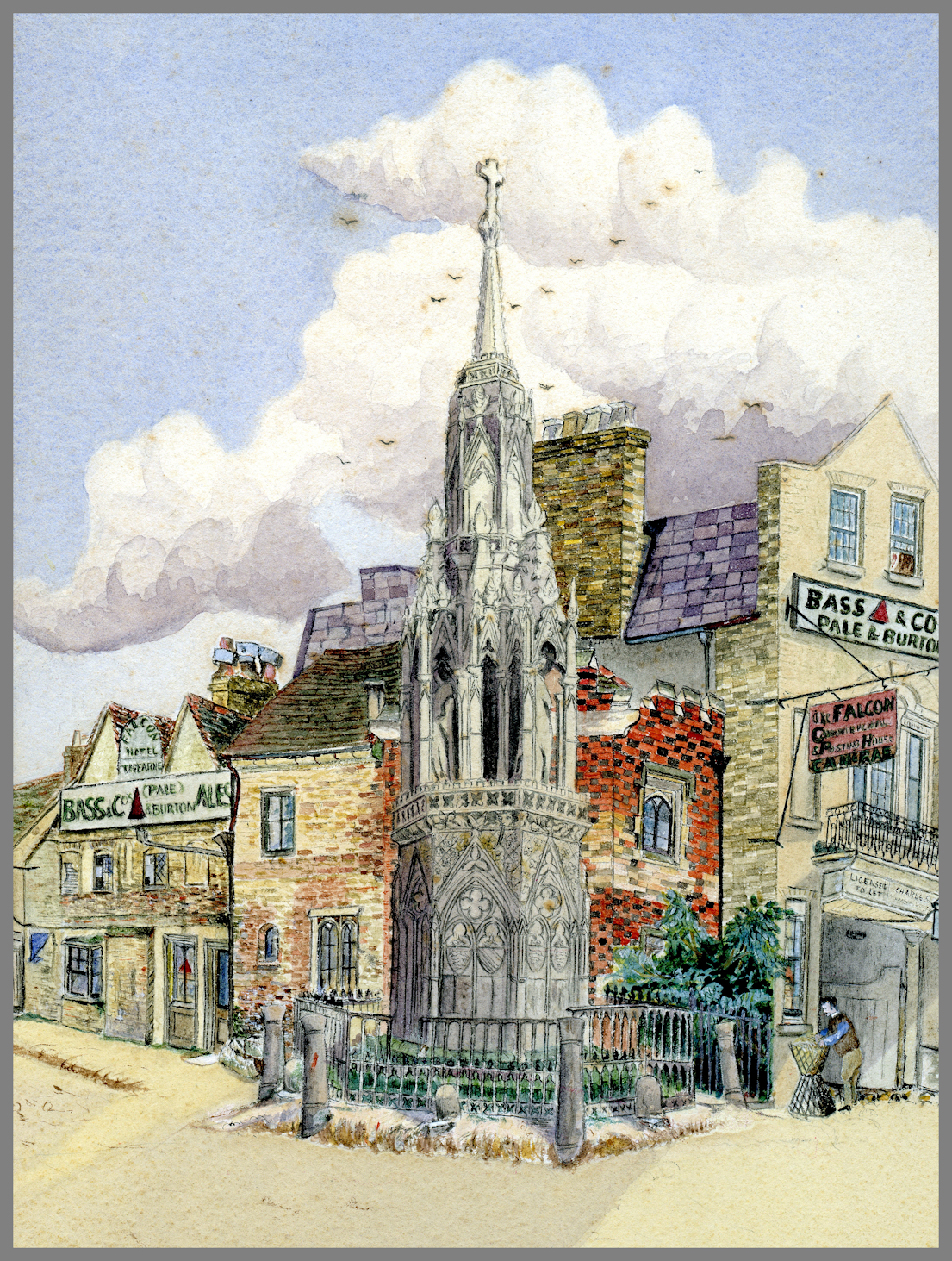
Waltham Cross (from a watercolour by W Bailey, 1889) [2014]

But the advantage doesn’t stop there. For a start there’s the fact that we create a postcard; with an image on one side and a greeting on the other. There’s still space for personalising the card, and for an address label. They’re also relatively light weight, thus saving on overseas postage. With printed address labels and no envelopes, they are easy and fiddle-free to write.

On top of which everyone gets something special – and many people tell us they love receiving our cards and often keep them to enjoy. And of course we have the spare cards in stock for later years when we may not be able to produce a new card.

Double Departure from Alexisbad [2008]

We ordered this year’s cards over last weekend and standard (free) delivery was expected to be in about 2 weeks. The cards arrived on Wednesday (so in 3 working days), and that is typical of VistaPrint‘s service over the years. But you’ll have to wait to see it as the design is staying under wraps for a while yet.

What’s not to like?

Auction Amusements

We’ve not had a collection of amusements from our local auction house for quite a while. That’s partly because the auctions haven’t been that interesting. That’s not too surprising as a lot of what they do is house clearance, which is going to be variable but also goes some way to explain the strange combinations of things which are used to make a lot. Anyway here are some of the highlights from the last three auctions: strange combinations, odd things to sell, or just poorly phrased descriptions.


A mixed lot including a pair of vintage ice-skates, a vintage wooden bat, small glass animal ornaments, three cameras including Kodak Instamatic 133X, an Agfamatic, shell model of a fox, a pair of Rand No. 1 opera binoculars in box, artist materials, Liverpool Road pottery dishes, Wade animals etc.


A vintage parking meter on pole No. 3447.


A vintage wooden boxed His Master’s Voice Valve Radio and a vintage Ransome’s Lawnmower.


A Dollmore fully ball-jointed male ‘Theo’ doll sculpted by Gu mi-jeong, with blue glass eyes and accessories including wigs, eyes in other colours, shoes, stand and sailor suit.


A 1929 Morris Cowley Flatnose saloon, registration KX 3053, for full restoration. This vehicle comes with a replacement engine, part-fitted, the original engine, and many other parts.


A typed letter from Ronald Reagan dated September 25 1980 thanking Mr Taylor for support with faded signature, mounted and framed, and a framed commission from George III to Captain Andrew Ross Esq. signed by Henry Dundas, framed.


Thirteen brass blow lamps including one petrol.


A vintage Slazenger croquet set in pine box, an earthenware crock and Panasonic Music Centre.


Two Civil Defence Geiger counters.


An adjustable reading light, a builder’s platform, a Black & Decker leaf blower.


An alabaster table lamp and stacking wine storage racks and an extending aluminium ladder.


A fine quality model of the Cutty Sark, 1868, in a glazed display cabinet.


A very large lot of mixed items including table lamps, a quantity of silver-plate including one silver golfing spoon, cocktail shaker, knife rests, cutlery, an Olympiette Special cased typewriter, a small quantity of pretty costume jewellery in two jewellery boxes, china tea services including Royal Doulton ‘Hilltop’; glassware: glasses, light bulbs; stationery, wicker storage baskets, wools and threads, vintage crochet hooks, embroidery stands, cashbox, wooden trays, a wicker clothes basket and a wicker wine rack and a vintage floor light, a real mixed lot.


A mixed lot including a Sony S Master micro hifi system CMT-G1B1P with speakers, a Samsung speaker, a quantity of electrical accessories including a digital thermometer, telephone cups, a Braun diffuser hairdryer, alarm clock radios, two cameras, two ladders etc.


A large mixed lot including a large quantity of cleaning materials and cloths, such as Flash, W5 degreaser, Mr Muscle etc., a large black and white meat plate, a print of a horse, stainless steel dinner wares, two black ceiling spotlights, a cuckoo clock etc.


Three vintage milk churns, an old petrol can, a large oak frame and a bag containing decoy pigeons with stands.


A mixed lot including food bags, foil, a wall tall organiser, sealants, slug pellets, vintage wood working planes, shoe polishes, etc.


A vintage circa 1965 Honda 50 scooter with original paint work and vintage helmet registration number DYY 376C
[Since when did helmets have to be registered?]


An impressive standard lamp with modern shade, probably Doulton though unmarked, on bronze stand with three hairy feet supports and classical column support.


Approximately 175 petrol lighters of various makes including approximately 20 lift-arm lighters, approximately 28 Ronson Varaflame gas lighters and 13 table lighters on ribbed bases, and 70 other lighters, many gas and 15 trench art lighters. (NB numbers are approximate and the lighters have not been checked for condition or originality)


An Hermes Plisse pleated scarf in Grand Fonds design in bright jewel colours, with original box.


Things to Think About: October

This year we’re beginning each month with a (potentially logical) oddity to think about, and to keep the brain cells active. This month:

Many animals probably need glasses, but they don’t know it and neither do we.

Please leave your thoughts in the comments.