
| Fri 1 | Monthly admin day again, and no sooner to clear one set of papers off the desk than two more arrive. Finally got to see some desk about teatime. |
| Sat 2 | In the garden mid-afternoon, and a noise overhead. Looking up there’s a red kite and a gull, quite low, and I’m not sure who was escorting which off the premises. The kite was surprisingly bigger than the gull; absolutely majestic. |
| Sun 3 | I seem to have spent all day writing my Chairman’s monthly update for the doctors’ patient group members – there was a never-ending list of healthcare items this month. |
| Mon 4 | Following last week’s diabetes check-up, doctor and nurse not happy. Increase statins. No alcohol for a week. Hrmph! |
| Tue 5 | I’m writing yet again. Today I’m working on a presentation about the places Anthony Powell lived, which I’ll probably end up giving later in the year. |
| Wed 6 | Blimey. What a day. I’ve lost count of how many members of the government have resigned today – but it is far more than there should be members of the government to start with, which says a lot about our rotten to the core system. |
| Thu 7 | It’s no wonder my PC refused to start this morning, and needed a helpdesk call. Johnson resigning is enough to frighten even inanimate objects, especially as his successor will likely be even more dangerous. |
| Fri 8 | One of the three pupae collected from the garden a couple of weeks ago has hatched into a large “house fly”. Not sure how you get something that size from a small pupa. 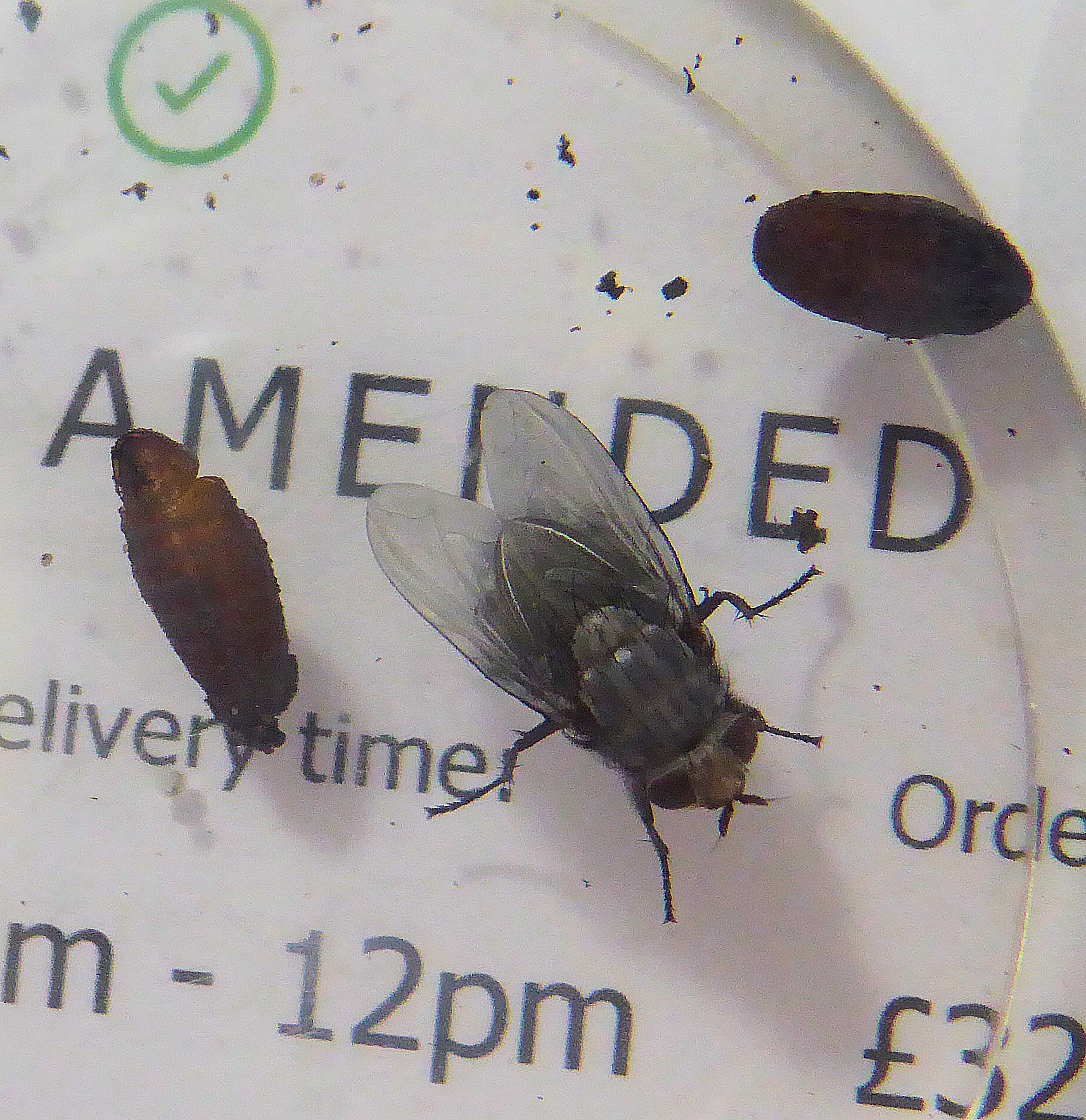 |
| Sat 9 | The day for a haircut. Now really short again. So much more comfortable in this heat. And it’s due to get hotter. |
| Sun 10 | What a good thing there’s nothing pressing to do today. Awake at 04:00 and 07:30. Next I know it’s 11:30! What happened there? |
| Mon 11 | Part of what happened there was that I’d put my back out. Hopefully I’ve managed to settle it down and it is now just muscular. If not I shall have to find me a new osteopath. |
| Tue 12 | It’s coming to something when the experts can’t even vaguely agree. Tonight’s weather: BBC says 1-2% chance of rain at any time tonight; Met Office say 40-50% chance of rain in the 2 hours around midnight. We had a few heavy spots just before 20:00. |
| Wed 13 | This morning, a pile of feathers in the bedroom doorway. Just feathers; oh and a foot. No sign of a bird. No sign of a corpse. Has it been hidden or eaten? Guess we’ll find out when it starts smelling. |
| Thu 14 | I was wondering why my morning fasting blood sugar levels had suddenly dropped about 10 days ago. Looks like it might be the hot weather. Who would have guessed this is a thing? |
| Fri 15 | Another good insect day, after yesterday’s butterflies (which I blogged about). Today a Jersey Tiger Moth. Yes, they’ve spread from Jersey to the south coast (I first saw one in Lyme Regis about 20 years ago) and are gradually moving north. I’ve seen one here most years for the last 6 or 8. They’re absolutely stunning; and quite large. 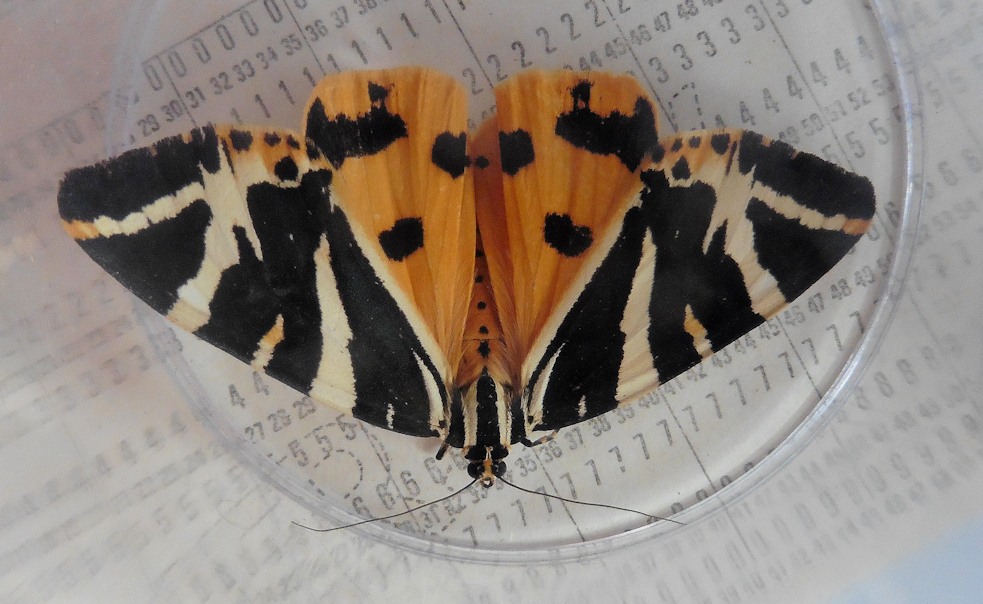 |
| Sat 16 | Having bemoaned the lack of the usual butterflies this year, today saw a beautiful red admiral feeding on the buddleia. It was, of course, camera shy. |
| Sun 17 | Saw the Lebanese guy next door this evening – first time in ages, so had a good long chat about everything from the eldest’s career aspirations to his plans to extend the house. His wife and 3 boys are in Lebanon for the summer. |
| Mon 18 | Scorching day! Walking down the garden this evening we disturbed four, yes four, Jersey Tiger moths (red wing morph) in the woodland glade. All flying together; absolutely stunning! There’s something they obviously like here. |
| Tue 19 | In more insect news … this morning an Oak Bush Cricket in the bathroom. Unfortunately N put it outside before I could catch it and work out exactly which species. |
| Wed 20 | A pleasantly cooler day with a refreshing breeze. The last 2 days have been unbearable, but we did have some heavy rain late last evening (not enough though) and it cooled a lot overnight. But still warm enough for a Peacock butterfly on the buddleia at lunchtime. |
| Thu 21 | Annual trip to the optician resulted in new glasses for me: £800 after the 20% discount! N escaped the rape of the credit card. We were there all morning chatting to the young lady dispenser. |
| Fri 22 | I don’t understand supermarket deliveries. You book a 1 hour slot. Often they arrive during the slot; occasionally they’re late; but not infrequently they’re early – like an hour early, as this morning – and catch you on the hop. |
| Sat 23 | Small but successful AP Soc. pub meet over Zoom. While it would be nicer to have real meets, using Zoom does allow those outside London, and especially outside UK, to participate – which is good. |
| Sun 24 | Picked the first crop of runner beans. They’re quite early as they’re last year’s plants which I’ve over-wintered, so got a head start. They were very tasty (cooked & cold) in salad. 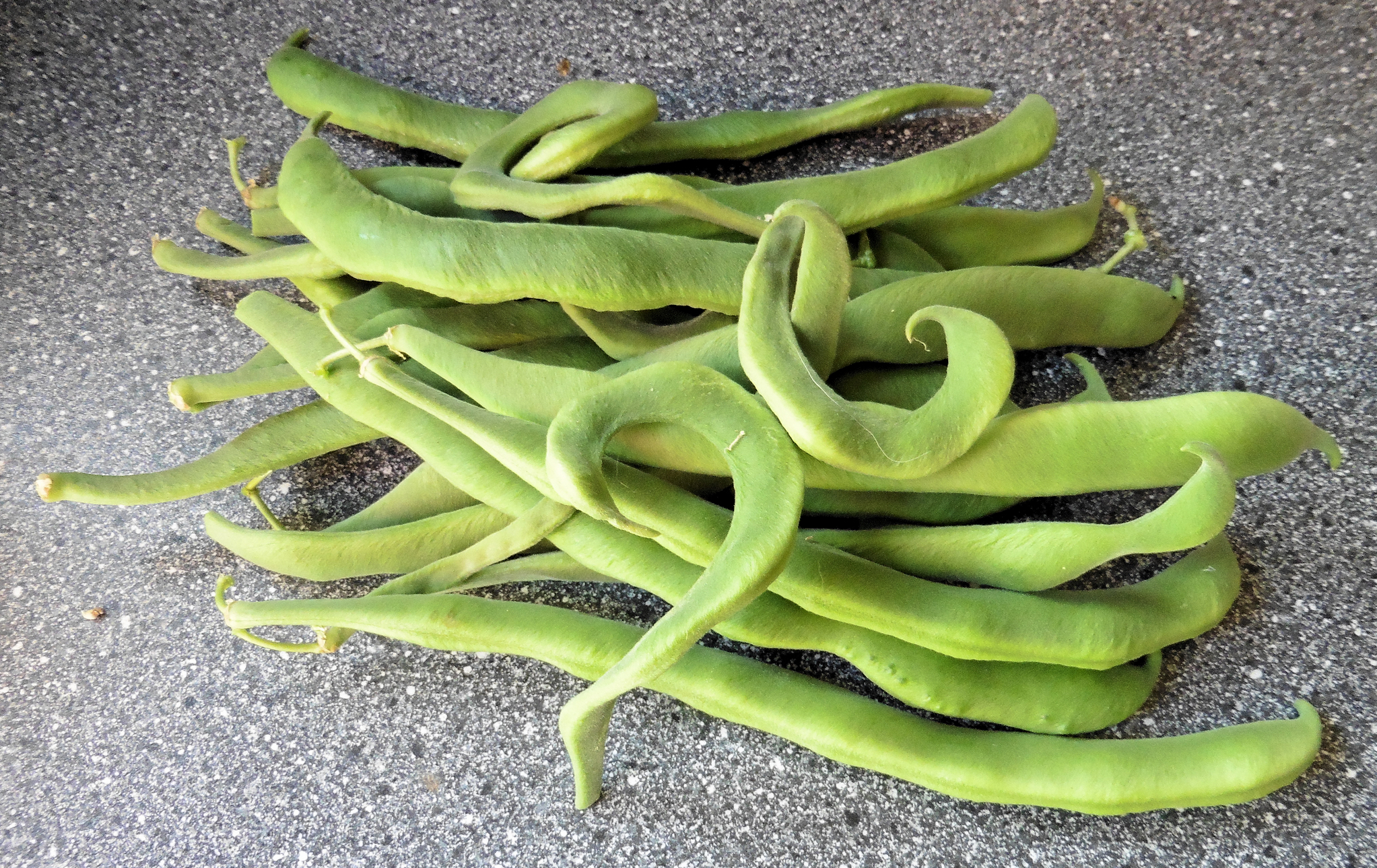 |
| Mon 25 | Two afternoons spent making zero progress on my family history: chasing Austens in Kent. Yes, that’s Jane Austen’s family. There are Austens everywhere; all the men seem to be called John, George or William; and they’re everything from baronets & surgeons to AgLabs. Can’t find a link to JA, but that’s hardly surprising given their proliferation. |
| Tue 26 | A day of pushing jelly uphill through treacle with a toothpick. Everything took forever, not helped by being decidedly sleep short. |
| Wed 27 | Sorry guys, I ducked this evening’s meeting. I just couldn’t face the endless waffle, especially knowing who was chairing it. |
| Thu 28 | Oh God! More unnecessary, costly and over-hyped circus acts. Commonwealth Games. Gah! |
| Fri 29 | It happens every week! By the time we get to Friday afternoon I’m firmly convinced it’s Saturday. And I cannot work out why. Guess I’m just going soft in the head. |
| Sat 30 | Uncomfortably warm & sticky to go with a day of depression, anxiety and inability. No wonder I think it’s Sunday. |
| Sun 31 | 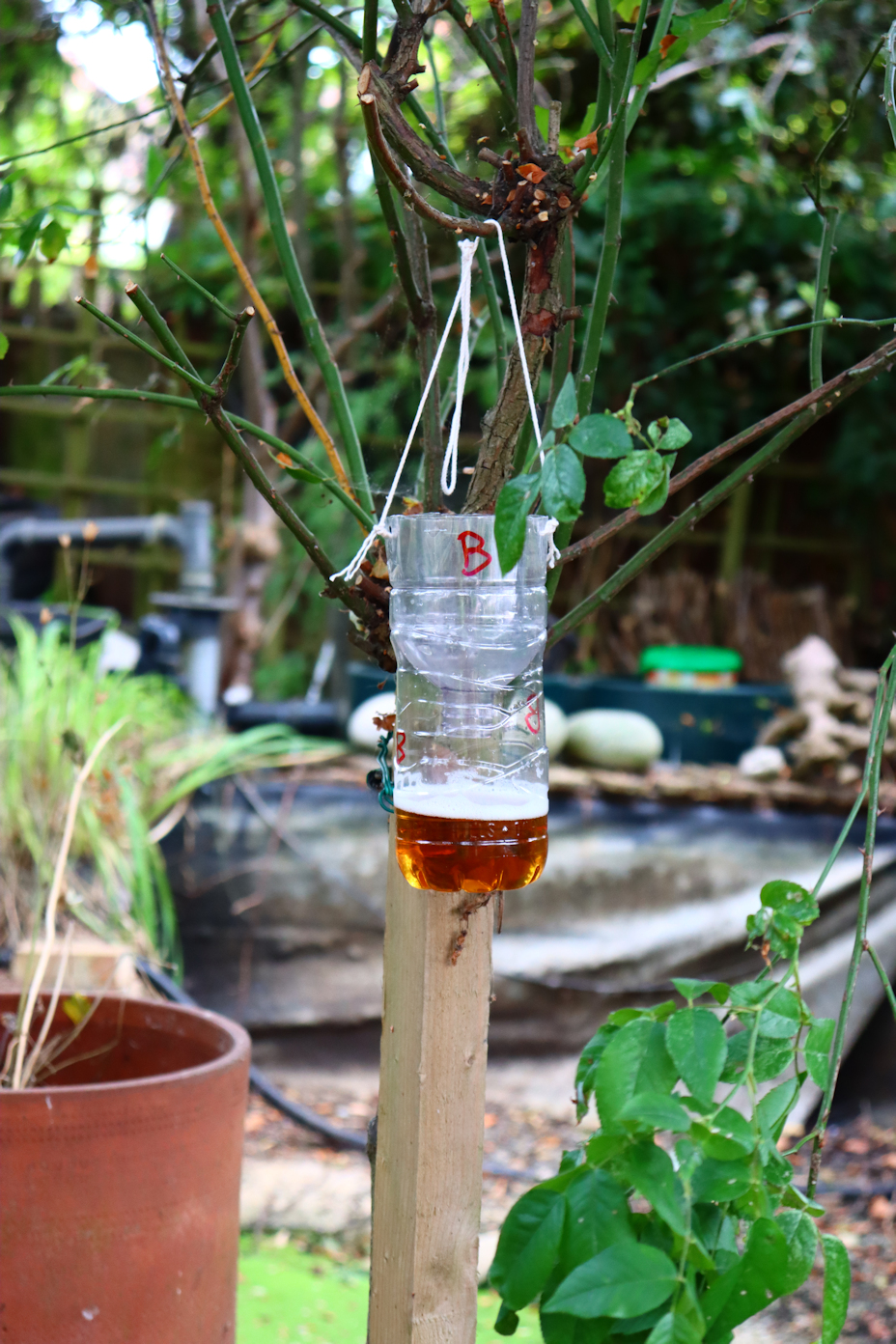 Today is the day we put out the wasp traps for the first of this year’s Big Wasp Survey slots. Two traps containing 200ml of lager, at different points of the garden, for 7 days. Today is the day we put out the wasp traps for the first of this year’s Big Wasp Survey slots. Two traps containing 200ml of lager, at different points of the garden, for 7 days.
As always it’ll be interesting to see what we catch, although I doubt we have any of the specific target species here; more likely to get the commoner ones in early September. I can’t believe this is the sixth year of Big Wasp Survey! |
All posts by Keith
Monthly Links
Here’s another edition of our monthly guide to items you may have missed the first time around.
Science, Technology, Natural World
We’ll start off with one of my favourite subjects: wasps. We need to take sting out of our fear and loathing of wasps and welcome their importance to ecosystems
One of these days scientists will make up their minds. Unlike a while back, they’re now saying dogs arose from two populations of wolves, study finds
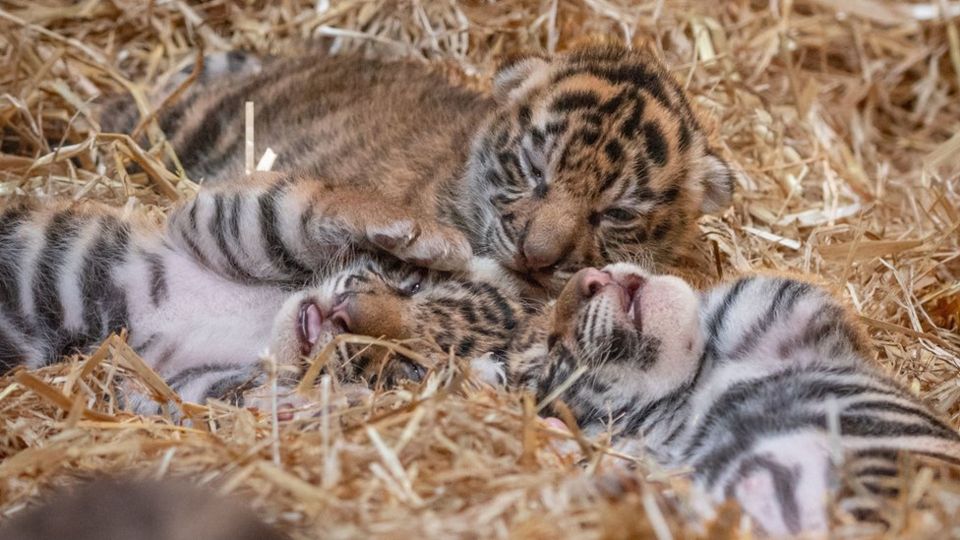
In good news, three Sumatran tiger cubs have been born at London Zoo. And they’ve released the usual cute cat pictures.
Scientists at London’s Kew Gardens, with many others, have found that the world’s largest waterlily is in fact a new species, now named Victoria Boliviana. That means there are now three giant waterlily species.
One of the lead scientists, Lucy T Smith, has written a blog item about the discovery. [LONG READ]
And James Wong writes about how the giant waterlilies changed architecture.

While we’re on engineering and architecture, Transport for London engineers have designed and are testing a totally new idea for cooling the London Underground.
Sexuality
In an unsurprising discovery many specialists have pointed out that male sterilisation (aka. vasectomy) isn’t going to solve (America’s) problem with abortions. [LONG READ]
Environment
While on things sexual, researchers are suggesting that grey squirrel numbers could be reduced using oral contraceptives. However I see the law of unintended consequences coming into play if this is tried.
Art, Literature, Language, Music
A look at the way our brains cope with speaking more than one language.
History, Archaeology, Anthropology
Some scientists are now reckoning that early human ancestors are one million years older than previously thought. It’ll be interesting to see if this holds up.
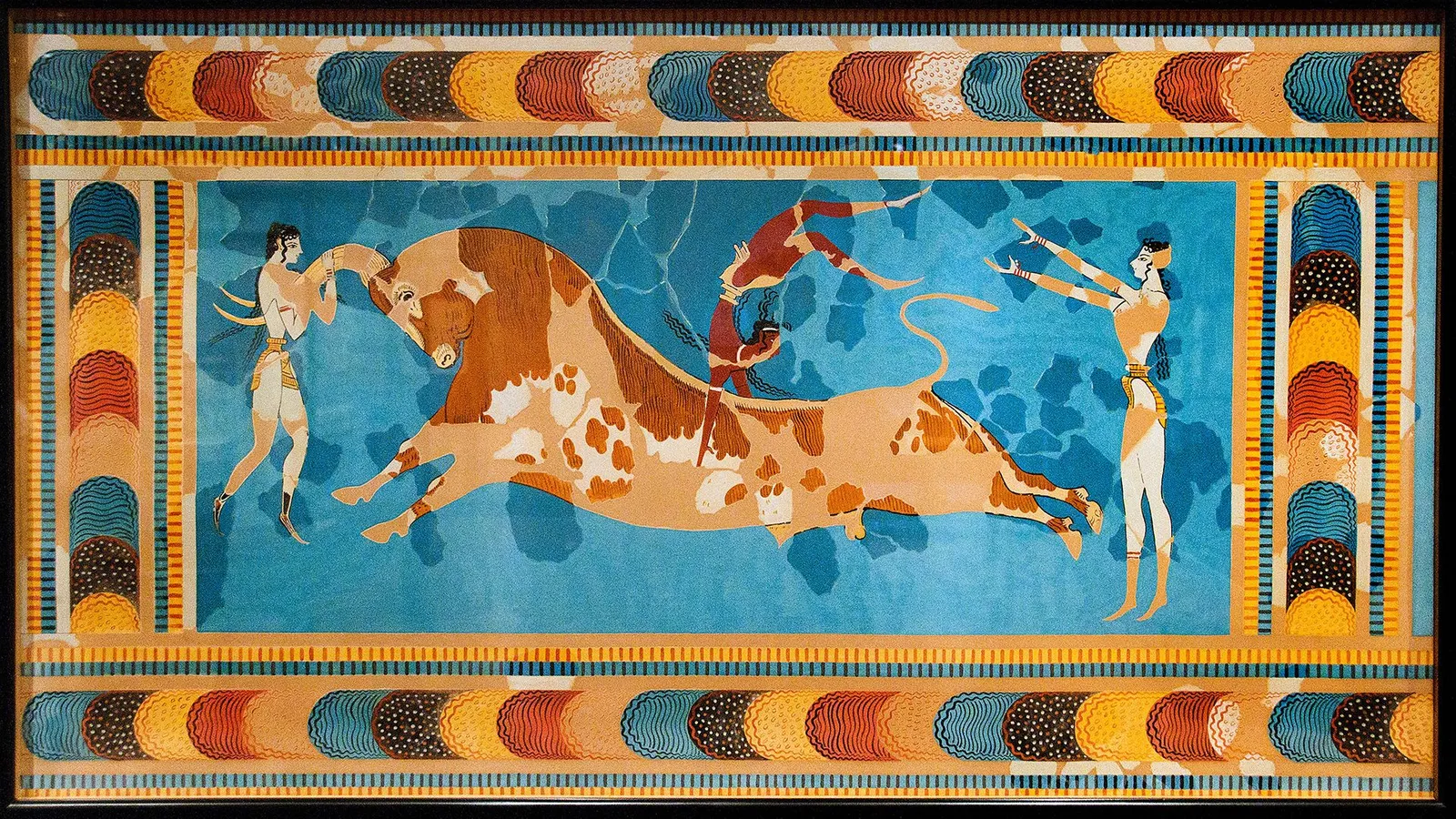
The mysterious Mycenaean and Minoan civilisations were a bedrock for much of Ancient Greece. [LONG READ]
An important hoard of Roman gold coins has been found near Norwich.
Here’s a review of Janina Ramirez’s new book Femina: A New History of the Middle Ages Through the Women Written Out of It.
Dr Eleanor Janega at Going Medieval provides a reading list on medieval abortion.
Meanwhile Scientific American takes a look at abortion and contraception in the Middle Ages. [£££]
Cavers have found a mineshaft in Cheshire which has been completely undisturbed for 200 years and is a useful time capsule.
Clandon Park House was gutted by fire in 2015. The National Trust which owns it has decided it will be mainly conserved as a ruin rather than restored to its former Palladian glory.
If you were a Victorian or Edwardian peer, what would you put in your vampire hunting kit? Well there was one for sale recently at Hanson’s Auctions; it sold for £13,000 (plus fees) some some five times it’s estimate!

London
On the interestingly named Pickle Herring Stairs.
Did you know that London had a naked Routemaster bus?
Apparently there are plans to un-culvert a stretch of the Gores Brook in Dagenham. A move which should be applauded, and repeated elsewhere.
It’s not quite London, but in our fourth item from IanVisits, he goes to Saffron Walden in Essex – a delightful small market town.
Food, Drink
The French authorities, like WHO, have now concluded there’s a definite link between charcuterie and colon cancer, due to the high level of nitrates and nitrites contained therein.
In better news, French scientists think they’ve cracked the puzzle of cultivating prized white truffles.
How safe is it to eat mouldy cheese?
Lifestyle, Personal Development, Beliefs
The Guardian goes to meet a handful of the country’s more unusual master craftsmen.
One of my favourite places is the Dungeness and the Romney Marsh. Caroline Reed in Kent Life looks at some of the best of the area.

Shock, Horror, Humour, Wow!
And finally, here’s a list of the rarest boy’s and girl’s names in the UK – 50 of each.
July Quiz Answers
OK, so here are the answers to this month’s quiz questions. All should be able to be easily verified online.
July Quiz Questions: Biological Science
- All plants and animals use DNA to store genetic information, and much of this DNA is common between species. How much of their DNA do humans and lettuces have in common? About 30%
- How many bones does a shark have? 0 (they’re cartilaginous fish)
- Which fruit is a hybrid of the pomelo and mandarin? Orange
- What creature is thought to be the closest living relative of T. rex? Chicken
- Which acid is mainly responsible for muscle fatigue? Lactic Acid
Answers were correct when questions were compiled in late 2021.
Monthly Quotes
Here’s this month’s collection of quotes encountered.
It’s almost impossible to believe he [Boris] exists in politics. It’s as if we took everything that was ever bad about the UK, scraped it up off the floor, wrapped it in an old sausage skin and then taught it to make noises with its face.
[Jim Whitehouse on Twitter]
What is offensive about a penis, a vulva or breasts? Nothing as such. I would argue, it’s like a knife. It’s not offensive until you point it at someone.
[Marc at https://www.nudeandhappy.com/2022/06/13/i-love-being-naked-and-no-its-not-sexual/]
My formula for living is quite simple. I get up in the morning and I go to bed at night. In between, I occupy myself as best I can.
[Cary Grant]
The only thing which has improved since Brexit is the average IQ of EU citizens.
[Kenneth Clarke]
We are a society of altruists, governed by psychopaths.
[George Monbiot]
There is considerable overlap between the intelligence of the smartest bears and the dumbest tourists.
[Yosemite National Park Forest Ranger]
I see
and I hear
and I speak no evil;
I carry
no malice
within my breast;
yet quite without
wishing
a man to the Devil
one may be
permitted
to hope for the best.
[Piet Hein, An Ethical Grook]
Religion is regarded by the common people as true, by the wise as false, and by rulers as useful.
[Seneca]
The time will come when diligent research over long periods will bring to light things which now lie hidden. A single lifetime, even though entirely devoted to the sky, would not be enough for the investigation of so vast a subject … And so this knowledge will be unfolded only through long successive ages. There will come a time when our descendants will be amazed that we did not know things that are so plain to them … Many discoveries are reserved for ages still to come, when memory of us will have been effaced.
[Seneca]
Acting ethically is how we, the musicians contributing to this performance called the universe, avoid hitting bum notes and screwing up the performance. Acting unethically is how We make the symphony of life into something ugly, confused, and cacophonous rather than something beautiful and deeply moving.
[Brad Warner, The Other Side of Nothing]
All of humanity’s problems stem from man’s inability to sit quietly in a room alone.
[Blaise Pascal]
St Augustine [in his] pages about the nature of time in his book “The Confessions” says, “When I listen to music I get a meaning from a musical phrase, but I never listen to the phrase. I listen to one note at a time.” If I listen to one note, how do I know about the previous notes? Well, of course I know because I remember them, but if I remember them … the meaning comes from the notes playing now and the memories of the previous ones. So it’s all in the present and it can only be the present together because there is memory. But it’s more than that because since the brain is designed by evolution to use memory to anticipate for
a purpose, because it is designed to try to get somewhere. That’s how living evolution designed our behaviour.
[Carlo Roovelli, Lecture “The Physics and the Philosophy of Time”]
Street Trees
I spotted this on Twitter. It is a perfect illustration of one reason we need street trees, and more of them.
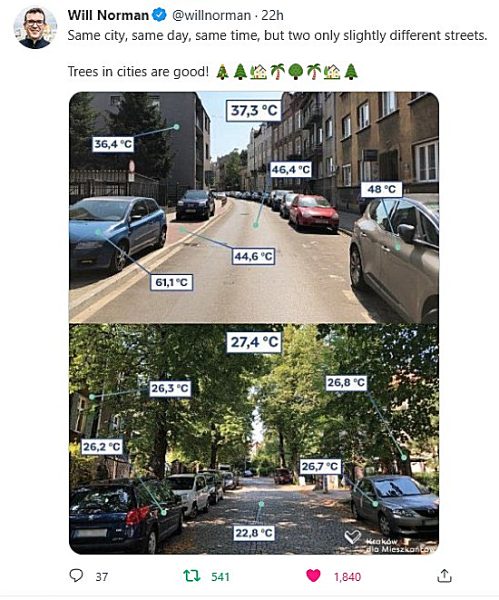
Other reasons include: biodiversity and ecological protection, surface water management, and mental health.
Quote of the Month
If liberty means anything at all, it means the right to tell people what they do not want to hear.
[George Orwell]
Butterfly Day
It’s a bit cooler today, so more congenial to sitting in the garden. There are so few butterflies around these days; when I was a kid the place was awash with them.
But for these days it was a good butterfly day with …
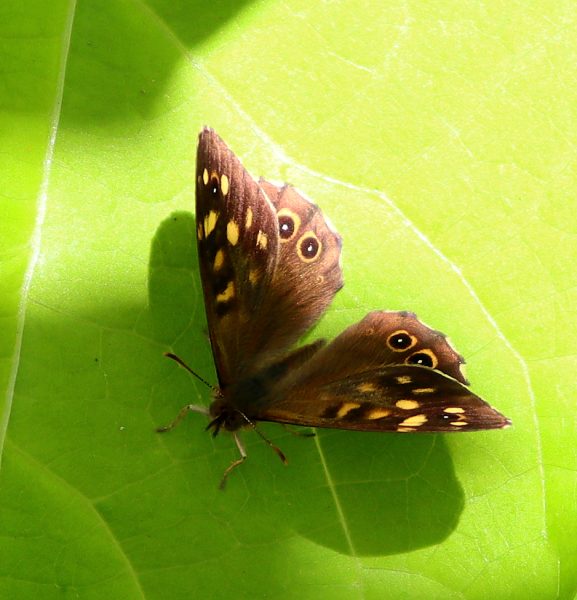
We usually have one around in mid-summer;
they like our dappled shady glades.
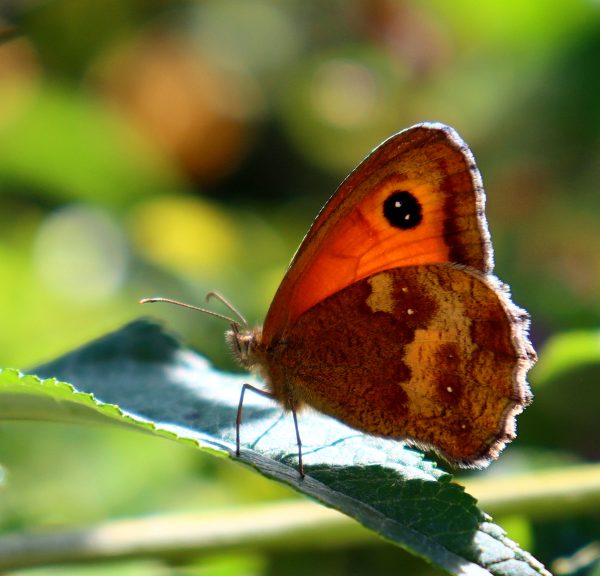
We more opften have Meadow Browns, which are very similar,
but note the two white dots in the eye marking on the
underside of the forewing, plus spots and marking
on hindwing which are together definitive.
and also several “cabbage” whites – mostly Large White I think – and at least one Comma. None of these latter would sit still long enough to be photographed.
Sadly as yet this year no Small Tortoiseshell (they were everywhere when I was young), Peacock, Red Admiral or Painted Lady.
And I’m still on the lookout for a Hummingbird Hawk Moth (which we have had here) or indeed any of the other large hawk moths.
Culinary Adventures #88: Monkfish
Just for a change I bought some (frozen) monkfish this weekend. I’d seen a recipe somewhere and thought we should try the monkfish because, as far as I know, neither of us has ever tried it.
As always, having gleaned an idea or two, I threw the recipe away and made it up as I went along.
Once thawed I marinated the monkfish in a combination of lemon zest & juice, olive oil, black pepper, ½ teaspoon of tandoori spice mix (powder), and some fresh chopped parsley and mint. It sat in this in the fridge for about 3 hours. The fish (and marinade) was transferred to a small metal roasting tin and put in a hot oven to cook for 15-20 minutes (the first half covered with foil).
Served with hot baguette and a tomato & chicory salad. The fish was really lemony and very tasty.
Monkfish used to be dirt cheap – why else would it be an essential in a peasant dish like bouillabaisse? Now it is fairly expensive (but then so is all fish). Nonetheless I might do this again.
Ten Things: July
This year our Ten Things each month are words with particular endings. Clearly this won’t be all the words with the nominated ending, but a selection of the more interesting and/or unusual.
Ten Words ending with -ra
- cobra
- abracadabra
- kookaburra
- aspidistra
- chakra
- capybara
- chimera
- tempura
- tantra
- mudra
Your challenge, if you choose to accept it, is to write a story in at most three sentences using all these words correctly. Post your attempt in the comments before the end of the month and there’s an e-drink for anyone who I consider succeeds.
July Quiz Questions
This year we’re beginning each month with five pub quiz style questions, with a different subject each month. They’re not difficult, but it is unlikely everyone will know all the answers, so hopefully you’ll learn something new, as well as have a bit of fun.
July Quiz Questions: Biological Science
- All plants and animals use DNA to store genetic information, and much of this DNA is common between species. How much of their DNA do humans and lettuces have in common?
- How many bones does a shark have?
- Which fruit is a hybrid of the pomelo and mandarin?
- What creature is thought to be the closest living relative of T. rex?
- Which acid is mainly responsible for muscle fatigue?
Answers will be posted in 3 weeks time.