Our monthly look at what happened 100 years ago.
On this day, 1 September 1923 saw …


Our monthly look at what happened 100 years ago.
On this day, 1 September 1923 saw …
| Tue 1 | Why do banks have to make internet banking so byzantine? Liberating a small amount today from a savings account into daylight, took two transfers (via an intermediate account), and I lost count of how many authorisations, texted security codes etc. Even then it will still take overnight to be rescued. |
| Wed 2 | Boy Cat to the vet for repeat x-rays. Sounds like they’re clear. More ouch of the wallet though; hope the insurance coughs up. |
| Thu 3 | Joyful annual trip to the opticians – they’re always a helpful and friendly bunch. Eyesight (mainly distance vision) has improved a bit, as it tends to with ageing – and improved enough that new glasses are advised, which I was going to do anyway. But yet more ouch of the wallet: almost £1000 for specs, and that’s after a 20% discount: good rimless frames are not cheap (there’s no room for any error as they have to be drilled) and neither are varifocals; Nikon have stopped the lenses I had in favour of their more expensive ones; and the various coatings have also been “improved” at a cost – all round that’s £300 more than last year. But blimey, £3 a day to be able to see! |
| Fri 4 | Yet again, I’ve been convinced since lunchtime that it’s Saturday. Why I just cannot fathom. |
| Sat 5 | Dear God! What a dismal day all round. Not very warm. Peeing with rain all day. Stygian darkness, so we have to have the lights on in the middle of the day in August! And we’re both feeling meh – in N’s case due to poor sleep; dunno why for me. Gawdelpus! |
| Sun 6 | Today’s the day for putting out the wasp traps for week 1 of this year’s Big Wasp Survey (now in its 7th year). As usual I have 2 traps, one up near the house, the other by the pond. They’re made from the usual plastic water bottles and spiked with a bottle of Newcastle Brown divided between them – I never know what’s the best inducement to use. Also today I finally managed to get a (not very brilliant) photo of a speckled wood in the garden.  |
| Mon 7 | Comes the gardener, complaining about the lack of Piccadilly line trains on our branch. He did do some gardening, but also fixed the shower door and decreed the dishwasher beyond economic repair. Yet more money going out, this time for a new dishwasher. |
| Tue 8 | Quoth N, on Sunday midday foresooth, “‘Ere there’s three geezers digging up the road outside”. And lo, they were. Electricity board navvies; ripping up a large chunk of the pavement; right outside our house. In the process they’ve chopped into some big roots of our street tree; hopefully it will recover. They appear to have made some major repair to a cable (happily not the one which feeds us). They went away leaving their hole and piles of dirt etc. exposed to the elements and yobbos, and surrounded by virulent green plastic hurdles. It’s all still there today, two days on. I’m contemplating opening a book on how long the hole stays there before it’s filled in. One is irredeemably reminded of Bernard Cribbins. |
| Wed 9 | An Alice Through the Looking-Glass day: having to run fast to stay in the same place and ever faster to get anywhere. |
| Thu 10 | The hole is no more. Noisy truck and geezers filling it in at 07:30 this morning, and taking away the debris. 10 ton truck parked right in the middle of the road. All we need now is the paviers to put the paving slabs down. Mind the men have left several of their hurdles standing on our neighbour’s paved front – he’ll be wanting to charge them rent; he’s that sort of guy. |
| Fri 11 | Yet again, according to my brain it’s Saturday. |
| Sat 12 | What are these guys on? When ordered, new dishwasher scheduled for delivery today 07:00-17:00. Refined yesterday (as promised to a 2 hour slot: 07:00-09:00. Up at 06:00. Guys ring at 06:14 to say they’ll arrive in the next half hour! New machine installed & old taken away; job done by 06:50. Well we are only 3 miles from their warehouse! |
| Sun 13 | It was really nice sitting in the sun, but out of the worse of the stiff breeze, this afternoon. Just sitting, accompanied by a sun-warmed cat or two. |
| Mon 14 | 10 o’clock on an August morning in London, and it’s so gloomy you (again) have to have lights on to be able to see what you’re doing. Mind it doesn’t help when half the study windows are swathed in chilli plants! |
| Tue 15 | Good evening wood pigeon! And your point is? |
| Wed 16 | Yet another of those days with too much to do and then more, even more urgent, piled on top. Consequently quite a bit didn’t get done. |
| Thu 17 | A successful hunt of the 1921 census for relations of my godparents. Well why not? Godmother needed only few details and it seems daft to shell out £200 to look up 4 records, especially when I already have access. One pleased godmother. PS. My godparents are both younger than me! Yes, really! Work that one out! |
| Fri 18 | I seemed to spend all day in the kitchen. First up the supermarket delivery. Then we had loads of surplus tomatoes (I always buy too many) so they were turned into tomato sauce. A blitz clean. And then cook spaghetti bolognaise (using some of the tomato sauce), which went down well for dinner with a bottle of red (some bolognaise left to freeze). That was followed by summer fruit salad with ice cream and a blackberry sauce I did earlier in the week. We’re both now stuffed and knackered. |
| Sat 19 | A morning spent asleep. An afternoon spent sending Postcrossing postcards. |
| Sun 20 | Having made tomato sauce a couple of days ago, and having 2/3rd left … tonight it was turned into a hearty tomato soup, with 3 leftover small potatoes and a small piece of pork chop from last night plus some fried onion and some mushrooms. Hearty it certainly was, served with grated cheese, hunks of bread and a bottle of Rioja. |
| Mon 21 | Hot baguettes and brie for tea reminded me of one of the things my father (when I would have been in my 20s) liked for tea: hot buttered crumpets, camembert and a couple of glasses of hock. It worked surprisingly well – as did G&T with fish & chips. |
| Tue 22 | I do wish I understood why there are some days (weeks even) when I’m depressed and unable to bootstrap myself to do anything. Most of the last week has been like that; just going through the (minimal) motions. Really no clue why. |
| Wed 23 | Damn. Go to collect my new glasses. I refuse them. Something has gone awry with them. The left lens is useless; everything is totally fuzzy – worse than my (weaker) right eye with no correction. It was like that time when you try on someone else’s glasses and everything is totally out of focus and misty. I know the prescription did change but not that much – I’d expect the usual short (hours?) adjustment period but not a totally fuzzy lens. And the lens is said to be what was ordered. Have to go back for a second eye test in a couple of weeks time. We’ll see what transpires. |
| Thu 24 | Hot and sticky with yet more Windows updates. |
| Fri 25 | Another day, another week, another … something. |
| Sat 26 | Well that’s the first time in a long while we’ve had a decent thunderstorm. It really only lasted half an hour, although odd rumblings continued. But it did include 20 minutes of absolutely cascading rain – real waterfall stuff. |
| Sun 27 | You see these triffids, poking their lighter green heads above the passionflower covering the archway? I can just walk under that archway.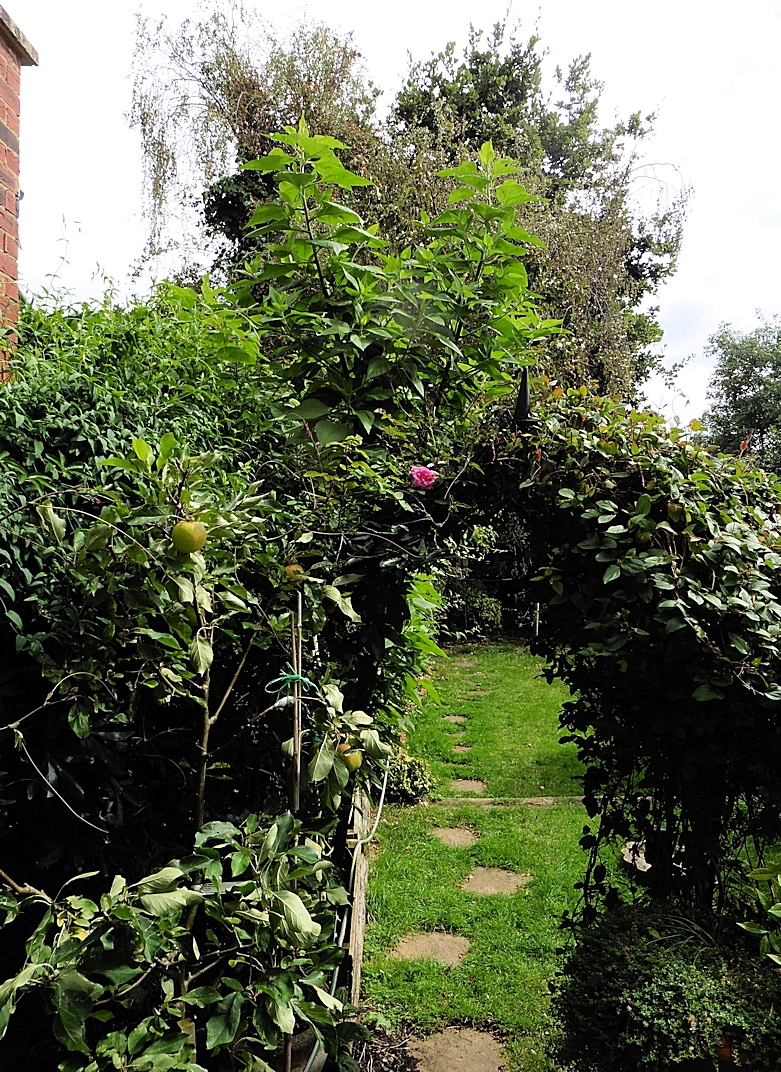 Well they’re Jerusalem Artichoke plants. Here they are from the other side: one set in the middle, one at the left, and another leaning off the right edge. Well they’re Jerusalem Artichoke plants. Here they are from the other side: one set in the middle, one at the left, and another leaning off the right edge.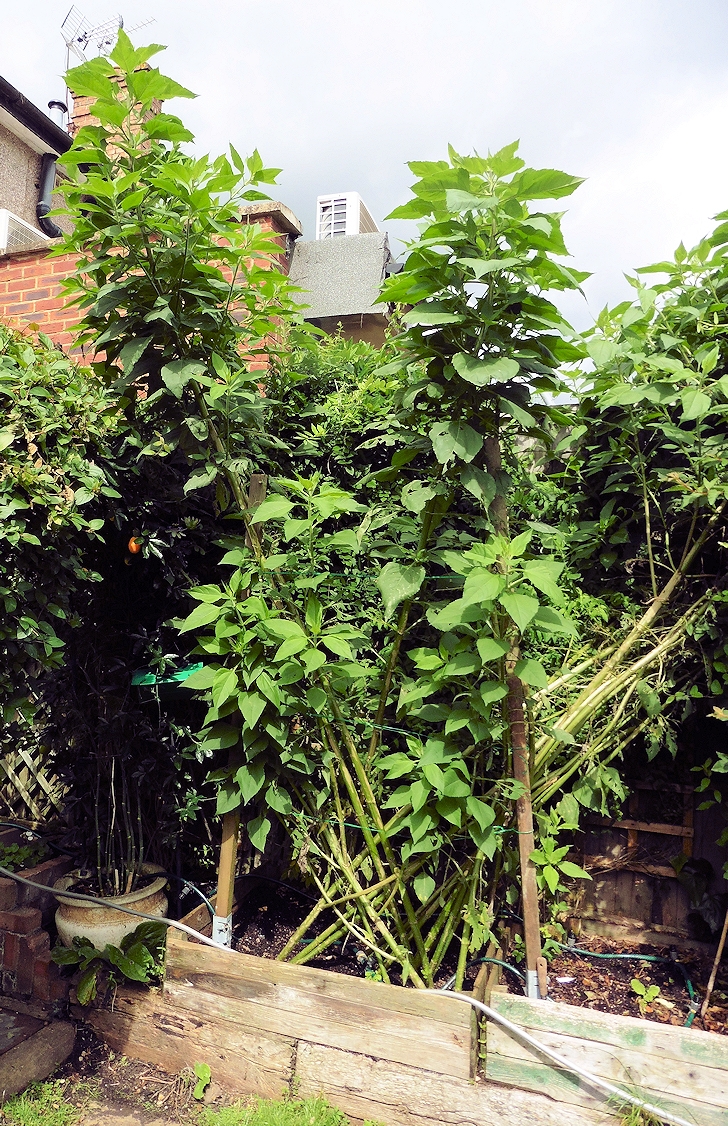 As you’ll see, they’re in a raised bed, so the plants are actually about 10 feet (3 meters) tall – maybe a bit more. As you’ll see, they’re in a raised bed, so the plants are actually about 10 feet (3 meters) tall – maybe a bit more.We stuck a handful of (past their best) tubers in the ground in the Spring; and they’ve grown like … well … triffids. They’ll die back in the winter and it’ll then be interesting to see what sort of crop we get from them. When I was a kid we always had a few Jerusalem Artichoke plants; they grew in a small patch of poor soil and still got to six feet. These are in good soil, with regular watering, so no wonder they’ve taken off. And they’re still growing – by rights they should have sunflower-like flowers at the top, but no sign yet. |
| Mon 28 | They say today was a Bank Holiday; essentially the last of the year. But no-one around here seemed to notice or care. It was just another Non-day. |
| Tue 29 | This cat has definitely got the right idea.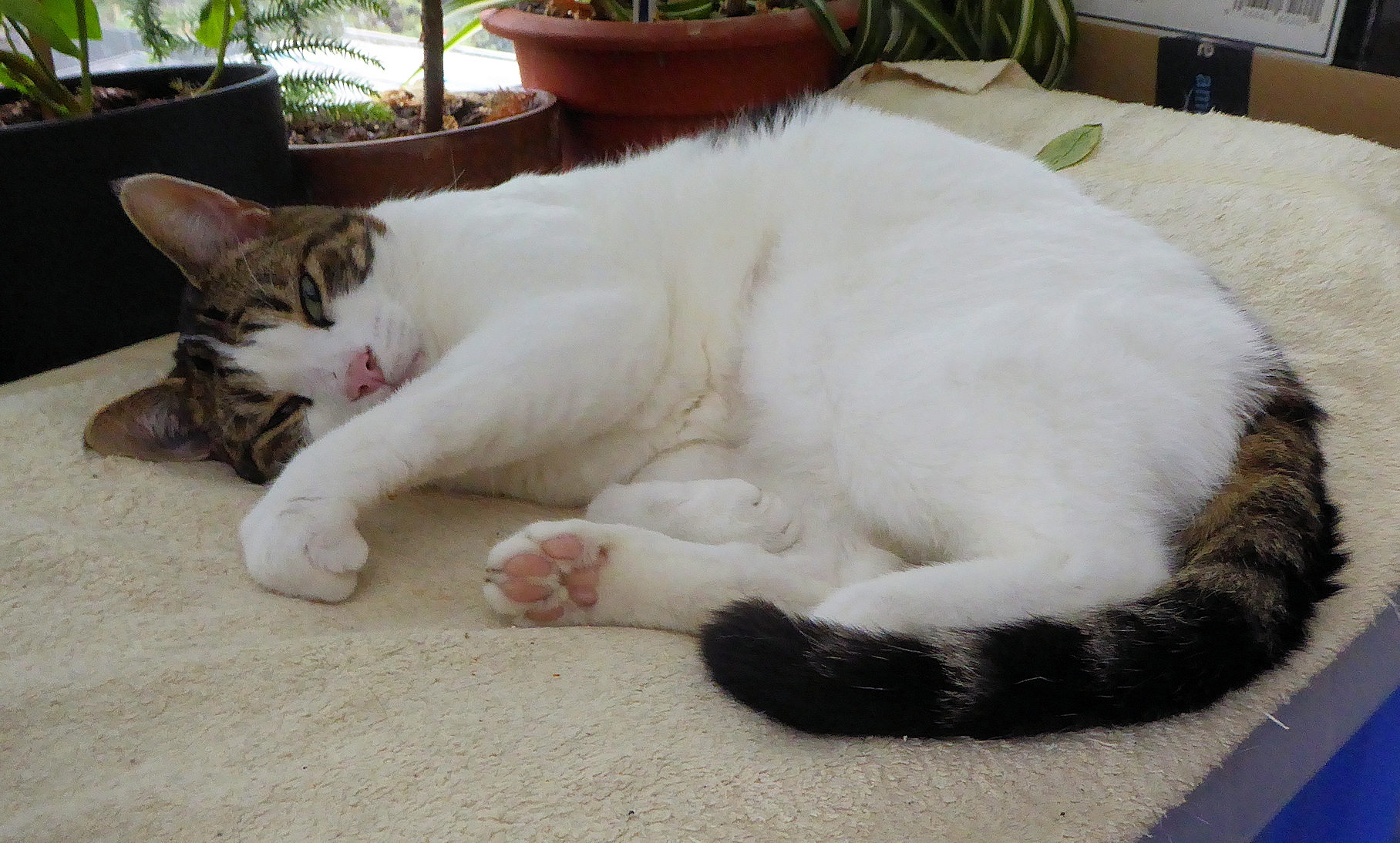 Apart from going out for about half an hour in the middle of the day, he’s been in this state all day. As I write it’s 19:40 and he hasn’t yet even bothered to stir himself to demand tea. Unlike the two girls who’ve taken it in turns all day to tell you they’re starving. Apart from going out for about half an hour in the middle of the day, he’s been in this state all day. As I write it’s 19:40 and he hasn’t yet even bothered to stir himself to demand tea. Unlike the two girls who’ve taken it in turns all day to tell you they’re starving. |
| Wed 30 | Well who knew that foxes like digestive biscuits? Last evening N put out a plate of remains for the fox: bones and scraps from our lamb chops and a few digestive biscuits we don’t like from a box of biscuits for cheese. She reported that, bar half a biscuit, the plate had been cleared within 2 hours. Now I can believe a cat or two may have salvaged the lamb scraps, but unlikely all the bones or the biscuits. But as I observed, a digestive biscuit isn’t that far removed from a dog biscuit – and I’ve certainly seen of people whose foxes like custard creams. Cheese puffs anyone? |
| Thu 31 | I was watching the squirrels this lunchtime and being impressed by their industry. They were busying themselves burying acorns from our oak tree in a nice friable piece of soil. They were digging for Australia; disappearing up to their shoulders in the hole. Then very deftly, with lots of scrapes and patting down, filling in the hole. Each one took a matter of seconds from start to finish. Busy little tree-rats filling their larder of winter! |
Here we go then with this month’s selection of links to items which interested me, and which you may have missed.
Science, Technology, Natural World
Let’s start with 16, possibly unexpected, facts about sweat.
Turmeric is supposedly one of those “cure-alls” but despite some interesting chemistry it looks like its claims are overstated.
Still on turmeric, here’s a report on how researchers uncovered a scam of improving the colour of turmeric with lead. [LONG READ]
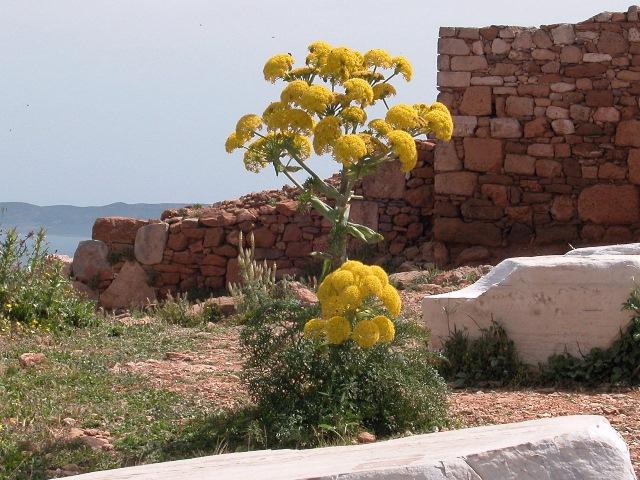
And while we’re on things yellow, a researcher thinks they’ve found a long-thought lost Ancient Greek and Roman medicinal plant.
And then there are wasps – in his case the common “yellow-jacket” Vespula vulgaris – where researchers using data from the Big Wasp Survey have found that the UK population is essentially genetically homogeneous. [Full disclosure: I’ve been part of Big Wasp Survey since its inception.]
Researchers are claiming that worms frozen in permafrost for 46,000 years are still alive and the oldest known living animals.
Continuing with the bizarre, in the deep Atlantic Ocean there lives a creature with 20 arms.
And so to the even more esoteric … Scientists continue to puzzle over whether nothingness exists.
On average your friends are on average more popular than you – on the paradox which links epidemiology and sociology.
Health, Medicine
Various scientists are making the observation that we aren’t prepared for the next pandemic (whatever that is) – here’s one. [LONG READ]
Covid cases have seen a small spike this summer; here’s why, and some thoughts going forward.
Here’s a look at six slightly surprising effects of common medicines. [££££]
In this one young researcher looks at the challenges she faced with OCD.
On the stigmatisation of menstruation through history to the current times.
Sexuality
There are different things helping towards great sex at various stages of life. [LONG READ]
Environment
Forget rich soil, try gardening with hardcore. [LONG READ]

More on wasps! There have been a number of sightings this year of Asian Hornets (aka. Yellow-Legged Hornet, Vespa velutina [image above], which is slightly smaller than a European Hornet, Vespa crabo [image below]) in the UK, most notably a cluster in Kent. While these are alien predators (often taking large numbers of honeybees) they are not the so-called “Murder Hornets” (aka Asian Giant Hornet, Vespa mandarinia, which are larger) which have invaded the American west coast. [As usual the article doesn’t really live up to the goriness of the headline.]
And there’s an even more recent report from the London area.

Art, Literature, Language, Music
Researchers at the Royal Museums of Fine Arts of Belgium have used infrared light to reveal a hidden portrait beneath a 1943 painting by René Magritte.
One scientist offers some tips for good scientific writing – and they aren’t what we’ve often been taught.
History, Archaeology, Anthropology
As always let’s start old and get younger, with an overview of our extinct human relatives the Neanderthals.
They’re still researching Ötzi the Iceman, and have now determined that he was balding and had dark skin.
Who was the first literary hero? There’s a suggestion that it is actually the ancient goddess Inanna.
The remains of an Iron Age female warrior have been discovered on the Isles of Scilly.
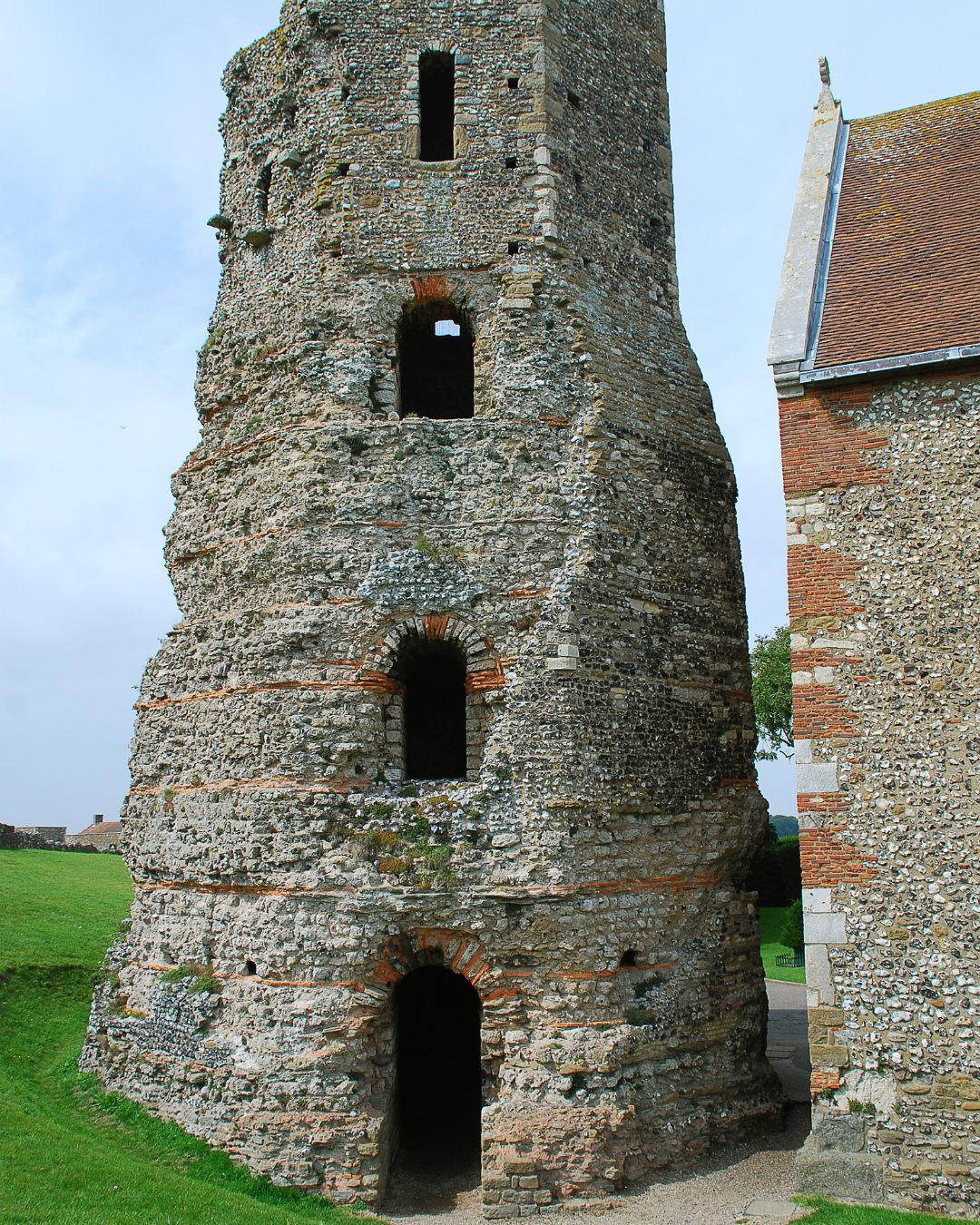
Just take a look at the magnificence of the Roman Lighthouse at Dover – the oldest in England.
Staying with the Romans, some marble fragments are giving an insight into Emperor Hadrian’s diary.
Further east in the Roman Empire archaeologists have uncovered a Roman amphitheatre with blood red walls.
A medieval historian appears to have recognised a new source about the Norman Conquest of England, and it was hiding in plain sight.
Laying to rest the myth that the medieval Kerrs were left-handed and that spiral staircases were always built to advantage the defender.
People
In an interview for the Big Issue, Professor Alice Roberts says she got side-tracked into academia.
Why do we always think that terminally single (and childless) women are unfulfilled, because they’re often happier?
Shock, Horror, Humour, Wow!

And finally two amusements. First one young lady pots up her Lego succulents.
And finally, finally someone has installed a urinal on the side of Sonning Bridge over the River Thames.

OK, guys & gals, time for my August collection of recently encountered quotes.
I have a difficult relationship with regeneration projects. All around me I watch as multi-million pound businesses build massive, overpriced penis extensions that loom over the patchwork of housing estates below, waiting to jizz all over them until at some stage, everyone will live on a dinghy in the Thames and have to catch eels with their toes to survive. The theme in Canary Wharf is to build empires of plate glass in which thousands of feet of marble clad floor are troubled only by a potted fig and three, uncomfortable Japanese chairs which nobody is allowed to sit on. Wealth here is measured by how much space you can squander.
[Katy Wheatley; https://katywheatley.substack.com/p/where-plaistow-patricia-meets-vera]
1. History is not there for you to like or dislike.
2. History is there for you to learn from it.
3. History offends you? Even better. Then you are less likely to repeat it.
Please read this out loud, then read it again. Then teach it to your children and grandchildren.
[Andrea Junker]
Surround yourself with people who make you happy. People who make you laugh, who help you when you’re in need. People who genuinely care. They are the ones worth keeping in your life. Everyone else is just passing through.
[Taylor Swift]
Human, the only species on Earth that shames its own body.
[Kendree Miller, Photographer]
“My motives, as ever, are entirely transparent.”
Hughnon reflected that “entirely transparent” meant either that you could see right through them or that you couldn’t see them at all.
[Terry Pratchett; The Truth]
“In our world,” said Eustace, “a star is a huge ball of flaming gas.”
“Even in your world, my son, that is not what a star is, but only what it is made of.”
[CS Lewis; The Voyage of the Dawn Treader]
What Orwell feared were those who would ban books. What Huxley feared was that there would be no reason to ban a book, for there would be no one who wanted to read one. Orwell feared those who would deprive us of information. Huxley feared those who would give us so much that we would be reduced to passivity and egoism. Orwell feared that the truth would be concealed from us. Huxley feared the truth would be drowned in a sea of irrelevance. Orwell feared we would become a captive culture. Huxley feared we would become a trivial culture, preoccupied with some equivalent of the feelies, the orgy porgy, and the centrifugal bumblepuppy.
As Huxley remarked in Brave New World Revisited, the civil libertarians and rationalists who are ever on the alert to oppose tyranny “failed to take into account man’s almost infinite appetite for distractions”.
“In 1984“, Huxley added, “people are controlled by inflicting pain. In Brave New World, they are controlled by inflicting pleasure.”
In short, Orwell feared that what we hate will ruin us. Huxley feared that what we love will ruin us.
[Neil Postman, Amusing Ourselves to Death]
“You know why trees smell the way they do?” Murphy asked, looking up from her hammering.
“Sap?” Logan guessed. “Chlorophyll?”
Murphy shook her head. “Stars. Trees breathe in starlight year after year, and it goes deep into their bones. So when you cut a tree open, you smell a hundred years’ worth of light. Ancient starlight that took millions of years to reach earth. That’s why trees smell so beautiful and old.”
[Frances O’Roark Dowell, Where I’d Like to Be]
Tranquillity comes when you stop caring what they say. Freedom comes when you stop caring what they think.
[Marcus Aurelius]
If having a soul means being able to feel love and loyalty and gratitude, then animals are better off than a lot of humans. You’ve nothing to worry about there.
[James Herriot]
Have you ever heard that patter-pitter of tiny feet? Or the dong-ding of a bell? Or hop-hip music? That’s because, when you repeat a word with a different vowel, the order is always I A O. Bish bash bosh. So politicians may flip-flop, but they can never flop-flip. It’s tit-for-tat, never tat-for-tit. This is called ablaut reduplication, and if you do things any other way, they sound very, very odd indeed.
[Mark Forsyth, The Elements of Eloquence]
Meanwhile, time goes about its immemorial work of making everyone look, and feel, like shit.
[Martin Amis, The Information]
[NYT] couldn’t show any vibrators. America is a puritan country, remember? We have all these uptight evangelicals here.
[Marilyn Minter, interviewed in The Guardian; https://www.theguardian.com/artanddesign/2023/aug/16/an-honest-depiction-of-elder-sex-marilyn-minters-best-photograph]
When the power of love overcomes the love of power the world will know peace.
[Jimi Hendrix]
I can write down a few words and make people thousands of miles away, whom I have never met and will never meet, laugh tears of joy and cry tears of true sorrow for people who do not exist and have never existed and never will exist. If that isn’t actual literal magic I don’t know what is.
[Neil Gaiman]
Here are the answers to this month’s five quiz questions. If in doubt, all should be able to be easily verified online.
August Quiz Questions: Mythology & Religion
Answers were correct when questions were compiled in late 2022.

This year our Ten Things column each month is concentrating on science and scientists.
Where a group is described as “great” or “important” this is not intended to imply these necessarily the greatest or most important, but only that they are up there amongst the top flight.
Great Chemists
It is the mark of an educated mind to be able to entertain a thought without accepting it.
[Aristotle]
Our monthly look at what happened 100 years ago.
On this day, 3 August 1923 …

Again this year we’re beginning each month with five pub quiz style questions, with a different subject each month. They’re not difficult, but it is unlikely everyone will know all the answers, so hopefully you’ll learn something new, as well as have a bit of fun.
August Quiz Questions: Mythology & Religion
Answers will be posted in 2 weeks time.