
All posts by Keith
Quotes
Another in our series of interesting, thought-provoking or humourous quotes recently encountered.
Each toy seems prologue to some great amiss.
[Hamlet IV, v]
Self-confidence doesn’t consist of knowing for sure something will go well. It has more to do with relaxing with the certainty that you can handle uncertainty, even if that means some kind of failure.
[Mark Tyrell]
All the things that truly matter — beauty, love, creativity, joy, inner peace — arise from beyond the mind.
[Eckhart Tolle]
She never looked nice. She looked like art, and art wasn’t supposed to look nice; it was supposed to make you feel something.
[Rainbow Rowell, Eleanor & Park]
Books en masse are more than a library, they are a statement of identity.
[Mark Miodownik, Stuff Matters]
Friendships must be built on a solid foundation of alcohol, sarcasm, inappropriateness and shenanigans.
[Source unknown]
The wise man is one who knows what he does not know.
[Lao Tzu, Tao Te Ching]
The greater the ignorance the greater the dogmatism.
[Sir William Osler]
If you are distressed by anything external, the pain is not due to the thing itself, but to your estimate of it, and this you have the power to revoke at any moment.
[Marcus Aurelius]
Amidst al the shoppinge and eatinge, remembir whatte the holidayes are trewely aboute: fightinge off the wolf who hath stolen the sun.
[Chaucer Doth Tweet, @LeVostreGC on Twitter]
Nothing will ever be attempted if all possible objections must first be overcome.
[Samuel Johnson, 1759]
Life is not a problem to be solved, but a reality to be experienced.
[Soren Kierkegaard]
When nothing is done, nothing is left undone.
[Lao Tzu, Tao Te Ching]
Your Interesting Links
Our catch-up of interesting articles you may have missed. Some of these are left over from Christmas. So, in no special order:
Rob Dunn on the evolution of the traditional Christmas mistletoe.

While we’re on mistletoe, here’s an piece which wonders about the actual purpose of kissing and why we do it.
Belgium’s Trappist beers are apparently under threat because the Trappist Brothers are dying off and the monasteries aren’t attracting enough new recruits.
The Bank of England is going to start issuing plastic banknotes in 2016. Why does it take so long? Why not 2014?
Ever thought your cat was up to no good? Not compared with these kleptomaniac cats. At least ours only steals contraband from within the house!
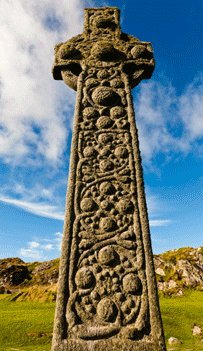 Here’s a round-up of ten extraordinary sacred sites from around Britain.
We all know the feeling: time flies by faster as we get older. But why?
Here’s an American who is maybe the world’s most acclaimed nipple tattoo artist. No it probably isn’t quite what you think!
Ben Goldacre has written an interesting little foreword to the new Romney Hythe and Dymchurch Railway guidebook.
Just 11% of Americans admit to doing their shopping in the nude — well at least their online shopping! Knowing the prudishness of most Americans I’m surprised it is so high. But why wouldn’t you shop in the nude?
So how and just where in the body do we feel emotions. As always, scientists are investigating and it turns out to be rather interesting.
What did 16th century painter Michaelangelo have for lunch? Well now we know because one of his illustrated shopping lists has been found.
Back to America. Who actually did discover America? It seems to be becoming less and less certain. History Today muddies the waters still further.
In another piece from History Today Stephen Cooper takes us to task for having a negative view of the Medieval Period and wants us to stop using “medieval” as a pejorative.
One doesn’t think of great authors like George Orwell being domestically inclined, but here are a couple of typescript pages from Orwell’s 1945 essay “British Food” which has recipes for Plum Cake and Christmas Pudding.
And finally, on a less wholesome note, here’s the annual survey of what Americans got stuck in the bodily orifices last year. I do worry about the mental age of most Americans!
Book Review
Mark Miodownik
Stuff Matters: The Strange Stories of the Marvellous Materials that Shape Our Man-Made World
(Viking; 2013)
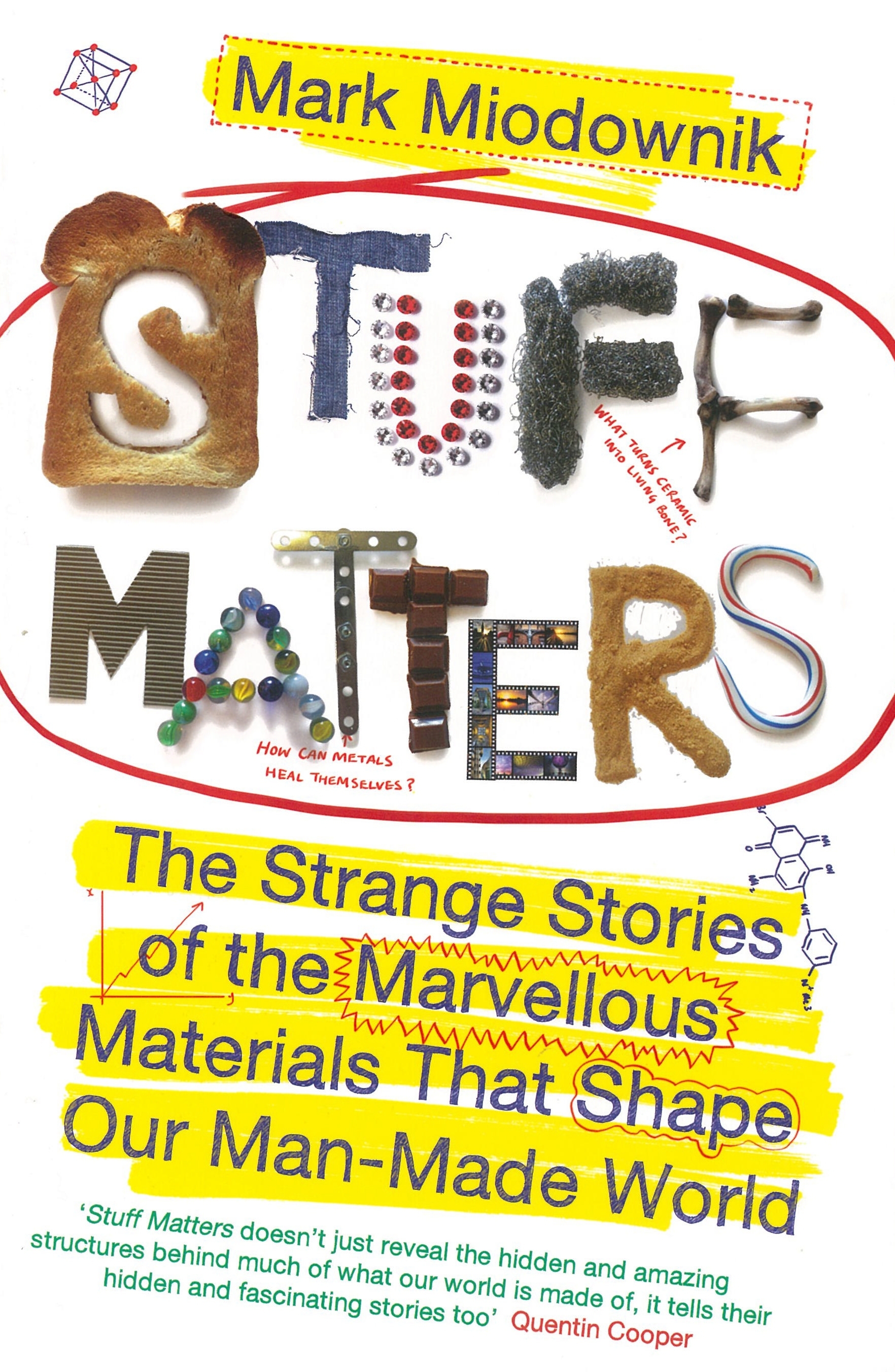 This was one of the recent crop of accessible science books which I wanted to read. From the reviews it sounded amazingly interesting. And yes, it was interesting but for me not amazingly so.
Sure, I learnt a lot. I didn’t know about how concrete works, nor about stainless steel or porcelain, and certainly not about aerogel.
But nevertheless I found the book rather unsatisfying. I’m not sure if this is Miodownik’s rather bland style or whether it is because the content is pitched too low for me. Maybe both. I could certainly have taken more technical detail, but then I guess I’m not the prime target audience. And I wanted far more in the way of explanatory diagrams.
On top of that I didn’t find the book a pleasant object. Not downright nasty but unsatisfying. There is lots of text on poor-feeling paper. The few illustrations are equally poor and all in black & white. The linking photograph, around which Miodownik hangs the text, is unintelligible because too small, lacking in contrast and in detail. I wanted better paper, better and more illustrations and diagrams, and for them to be in colour.
All of which is a shame as the book should, and could, have been so much more enjoyable and so much more memorable. The content, which in isolation is interesting, deserved better.
Overall Rating: ★★☆☆☆
Royal Institution Christmas Lectures
I watched, as I always do, this year’s Royal Institution Christmas Lectures (BBC4, 28,29,30 December), given by Dr Alison Woollard under the title “Life Fantastic: Am I a Mutant?”. They were essentially about (human) developmental biology.
Lecture 1. Revealed how the transformation from a single cell into a walking, talking, multi-trillion-celled organism we call the human body takes place.
Lecture 2. Looked at how diversity in the natural world has come from genetic mutation, explored how species adapt and change to survive and at the evolutionary theories of Charles Darwin.
Lecture 3. There’s one certainty in life: death. Every living thing eventually dies. But why? How do cells know when to stop living? What happens when they age? And are there ways of halting that process?

RI Auditorium: Christmas Lectures 2010
Now I know I’m a scientist and way above the experience level of the target audience (young teenagers), but I am not an expert on cell biology so I should be able to learn things. But I didn’t. And I found the series dull and pedestrian (although better as it went on) — which has been a feature of the RI lectures in recent years.
This is partly down to the lecturers. I found Woollard’s style wooden and lifeless, especially in the first lecture; for someone who professes to be excited by what she was talking about there was little or no trace in the delivery. It was almost lecturing by sound-bite. And she was easily upstaged at the end of the first lecture by Prof. Sir Paul Nurse, who frankly should have been giving these lectures as he is clearly a natural communicator.
But the pedestrian nature of the lectures is also in part down to the way they have been dumbed down over recent years. Years ago there were six lectures in the series and the audience were expected to crane their necks to understand, but at the same time they were taken on a much better explained journey — logical step by logical step — with lots of practical demonstrations and models. In recent years the lectures have been commercialised, gradually reduced in number to the present three and made bland. The audience are now spoon fed a series of facts in vaguely connected steps with little useful explanation or demonstration of how one gets from A to C. Clearly the kids are not expected to be able to follow logic, understand demonstrations or have to crane their necks to understand. And I feel damn sure many don’t understand and can’t follow what’s going on.
Let me give a trivial example. At the start of lecture one Woollard bombarded the auditorium with 200,000 pieces of confetti, which scarcely created a carpet, and compared this with the 40 trillion cells in the human body. OK, as Woollard said, to create that number would take 6 years at the rate of 200K/second. I find this a useless comparison because it relates to nothing tangible — who can really envisage what 6 years is like? Wouldn’t it be better to point out that if this is 200K pieces then 40 trillion would fill the auditorium (how many times over?) and that the 200K wouldn’t even be enough cells to make your little finger? This can be related to things the audience can see and relate to. Isn’t that a more easily understood, because more tangible, comparison? It is really hard, even for me, to relate to the sheer scale of 40 trillion!

Christmas Lectures 2013
OK I understand in part why this dumbing down has happened. There is a level of scaredness that something might go wrong with a demonstration and someone get hurt. Has this ever happened during the lectures? I very much doubt it.
There is also the question of cost. These lectures are not cheap to stage. Apart from taking the lecturer away from their day job for an extended period to prepare, there is the cost of building and acquiring all the demonstrations as well as the several technicians that are required to do it. We are talking about a cost well into five, probably six, and maybe even seven figures. That money has to come from somewhere which is why the lectures have been commercialised through sponsorship and reduced in number.
In my view this dumbing down has to change if we really are going to inspire the next generation of scientists. I have no problem with funding these lectures, at least in part, through sponsorship; given the cost that is sensible as long as the sponsor isn’t calling the tune. But wouldn’t it be a great idea if the Department of Education contributed the equivalent of a couple of headmasters’ salaries each year? — a flea-bite in the overall education budget, but surely a significant contribution to bringing on the next generation of scientists. If this happened we could go back, as I believe we should, to a series of six lectures, with really inspirational lecturers who are also great communicators, and proper “wow, so that’s how it works!” demonstrations.
I’m thinking of the great lectures of some years ago: eg. Prof. Eric Laithwaite (engineering, 1966 & 1974) and David Attenborough (animal communication, 1973). Who do we have now to come up to their standard? Well let’s start with Prof. Sir Paul Nurse, Prof. Steve Jones, Prof. Alice Roberts. We need inspirational lecturers; recent years have seen too many who really aren’t.
But I seem to be in a minority of one. From what I see on Twitter, and elsewhere, the modern generation of young scientists lap up these lectures and think they’re brilliant. Maybe they are if you’ve been brought up on yoghurt and fish fingers. I believe that kids need to be brought up on something more substantial; you build robust adults by feeding them roast beef and proper vegetables. The same is true of scientists.
2013 In Review à la mode d'ici
We present our round-up of some of the curiosities which have come our way during the last year.
eBay Auction Item of the Year
Medieval Victorian Piano at Ingatestone Hall Essex Postcard
Excellent Name of the Year is awarded jointly to:
Roger Kneebone, Professor of Surgical Education, Imperial College, London
Daniel Shittu, Millwall footballer
Meaningless Neologism of the Year
Innovation ideation process. Thanks to Sue for that one.
Book Titles of the Year
Goblinproofing One’s Chicken Coop by Reginald Bakeley (Bookseller / Diagram Prize for Oddest Book Title, 2013)
How Tea Cosies Changed the World by Loani Prior
Greek Rural Postmen and Their Cancellation Numbers (1994) (Bookseller / Diagram Prize for Oddest Book Title, 1996)
Practical Skunk Raising by William Edwin Pratt (1915)
You can find them all on Amazon UK.
Academic Paper of the Year is awarded jointly to:
“An In-Depth Analysis of a Piece of Shit: Distribution of Schistosoma mansoni and Hookworm Eggs in Human Stool”; Stefanie J Krauth et al.; PLOS Neglected Tropical Diseases; December 2012
“Toilet Hygiene in the Classical Era”; Phillippe Charlier et al.; BMJ; December 2012
TV Programme of the Year
Nothing has yet beaten last year’s winner: Pointless Celebrities (BBC1)
Online Video of the Year
The reaction to my vaginal knitting shows society is still telling a woman what to do with her body; Independent; 17 December 2013
Headlines of the Year
Hotel offers goldfish for lonely guests; Daily Telegraph, 11 April 2013
n exciting new chapter in the life of suave Tony Blair (sic); Daily Telegraph; 10 February 2013
Penis enlargement ad banned after ‘inadequacy’ complaint; Daily Telegraph; 19 February 2013
David Cameron leaves us with a ‘Tantric’ time bomb; Daily Telegraph; 26 January 2013
Is it a Mop Handle or a Penis?; Court News UK
Happy New 2014
Happy New Year
May you have a peaceful and prosperous 2014!
Weekly Photograph
A photograph this week to cheer us all up on this miserable, grey, wet ad windy almost-last-day of the year. This red rose was taken (rather longer ago than I thought!) at Kew Gardens — worth a visit at any time of year, but especially when the roses are at their best in late-May/early-June.

Red Rose 3
Kew Gardens; June 2008
Book Review
Dr Tony Bleetman
Confessions of an Air Ambulance Doctor
(Ebury Press, 2012)
I was given a paperback of this book as a Christmas present, which was good as it was one I wanted to read. And who wouldn’t when the blurb on the back cover says:
Drug addicts, lorry crashes, open heart surgery, stab wounds, headless chickens, mating llamas and strip routines — it’s all in a day’s work for emergency doctor Tony Bleetman and his team …
Confessions of an Air Ambulance Doctor is a dramatic behind-the-scenes account of life onboard an air ambulance. Whether they are landing in the middle of the M1 or at a maximum security jail, Tony and his crew Helimed 999 are first on the scene in the most critical of emergencies.
This gripping read will make you laugh, cry and marvel at the wonders of life (and death) in equal measure.
The book certainly lives up to its billing.
Bleetman starts off with stories of the initial days for setting up the first UK Helimed service outside London — that’s no ordinary Air Ambulance but one which carries a trauma doctor plus paramedic rather than two paramedics. Experience has shown that having a trauma doctor on-board does save lives, because they are able to do so much more to help really seriously ill patients than even paramedics can.
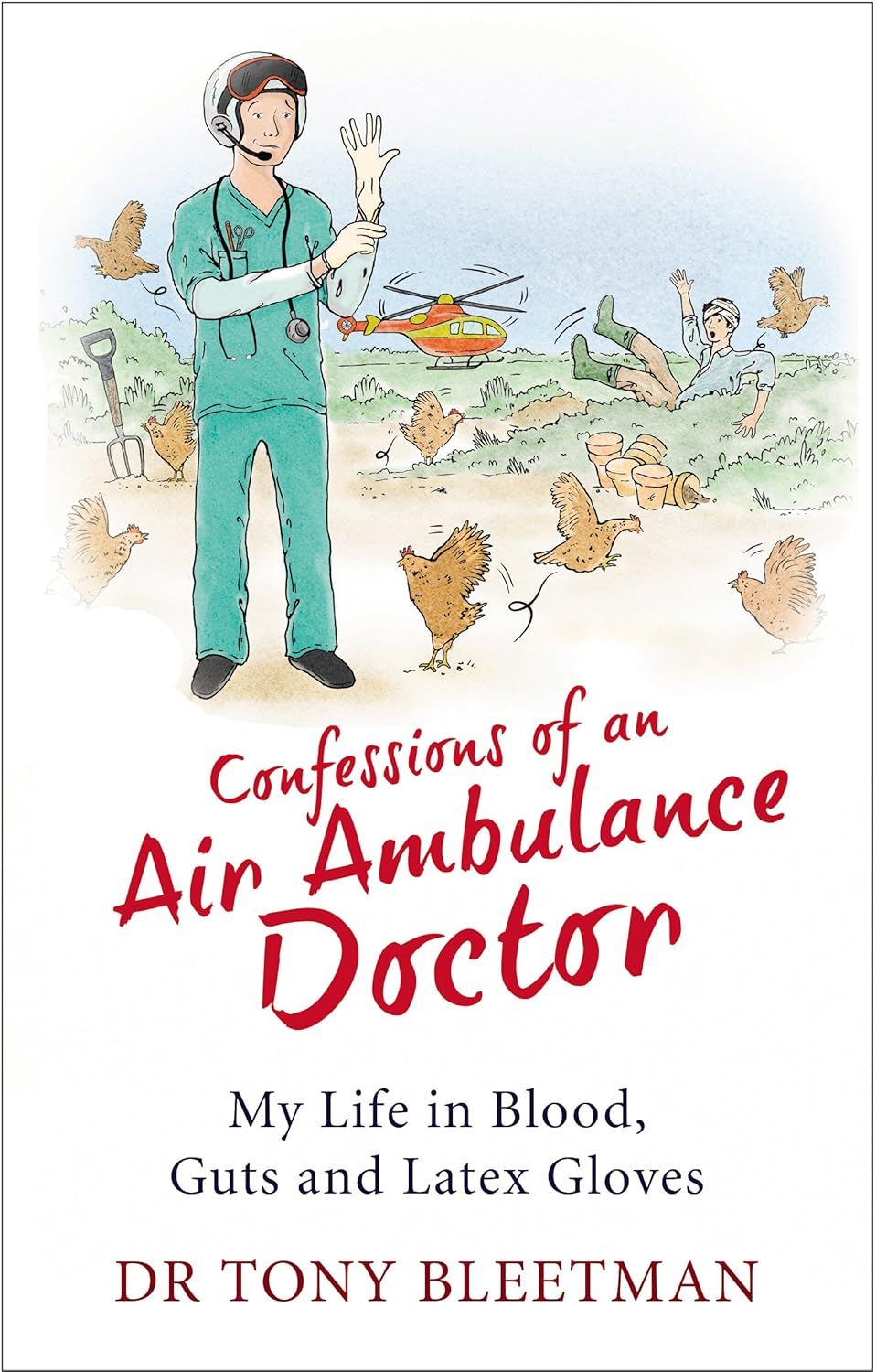 And that is hardly surprising when one reads of some of the major surgical interventions that were done on-site by the side of roads and in fields — and yes that does include things like open heart surgery! Which is really scary when one considers that one would not normally want to have this done even in the controlled environment of a hospital operating theatre with three or more surgeons and a full theatre team present. Whereas here this is all done by one trauma surgeon and a paramedic (albeit a super-trained one) in the field with no sterile environment.
Yes I was surprised, amazed and really impressed by some of the things they were doing out in the wild. But when Bleetman tells you about saving severely injured casualties, who would not otherwise have survived to be put in a land ambulance, let alone got to hospital, you have to be impressed and immensely grateful …
… And even more immensely grateful because all of this (with the exception of the paramedics who are paid by the local Ambulance Service) is funded by charity and by doctors giving up their free time for no reward except the satisfaction of helping people. Yes, that’s right, none of this, except the paramedics and, I assume, the drugs, is funded by the NHS! The helicopter, its fuel, the buildings required — ie. all the running costs and capital spend — is all down to big companies and people like us being generous. Which when you consider they would often fly up to six jobs a shift with fuel at £1000 a flying-hour; a helicopter costing millions; and that this is replicated across around two dozen services in the UK means a lot of cash has to be found.
But what about the book? As you might expect it is full of tales of derring-do — real Biggles flying ace stories with a lot of serious (and often bloody) medical stuff added on top. Medical teams are put in positions we have no right to expect them to go (upside down in filthy ditches full of petrol), and they’re almost constantly hampered by officious firemen, police and on-lookers whose objective is to get people out and get things moving and unable to see that doing so will kill the casualty. No wonder these people regularly get called “Muppets” (and that’s the polite version) to their faces.
If you can stomach the medical bit then this is a light but engaging read which I found it hard to put down.
Overall Rating: ★★★★☆
Coming up in January 2014
This is, I hope, going to be a new monthly feature. My intention is that towards the end of each month to post a listing for the following month. The listings are likely to contain an eclectic mix of interesting anniversaries, historical events, red letter days and upcoming interesting (to me) “awareness events”, mostly UK-centric. As such this will replace the individual listings I’ve been posting erratically over the last year or more and allow me to add in days when traditional celebrations happen.
So let’s start off with what’s coming up for January 2014.
1 January
New Year’s Day. The first day of the new year and one of the important days for the wassailing of apple trees. Read more here >>>>
New Year’s Day has been a public holiday in the UK only since 1974. When I was young, before this was a public holiday, it always seemed daft to me that everyone went to celebrate and drink the New Year in, but we were then expected to be able to get up and go to work the following day.
First UK Shipping Forecast broadcast, 1924.
5 January
The Twelfth Day of Christmas and hence (in my book) Twelfth Night when all Christmas decorations have to be taken down, or left up until next year so as to avoid bad luck. The day is also sometimes known as Wassail Eve, being one of the occasions when we traditionally wassail our apple trees to encourage them to crop well this year.
6 January
Epiphany, the day the Western Christian Churches celebrate the visit of the Magi to the infant Jesus.
Old Xmas Day. In the old Julian Calendar this was 25 December, Christmas Day.
This is also the day when most people, and most traditions, celebrate Twelfth Night and is thus an important day for wassailing apple trees.
7 January
Eastern Orthodox Christmas Day. Because the Eastern Orthodox Churches still follow the old Julian Calendar this is the day on which their Christmas now falls.
Marriage of Princess Matilda, 1114. 900 years ago today the 12 year old Princess Matilda, grand-daughter of William the Conqueror, was married to the Holy Roman Emperor, Henry V at Worms. Following the death of Henry V in 1125, Matilda married Geoffrey Plantagenet, heir to the Count of Anjou. Their son later became Henry II of England. Read more here >>>>

Daguerreotype of Louis Daguerre in 1844
by Jean-Baptiste Sabatier-Blot
9 January
Birth of the Daguerrotype, 1839. On this day Louis Daguerre introduced the first publicly announced photographic process, which was to be named after him. Read more here >>>>
11 January
Old New Year’s Eve.
Birth of Sir James Paget Bt, 1814. Surgeon and pathologist who is best remembered for Paget’s disease, a chronic disorder of bone mis-growth. Paget was born in Great Yarmouth and is today commemorated in the name of the local hospital. Read more here >>>>
Charing Cross Station opened, 1864. Read more here >>>>
13 January
Plough Monday is the Monday after Epiphany. It marks the resumption of agricultural work after the Christmas festivities. In some areas of England the farm labourers toured the villages with their plough in a money-raising trip, perhaps with singing, mumming plays and dancing. Read more here, here and here >>>>
18 January
Winnie the Pooh Day. The annual celebration of the birth in 1882 of AA Milne, creator of Winnie the Pooh.
19 January
Birth of painter Paul Cezanne, 1839.
World Religion Day. Founded in 1950 the aim is to unite everyone, whatever their faith, by showing us all that there are common foundations to all religions and that together we can help humanity and live in harmony. Read more here >>>>
20 January
Blue Monday. At a time of year when we all need cheering up Blue Monday is a special day for people to focus on doing good for each other. Not necessarily presents and cards, just small (or large) acts of kindness.
24 January
Global Belly Laugh Day. Go on, cheer yourself up, have a good laugh. Read more here >>>>

Robert Burns by Alexander Nasmyth
25 January
Burns’ Night. The annual celebration of Scotland’s most famous poet, Robert Burns (1759–1796) held on his birthday. Celebration includes the eating of haggis and the drinking of whisky. Read more here >>>>
26 January to 1 February
Farmhouse Breakfast Week. Breakfast is, we are told, the most important meal of the day and what could be better than a full English farmhouse breakfast? This is a week to celebrate and indulge in just that! Read more here >>>>
31 January
Chinese New Year. 2014 is the year of the Horse.
More next month!