All posts by Keith

I’m a controversialist and catalyst, quietly enabling others to develop by providing different ideas and views of the world. Born in London in the early 1950s and initially trained as a research chemist I retired as a senior project manager after 35 years in the IT industry. Retirement is about community give-back and finding some equilibrium. Founder and Honorary Secretary of the Anthony Powell Society. Chairman of my GP's patient group.

Weekly Photograph

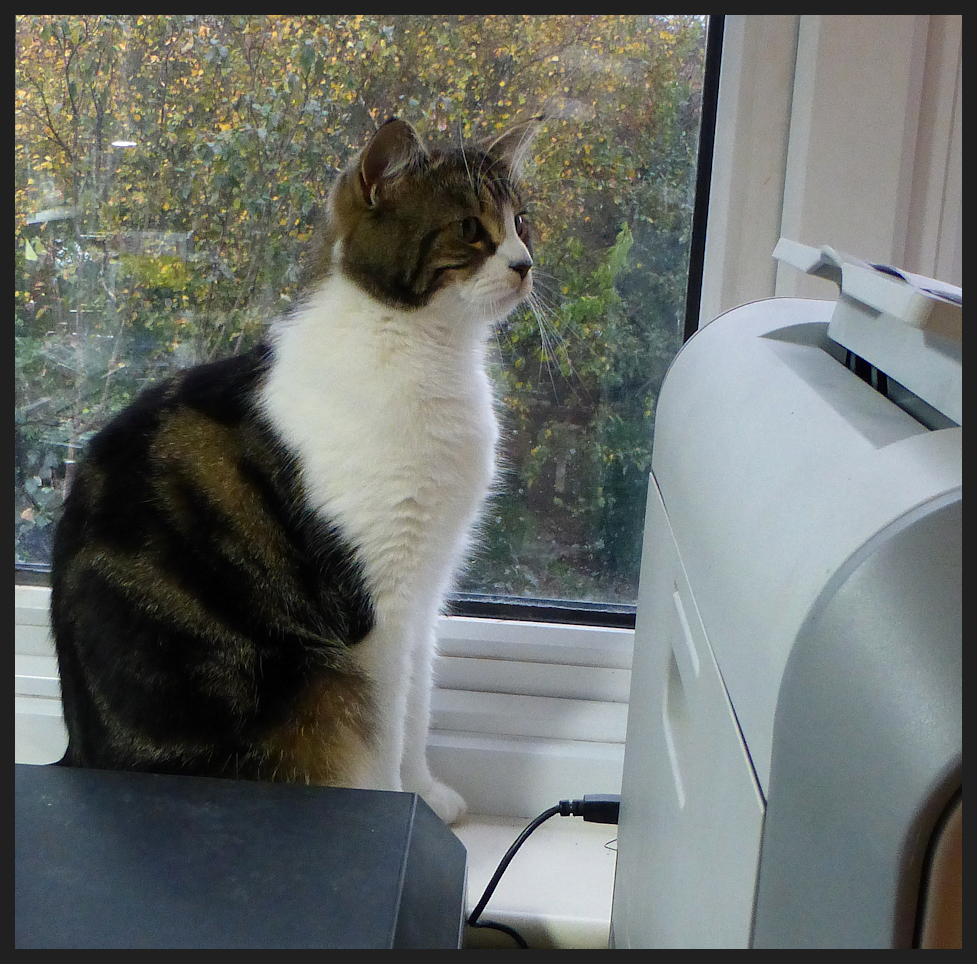
This week it’s time for more pussy porn, so here’s Tilly the Cat again. She hates my printers; they have to be watched ans supervised:
“I must watch this rotten printer. I don’t trust it. It makes funny noises. I’m worried it’s turning into a hoover!”

On Printer Watch
On Printer Watch
Greenford; November 2015

Thinking Thursday #2 Answer

This week’s Thinking Thursday post asked you to make sense of

11 was a racehorse
12 was 12
1111 race
12112

Well it’s all down to how you read it. How about:

Eleven was a racehorse,
Twelve was one too.
Eleven won one race,
Twelve won one too.

Hat-tip Marcus du Sautoy who provided this in his book Finding Moonshine.

Word: Trailbaston

Trailbaston
Originally a class of violent evil-doers in the reign of Edward I, who, as brigands or hired ruffians, bludgeoned, maltreated, and robbed the king’s lieges, during his absence or absorption in foreign wars.
It was also applied to their system of violence, for the suppression of which special justices were instituted in 1304–5. And thence the term was applied to the ordinances issued against said brigands, and to the inquisitions, trials, courts, and justices appointed for their suppression.
So trailbaston was a special type of itinerant judicial commission first created during the reign of Edward I and used many times thereafter during the reigns of Edward II and Edward III, primarily to punish felonies and trespass at the king’s suit.
The declared intention of the trailbaston commissions was to combat increasing levels of violence and public disorder, but an added bonus for the crown was the revenues brought by forfeiture, which was the punishment for conspiracy.
The first trailbaston commissions date back to 1305, when Edward I directed several teams of justices to visit each English county and seek presentments for felonies and certain trespasses. This was extended in late 1305 and revamped and it’s scope widened considerably in 1307.
The term was in living use from 1304 to about 1390 and has survived only as an often misunderstood historical expression.
Trailbaston ultimately derives from the Old French traille, to trail + baston, a stick, club or cudgel; so literally “one who trails or carries a club or cudgel”.

Thinking Thursday #2

Hot on the heels of our first Thinking Thursday post, here’s the second puzzle in this irregular series.

Make sense of the following:
11 was a racehorse
12 was 12
1111 race
12112

As before there’s no prize for correct answers other than the fun of taking part, but I would love it if you put your answer in the comments.
As before, I’ll post the answer on Sunday evening.

Oddity of the Week: Carrots

The claim that carrots can help your vision would seem to have some pretty solid scientific grounding. Retinal is essential for vision, and the beta-carotene in carrots offers a compound from which our body can produce the retinal our eyes require. However, eating carrots will only improve your eyesight if you are vitamin A deficient.
It turns out that the idea that carrots can improve your eyesight has its roots in a bit of British propaganda from World War II. After successfully using a new radar system to locate and shoot down German bombers, the British forces came up with the entirely false campaign stating that their pilots were eating carrots to improve their night vision in order to hide the existence of the radar system from the Germans. This campaign of disinformation was so successful that it took root and persists today.
From Can carrots help you see in the dark?

Weekly Photograph

This week another photograph from the archives. And this is a very old one, dating as it does from April 2001 when the Anthony Powell Society held its first ever conference in the Farrar Theatre at Eton College. This piano was resting quietly in the theatre foyer.

Piano
Piano
Eton College; April 2001
Click the image for larger views on Flickr

Thinking Thursday #1 Answer

So in our first Thinking Thursday post I asked the question:
What says 0123, 1234 and 2345 but never 3456?
And the answer, as you will all have worked out, is something quite common and which most of us will have in our homes: a 4-character digital clock.
For the benefit of this who still don’t get it, here’s the logic.
0123 hrs is in the middle of the night
1234 hrs is lunchtime
2345 hrs is bedtime
And because we have a 24 hour clock 3456 hrs cannot exist — unless of course your clock is broken (and broken clocks don’t count).
Watch out for the next Thinking Thursday puzzle.

Auction Oddities

We’ve not had a collection of the weird and wonderful from our local auction house recently. Their last sale was on the whole quite dull, although with a small number of oddities. But their upcoming sale provides a good selection of the eccentric.
As always it is not just the strange things which people sell (and presumably buy) but also the wonderful collections of things which auctioneers seem to think go together to make a lot — and the way they describe them. And as with so many things the sting is often in the tail.
Anyway here is a selection from the last sale, and the upcoming one.
(Oh, and if you wonder about the spelling, punctuation and grammar, this is exactly as copied from the online catalogue!)
A British soldier’s helmet, c.1976, and the 1939-45 and Italy Stars, also the Defence Medal and 39-45 Medal
A late Victorian silver piecrust waiter, London 1899
A humorous corkscrew comprising a pair of Victorian stockinged legs, ‘Compliments B&L Salloon’, a naked lady bottle opener, and an embossed brass vesta case commemorating the Louisiana Purchase, 1904
Nine old oil cans to include Shell
Eleven Limoges “Bouquet Medicis plates decorated with flowers, a large Russian figure of a Giraffe, a Spanish figurine of a gent, spelter figurine of a horse, a small quantity of brassware to include vases, kettles, candlesticks, trivets etc., a Doulton Bunnykins plate, a 1970’s Donald Duck toy with jointed limbs and a Seiko Quartz Westminster Wittingham drop dial wall clock
A table lamp styled as a horses head with shade
A 1930’s glass dressing table set on tray, two glass jelly moulds, fruit bowls, trays etc., ruby glass vase, a quantity of decorative jugs to include Brixham pottery, floral decorated etc., a Rhapsody Ellgreave vase, a T&G Booth pot, a brass Ferndale Coal miners lamp, a horn handled corkscrew, small quantity of flatware and a wooden card case etc.
A Carltonware Rouge Royale sauce boat on stand, a large Carltonware vase and cover and another smaller decorated with oriental scenes, two wooden biblical figurines, plus a further African carved figurine etc.
A Tobias and the Angel tapestry cat door stop and further Tobias and the Angel Christmas heart cloth decorations, along with cloth fishes, slippers etc., a pretty dog embroidered blanket, a collection of brooches to include butterflies, dragonflies, floral etc., a Jay Strongwater pewter poodle, a Ticher pewter poodle, a ceramic toadstool plus another in fabric, a green brass candlestick with green shade embellished with brooches and two further decorative lamp shades, a wicker basket and a sewing box etc.
An old guitar, a quantity of wicker dolls chairs and baskets, a large oriental wall fan, metal fire surround, a vintage wooden bird cage and a metal vintage dolls crib and a pine trunk
An antique brass fireman’s helmet
A 1918 Beck mark IX trench periscope
An old iron single furrow plough.
A large oil of fishermen harvesting shellfish with horse and cart …
Not sure that a net wouldn’t be an easier way to catch shellfish!
A finely carved ivory group of 7 monkeys
An old penguin teething ring …
You probably knew, but I didn’t, that penguins needed teething rings.
A charming late Victorian small liqueur decanter in the form of a duck, in glass with silver head … Birmingham 1895
Three antique wooden planes and one antique spokeshave plus a 9 piece collection of glass animals including birds and foxes.
A collection of approximately 23 decorative masks to include African wooden carved, wooden oriental, oriental brass, Chinese, etc …
Two stuffed pheasants, one male one female.
A figural eight piece jazz band set plus drums and piano.
A box of 19th century hand tools including drills, saws, planes, an originally boxed Rentokil woodworm treater plus a 19th century folding rule, a Poole pottery part tea service, quantity of flatware, a leather cased Ensign Ranger ii camera, a Mauchlin ware letter opener, small quantity of mother of pearl handled cutlery, a cased set of silver plated teaspoons
An old AA badge and a CBM similar, Victorian photograph album, two Parker pen desk inkstands, one boxed, two Indian cloth dolls, an old toasting fork, a brass engraved box, a leather cuff box containing six silver half crowns, a boxed set of Dorwin dart flights and a Sparklets Corkmaster.
A vintage elephant foot waste paper basket
A 19th century ten-step wrought iron spiral staircase, made by Haywood Brothers Union Street London
A very large and impressive carved stone Celtic cross on base
A 19th century Olympia typewriter with skeleton keys
“Skeleton keys”? I think they might mean “shift keys”
An old canvass covered cabin trunk containing two saws, an old petrol can and two rugs, bearing labels Singapore etc.
Five vintage fruit boxes including one by C.Stuchbury Northwood, others carrying South African grapes and New Zealand Apples
A stereo integrated turntable ampli tuner, a set Luca Russo sunglasses, a portable typewriter, three Guinness advertising figures one being Jimmy Hill and a cased set of old butterflies
An old metal art nouveau desk lamp, pewter hip flask, a quantity of brass ornaments and metal wares, a large pair of metal tailors scissors, decorative metal boxes and old office items plus three vintage fire extinguishers, and a box of old polishes
A selection of unopened jars of vegetables and fruit in oil

Word: Cuntline

Cuntline
No it has nothing to do with female anatomy — at least not obviously!
It is a nautical term for the “valley” between the strands of a rope or cable.
It may also be the space between casks stowed side by side.
According to Wikipedia’s “Glossary of Nautical Terms”: Before serving a section of laid rope eg. to protect it from chafing, it may be “wormed” by laying yarns in the cuntlines, giving that section an even cylindrical shape.
Although the word is not listed in my edition of the OED, it did make an appearance on the OUP Blog back in 2012.
The suggestion is that the word was originally cantline or contline, but from the few references I’ve found there doesn’t seem to be a lot of evidence for this. And of course it is always possible that, to the male nautical mind, anything with a “crack” or “crease” is going to be associated with the female pudenda.