
At last. Some people who might have some influence are finally getting the message: prohibition doesn’t work. And that by decriminalising and licensing things you can not only control them but you can tax them.
No, for once I’m not talking about sex work. This is about cannabis.
The headline in yesterday’s Guardian read:
Sell cannabis to over-18s in licensed shops, says Lib Dem panel
It isn’t quite the Dutch model, but the recommendations have been put forward by a panel of experts including a couple of top cops.
The article is worth a read.
All posts by Keith
Oddity of the Week: Not Garden Gnomes
Bored with garden gnomes?
Want something else to cheer up your front garden, and your neighbours?
Well then the AliExpress website has just the thing: erotic nude female statues like this one …

Why not start a new trend?
Bathtime
There was an interesting article in yesterday’s Guardian which bears out something I have long thought. It begins …
I shower once a week. Here’s why you should too.
Daily showering is expensive, polluting and unnecessary. The old-school weekly bath or shower — with a brief daily sink-wash — is healthier for the environment, and for us.
When I was a kid, bathtime was a once-a-week affair. We weren’t an unhygienic family — this is just how most of us lived in the 1960s, and I do not remember any horrific body odours resulting from it. By the time I was an adult, I was showering every day. With hindsight, I should have stuck to the old ways.
Indeed so, although in my family bathtime was twice a week, at least for me. If nothing else heating water was inconvenient and expensive in the days before ubiquitous central heating.
As a student I did shower every morning, and often more than once a day as I was playing lots of cricket, squash etc. Otherwise I actually have stuck to my childhood regime. Although it’s a bit more flexible now (partly down to lifestyle and partly as there’s easy hot water) I seldom shower more than a couple of times a week. And even then one seldom needs to spend more than 5 minutes in the shower (according to the article the average shower lasts 10 minutes).
(Now I’m not working, I also seldom shave more than every few days. I can’t stand more than 5 or 6 days beard, but shaving every day gives me far more skin problems.)
Did anyone notice? No of course you didn’t. Most of us don’t lead very dirty lives. Few these days work in dirty industry, down the mines or shovelling muck on the farm — when I concede that a daily bath or shower, after work, would be essential.
Yes, I like that nice, clean, scrubbed and pampered feeling a shower gives you; especially if you can then dive under lovely crisp, fresh bed-linen. It’s pleasant. But it isn’t essential. And on its own it isn’t a good reason for a daily shower (or two).
This is one area where we could go back in time without actually feeling any inconvenience. It would save massive amounts of water; and you would save on the cost of heating that water — both of which would be good for the environment as well as your wallet. On top of which you would probably save some time; and it might actually be better for your skin. That sounds like WIN-WIN to me!
Oh and here’s another take on the question from a plumbing supplier.
Weekly Photograph
Another from the archives this week — a montage, inspired by David Hockney’s techniques.

Glasgow Central Station Concourse
March 2008
Click the image as you’ll want to look at the larger views on Flickr
Thinking Thursday #6 Answer
OK, so last Thursday I posed the following problem from Alcuin of York:
A man has to take a wolf, a goat and a bunch of cabbages across a river. The only boat available can accommodate just two of them at a time. It is well known that if left alone together the goat would eat the cabbages, and the wolf would eat the goat; but the man has been ordered to transfer all of them to the other side dry and in good condition. How can he achieve this?
So this is how the man did it …
First take the goat across and leave the wolf and the cabbages behind. Then return (empty) and take the wolf across. Having put the wolf on the other side, take the goat back over (remember, you can’t leave it with the wolf!). Leaving the goat on the near side, take the cabbages across. Then you can return (empty, again) and having picked up the goat take it over once more. You should now have everyone on the far bank, safe and well, and you’ve had some healthy rowing.
How many of you worked that out? Good, well done.
Now the remaining challenge is to return the boat to it’s starting point. Bright ideas on how to do that — without getting wet or damaging your charges?
If you want to know more about Alcuin’s puzzles then Can You Solve Alcuin’s Puzzles? is a good starting point.
Decriminalising the Sex Industry
There have been lots of media reports this week along the line of Jeremy Corbyn is right: decriminalising the sex industry is the way forward.
Thank God someone in political circles is getting the message.
More of this common sense please.
Something for the Weekend

Thinking Thursday #6
Here begin the problems to sharpen the young is the beginning of a wonderful text which it is believed was written by the Carolingian scholar Alcuin of York (c.735–804). The work presents over fifty mathematical puzzles many of which remain a challenge even for modern readers. Here is one of the best known, which you may well have come across before:
A man has to take a wolf, a goat and a bunch of cabbages across a river. The only boat available can accommodate just two of them at a time. It is well known that if left alone together the goat would eat the cabbages, and the wolf would eat the goat; but the man has been ordered to transfer all of them to the other side dry and in good condition. How can he achieve this?
As always there’s no prize other than the satisfaction of solving the puzzle — but do feel free to show off by putting your answer in the comments.
Answer on Sunday evening, as usual.
Oh, and no cheating!
Oddity of the Week: Not Taxidermy
Should you be of a mind, it is quite easy to buy examples of taxidermy: just go to a few local auctions and you’ll soon find all manner of creatures in glass cases.
But you can now go one better: Upholstered Faux Taxidermy Heads and Animals.
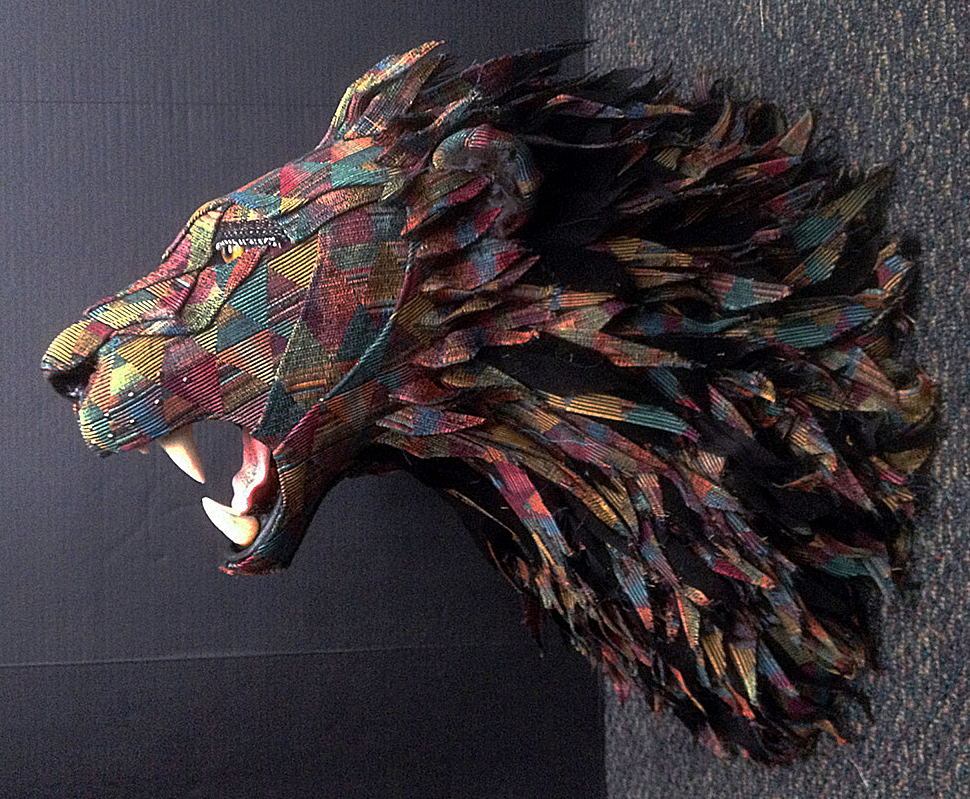
American artist Kelly Rene Jelinek fabricates life-sized replicas of taxidermied animal heads using fragments of upholstery fabric. The results are surprisingly modern sculptural objects that mimic traditional anatomical mounts.
See more on Colossal.
Your Interesting Links
Another of our monthly round-ups of links to items you may have not wanted to miss the first time round.
Science & Medicine
The Black Death, a strain of bubonic plague, wiped out an estimated 50 million people in Europe during the 14th century. But it didn’t then disappear.
Ever wondered how scientists choose those awful Latin names for species? Here’s the low-down.
We know cats are odd creatures, but apparently cats’ legs are extra weird.
Manx cats have no tail. It’s genetic, see, but that brings other problems along with it.
And yet more on cats … here are a dozen cat myths debunked.
Scientists and medics are beginning to discover (realise?) that our circadian rhythms affect the way drugs work.
Finally in this section, here’s an interview with one of our top science writers, Ed Yong, on being a science journalist.
Sexuality
Sex educator Emily Nagoski (author of Come As You Are) gave a TEDx talk on “Unlocking the Door to Your Authentic Sexual Wellbeing”. Here’s the video, and transcript.
Seems we’re too busy these days to have sex, but two minutes sexual arousal for its own sake can help a lot — apparently.
Environment
Beavers. It seems the ones in Devon are helping fight floods as well as improving the environment.

There’s been a lot of work in recent years on the intelligence of corvids. Now it seems corvids are the key to saving the world’s forests too.
Social Sciences & Business
Parenting — we all know it is tough work. But here are two articles, both from the Guardian, which might help. First “How to raise a brilliant child without screwing them up” and on a similar theme “How to get your kids to 18, sane and not hating you“.
Some thoughts on why we don’t live in a perfectly nude world?
History
Archaeologists are beginning to piece together the lost town of Dunwich which has progressively been reclaimed by the sea over the last 1000 years.
And now for several items on London’s history …
Firstly on the dissolution of London’s monasteries.
And on the two great 17th century diarists, Samuel Pepys and John Evelyn.
In his series on “Unbuilt London” IanVisits looks at the proposed Georgian Houses of Parliament.
There are lots of monsters in London, but they aren’t all scary.
Food & Drink
Why is it that some things we find tasty other cultures find disgusting, and vice versa?
Shock, Horror, Humour
And finally, IanVisits provides an entirely level-headed and rather interesting discourse on the EU referendum without coming down on one side or the other.
Another round next month.