All posts by Keith

I’m a controversialist and catalyst, quietly enabling others to develop by providing different ideas and views of the world. Born in London in the early 1950s and initially trained as a research chemist I retired as a senior project manager after 35 years in the IT industry. Retirement is about community give-back and finding some equilibrium. Founder and Honorary Secretary of the Anthony Powell Society. Chairman of my GP's patient group.

Good Deed

It isn’t often that one gets the chance to a really good deed for the day, and dig someone else out of the midden. And what’s more someone you don’t know, and will likely never meet again.
On Saturday morning I was in central London and stopped for a coffee in the Brunswick Centre. On leaving the Centre I was stopping to get some cash from the machine outside the small Sainsbury’s store. As I approached it a large, foreign-looking, middle-aged man walked away and into the Sainsbury’s store … leaving the cash machine beeping at nobody.
As I approached I could see that he’d left his money in the mouth of the machine! Duh!


Luckily there was no-one else much in the immediate vicinity. Arriving within seconds at the machine I removed the money, folded it and held onto it. I considered running after the man, but figured this would be pointless given my crocked knees, especially as he was unlikely to disappear from the store in the minute it would take me to get money for myself. So I did just that.
I then wandered into the Sainsbury’s store, easily located the man, who was quite distinctive, and handed him his notes. Needless to say he was profusely grateful.
I’ve no idea how much money was involved as I didn’t count it; it looked like about £50. I could have had a nice little bonus at someone else’s expense. But I didn’t.
However I did get something back. The satisfaction of saving some guy’s embarrassment. Oh and a £25 win on Saturday evening’s National Lottery.
It isn’t that often one gets to do a significantly good deed for a random stranger. But it feels good when you do.

MPs with some sense?!

There is hope that some MPs, at least, are beginning to see some sense.
The Commons Home Affairs Select Committee has issued an interim report on possible changes to the law on prostitution with MPs coming down on the side of decriminalisation.


According to a BBC News report they are suggesting that soliciting should no longer be a crime and that the rules on brothel-keeping be relaxed to allow prostitutes to share premises. They are however also saying that using brothels to control or exploit sex workers should remain illegal.
Note though that this is only an interim report and that the committee still needs to do more work on looking at both the Swedish model and the New Zealand model.
But if they make their current suggestions stick it will be a significant victory for common sense.

And there's more …

Yes, I’m afraid the fallout from the Brexit vote continues.
Last evening I picked up an interesting item on the BBC News feed in which the EU Trade Commissioner, Cecilia Malmstrom, points out the realities of the UK’s exit negotiations. (The article is short, very clear and worth a 5 minute read.)
The Commissioner is quoted as saying “There are actually two negotiations. First you exit, and then you negotiate the new relationship, whatever that is”. This is because:

  1. Under EU law, the bloc cannot negotiate a separate trade deal with one of its own members, hence the commissioner’s insistence that the UK must first leave.
  2. It is also against EU law for a member to negotiate its own trade deals with outsiders, which means the UK cannot start doing this until after it has left the EU.

So basically we have to negotiate just the exit deal (ie. the transitional arrangements). Then, and only then, can we start negotiations to join the EEA and/or arrange bilateral trade deals with other countries. And I have seen it suggested that negotiation to join the EEA normally takes 5-7 years, and bilateral trade deals aren’t usually a lot quicker.
Meanwhile the UK has to trade (with everyone!) under the WTO rules, which may not be to everyone’s liking or advantage — WTO rules restrict the circumstances in which countries discriminate in favour of each other in trade; they must apply to each other the tariffs they apply against the rest of the world.
Unfortunately many people, including some MPs like Geraint Davies writing in yesterday’s Guardian, clearly have no understanding of this. The two year clock started by invoking TEU Article 50 covers only the exit negotiations, and until that clock expires no other negotiations may legally take place.
So basically, if we trigger Article 50, we’re stuffed for years before we can even start to see a route out of the caldera.

Your Interesting Links

So here’s this month’s collection of pointers to articles you may have missed the first time round. And you’ll be pleased to know there is (almost) no mention of the political omnishambles in the UK.
Science & Medicine
Ooo-eerrr. Did you know you can actually see the evidence for evolution on your body? Goose-bumps. Ear muscles. And more. [Short video]
Why do we have so much trouble with our modern reinforced concrete but ancient unreinforced structure don’t?
Bigfoot — the American version of the Yeti. What if it actually was real?
Sexuality
[Not for the faint-hearted] One man tells what it is like to have 90 degree bend in his penis. Apart from painful, that is.
[NSFW] Girls, have you got a pain in c***? If so it might be vulvodynia. And like bent pricks it can be just as painful and is often curable.
[NSFW] Female Ejaculation. Myth or reality? Here’s some more investigation.
Environment
Given that we should all be concerned to conserve water, mathematicians reckon that we should always pee in the shower.


Beavers. They’re definitely beginning to make a difference to the ecology down in Devon. And it’s all for the good.
Samphire, aka Glasswort. It’s that tiny green, succulent-like plant that is sometimes served with fish. And it is a superb defender, and stabiliser, of our coastlines.

Social Sciences & Business
I promised (almost) nothing about the UK political situation. This is the one exception, and it is really sociology we already knew. There are five lessons which have been brought into sharp focus by the current mess.
I find it surprising that apparently pet ownership is in decline. This article looks at some of the possible reasons.
No apology for returning to one of my regular themes: nudity. Jess Staufenberg in the Independent argues that nudity and naturism is ‘best way to teach sex education’ to children. I agree; and it certainly seems to work for the Dutch.
History
Edward Johnston designed his iconic typeface for London Underground during WWI and, although it has been tweaked over the years, Transport for London have brought it up to date for its centenary. This is the history.
Shock, Horror, Humour
Finally, not so much something shocking or amusing but something philosophical to make you think from zen master, Brad Warner. What if we’re wrong? About everything. And there’s good (if circumstantial) evidence that we might be. And there’s a follow up on life after death.
More next month.

More Brexit Thoughts

A few more (random-ish) thoughts on the machinations behind all the mess of Brexit.

  1. First of all let’s be clear where I’m coming from. At this point I do not care about whether the referendum result is right or not. While I would prefer to remain in the EU, the dice have been thrown and we are where we are. My interest now is a (forensic) understanding of what can, should and will happen especially from a legal and constitutional perspective. I am not an expert in this; I rely on those who are, which is why I have been (and will continue to) try to represent the position as objectively as possible based on the reports available to me. I am trying to avoid speculation and wishful thinking.
  2. Contrary to my previous understanding, legal opinion seems divided as to whether the executive (ie. ministers) can serve notice under TEU Article 50, or whether to do so would require the active advance agreement of parliament via an Act. It all seems to boil down to how you view the use and the reach of prerogative powers by the executive.
    Head of Legal argues that the executive have the prerogative powers. Constitutional lawyer Geoffrey Robertson QC and perhaps our top expert public lawyer David Pannick QC [paywall] disagree.
  3. Pace many politicians and commentators, we appear to be in a very weak bargaining position on the exit deal. It seems to me that the EU hold all the chips, bar one.
    The only chip we hold is the timing of the starting gun.
    The EU hold all the other chips.

    • They can (as they have said they will) decline to enter into informal pre-negotiations.
    • They can continue to arm-twist the UK into issuing a notification under Article 50, although as Jack of Kent and others have pointed out they cannot do anything at law to force this to happen.
    • The EU are in a position to dictate the terms of the deal. What we want is irrelevant; it is all about what they’re prepared to offer; they can say “this is the deal, like it or lump it” because if we don’t agree then exit happens automatically anyway even without a deal. Moreover they have no reason to be overly benevolent towards the UK – apart from securing their own trade position (which they can do by offering membership of the EEA at great cost to us) they have no need to be benevolent.
    • Notice too that the formal exit negotiating period (two years or whatever it turns out to be) allows only for negotiating the exit deal (ie. transition arrangements). It says nothing about what deals might be done on the post-exit arrangements, for example by offering the UK membership of EEA. And the EU have said that the exit deal negotiations are unlikely to include anything on post-exit trade deals which would have to be agreed separately post-exit.
    • Once Article 50 has been invoked there appears to be no way to cancel the process; everyone seems to agree that once triggered we must and will cease to be an EU member. Of course we could then apply to rejoin, but what draconian terms might we be offered?
    • And once we’re out, all bets are off. We have to negotiate completely new deals on just about everything and again from a relatively weak bargaining position.
  4. Do we need to trigger Article 50 or can we leave some other way? Essentially, no, Article 50 is the only accessible exit procedure. Again see Head of Legal.
  5. There seems to be growing opinion that neither Scotland nor Northern Ireland (both of whom voted to remain in the EU) can block the UK from leaving if Westminster is determined to do so. This is nicely summarised over at Legal Business.
  6. Legal Business also has an interesting discussion about the duty of an MP being to vote with his/her conscience rather than trying to reflect the whimsy of their constituents’ desires. The conclusion is that the constitutional principle upon which our parliamentary democracy is based is that MPs betray their constituents if they vote against their consciences (they are representatives not mandated delegates) — which is in turn based on this wonderful passage from Edmund Burke’s speech to the electors of Bristol in 1774:

    It ought to be the happiness and glory of a representative to live in the strictest union, the closest correspondence, and the most unreserved communication with his constituents. Their wishes ought to have great weight with him; their opinion, high respect; their business, unremitted attention. It is his duty to sacrifice his repose, his pleasures, his satisfactions, to theirs; and above all, ever, and in all cases, to prefer their interest to his own. But his unbiased opinion, his mature judgment, his enlightened conscience, he ought not to sacrifice to you, to any man, or to any set of men living. These he does not derive from your pleasure; no, nor from the law and the constitution. They are a trust from Providence, for the abuse of which he is deeply answerable. Your representative owes you, not his industry only, but his judgment; and he betrays, instead of serving you, if he sacrifices it to your opinion …
    To deliver an opinion, is the right of all men; that of constituents is a weighty and respectable opinion, which a representative ought always to rejoice to hear; and which he ought always most seriously to consider. But authoritative instructions; mandates issued, which the member is bound blindly and implicitly to obey, to vote, and to argue for, though contrary to the clearest conviction of his judgment and conscience, these are things utterly unknown to the laws of this land, and which arise from a fundamental mistake of the whole order and tenor of our constitution.

    However, again, not everyone agrees with this stance with many of the opinion that an MP is required to reflect the majority wishes of his/her constituents.

More snippets when there is anything useful. This one could run and run!

More Auction Oddities

Here’s the latest in the odd and eccentric from our local auction house catalogue. Sadly on this occasion there are no stuffed capybara, but there is …
A large oil portrait of a gentleman seated half-length with a cello and bow, wearing a blue jacket, white stock and frilled cuffs …
[What sort of eccentric dresses his ‘cello?]
A large William IV gilt chimney glass with scrolling leaf and flower decoration
[WTF? Oh it’s a mirror.]
A collection of South or Central American stone carvings, Pre-Columbian or later, comprising a large mask, a dagger, an engraved fragment, a ring, and seven other small pieces
[Well that covers a multitude of sins. Basically we have no clue what date they are; could be anything from the Creation to yesterday.]
Tribal art African hardwood elephant seat on carved base
A vintage Japanese ‘sit up and beg’ bicycle ‘Tomtom Fruits’ by Shiga Maruishi No. 89416632
[No, even having seen a photo, it doesn’t make sense to me either!]
A quantity of picture frames, a leather travelling make up case from Harrods, photo frames, plant pots, glass jars, a stacking system of shelves, Laurel & Hardy fridge magnets, crafting items
Five boxes of chilled packaging
[Didn’t know they had a cold store!]
Two shelves of general items including photo frames, flower pots, kitchenalia, a Carltonware Oriental pot, old biscuit tins, crafting colouring items, etc.
[You know you have to worry when you see etc. in a lot description.]
Five suitcases of varying sizes, a quantity of briefcases and sports bags, three small deed boxes and a money tin, a quantity of files, a set of jump leads, etc.
A wooden model sailing boat, a quantity of wooden jewellery boxes, some in oriental style with brass mounts, a silver-plated hipflask, a quantity of animal figurines, revolving wooden hors d’oeuvres set, a Grecian bust on stand, a quantity of Christmas decorations including a snow globe and a wooden Christmas tree ornaments in the shapes of Russian dolls, a Villeroy and Boch Father Christmas trinket box plus others, two Maling lustre bowls and a quantity of American Geographical Society’ Around The World’ programmes including Russia and Venezuela, etc.
[We had this pile of old toot and didn’t know what to do with it.]
A cased Rummy game, two Wedgewood collectors plates, three 1940s Film Award annuals and a cased car DVD player
A small table, the octagonal top interestingly covered in copper and acid etched with leaves and a tray with a display of butterfly wings
[All in the best possible taste.]
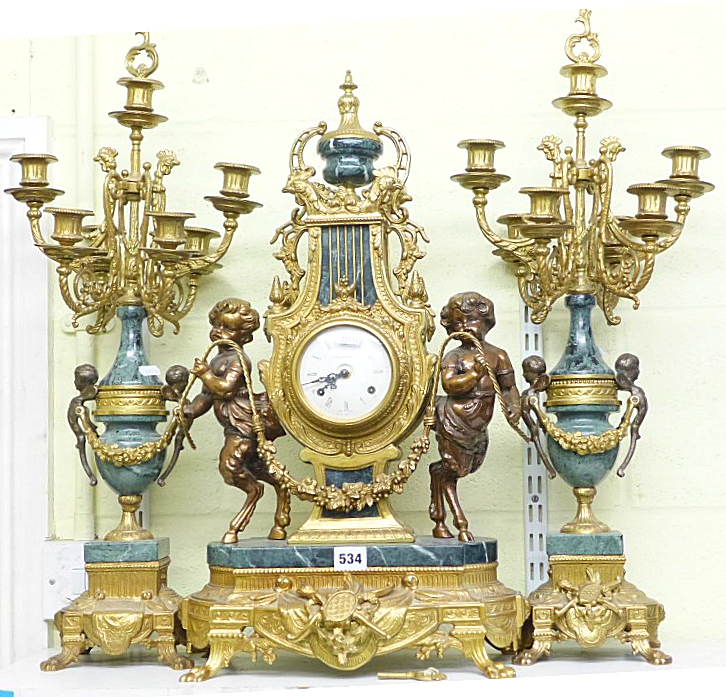
A collection of various items including an Imperial -Good Companion cased typewriter, a small quantity of cameras including a Diodem box No2 and Kodak, an old suitcase with original labels including Cunard White Star, a pair of brass candlesticks and a copper warming canister in oak stand

unicorn

A cast iron unicorn door stop (above)
A large milk churn, hand painted decoration by a local Mouth-artist, a folding garden parasol on hardwood frame and a nest of three metal framed glass topped coffee tables with map inserts
[More great taste!]
A shelf of decorative clown ornaments

A modern musical box surmounted by an elaborate model drum kit, under Perspex cover (above)
A late 19th century Concert Roller Organ, in mahogany with stencilled decoration, with eighteen rollers (below)
[Now that really is interesting; I’ve never seen one of these before.]

An early 19th century set of hand-coloured engraved cards of the Kings of England, in mica paper slip case, a Sallis’s Illustrated Game of Doctor Busby, in original slip case, and a miniature 1871 Royal Wedding edition of The Graphic
A garden ornament of probably Venus, well patinated
A stained glass fire screen, incorporating pieces of old possibly Cathedral glass interposed with newer pieces
A child’s toboggan with metal frame, wooden legs and wooden slats for sitting on, lot also includes a large toy lion with green eyes, pale yellow ochre coat and pale mane
Not the most interesting of sales, although it also contains a quantity of ceramic which sound boring and look hideous.

Carry On Living

Over the last few days everyone has done their fair share of wailing and gnashing of teeth in response to the referendum result to leave the EU.
Whether the voters meant what they said or not; and whether we like it or not; that was the opinion of the British voters.
While I would prefer to remain in the EU, it is now time for us all to shut up and get on with life.
Why? Because we have no option.
All the possible routes for changing the decision are essentially closed. This is outlined in a very interesting Briefing Paper Brexit: What happens next? from the House of Commons Library (which is about as independent as you can get) issued on Friday 24 June.
Let’s look at some of the options, through the eyes of this Briefing Paper.
[Note that this is NOT legal opinion but my reading of the aforementioned Briefing Paper and a number of other legal pieces I’ve seen.]
Must the Government respect the vote to leave?

No, but politically it is highly unlikely that the Government would ignore the result.

Referring to a David Allen Green column in the Financial Times on 14 June:

What happens next in the event of a vote to leave is therefore a matter of politics not law. It will come down to what is politically expedient and practicable.

If any future Prime Minister ignores the result, basically they cook their goose. And they are all astute enough to know that.
What happens now in the EU and the UK?
As far as you and I are concerned, nothing in the immediate term.

The UK ‘deal’ agreed in February 2016 on the UK in the EU will not come into force.
Although the UK has voted to leave the EU, from 24 June until the point of departure from the EU the UK is still a member of the EU. Nothing about the UK’s EU membership will change initially.
… … …
The UK will continue to apply EU law and to participate in the making of EU law in Brussels. There is no need to give immediate notice of withdrawal under Article 50 TEU [Treaty on European Union] …
As David Cameron has said he will not lead the exit negotiations, there will now be a period of three or four months before a new prime minister will notify the European Council of its intention to withdraw. During this time the UK and the EU will be able to “take stock and work out who, and by reference to what strategy, the negotiations will be conducted”.

It is likely that parliament will need to set up a joint Lords & Commons select committee to scrutinise the withdrawal procedure. This is going to cost us as they will need large numbers of support staff, office space etc. — there is an estimated 80K pages of legislation which will need scrutinising.
Is Article 50 TEU the only route to leaving the EU?

The Article 50 TEU route is the legal way to leave the EU under EU and international treaty law …
… … …
The UK Government has ratified a whole series of EU Treaties, meaning that it is bound by the obligations under those treaties as a matter of international law. Repealing the European Communities Act 1972 and/or other EU-based domestic legislation would not remove those international law obligations.
One of the main principles of customary international law is that agreements are binding and must be performed in good faith … [this is] reaffirmed in article 26 of the 1969 Vienna Convention on the Law of Treaties, to which the UK is a party.

Of course we could just ignore the rules, break the treaty obligations and be in contempt of international law. Who knows what the consequences of such an approach would be, but you can be sure it would not be pretty.
What about the devolution angle?
Quoting Sionaidh Douglas-Scott of Oxford University the Briefing Paper suggests that although the UK Parliament may repeal the European Communities Act 1972, this would not bring an end to the domestic incorporation of EU law in the devolved nations.

It would still be necessary to amend the relevant parts of devolution legislation. But this would be no simple matter and could lead to a constitutional crisis. Although the UK Parliament may amend the devolution Acts, the UK government has stated that it will not normally legislate on a devolved matter without the consent of the devolved legislature. This requires a Legislative Consent Motion [in the devolved parliaments] However, the devolved legislatures might be reluctant to grant assent, especially as one feature of the ‘Vow’ made to the Scottish electorate was a commitment to entrench the Scottish Parliament’s powers … So the need to amend devolution legislation renders a UK EU exit constitutionally highly problematic.

And that says nothing about the peace agreements in Northern Ireland.
What if Parliament does not pass legislation to implement EU withdrawal?

Parliament could vote against the adoption of any legislation linked to withdrawal – an amendment to or repeal of the ECA, for example … but this would not prevent the UK’s exit from the EU if the UK Government had already notified the EU under Article 50 TEU. Article 50 stipulates withdrawal two years from formal notification, with or without a withdrawal agreement.

As I read it, and I’m sure I’ve seen this opinion in print somewhere, the decision to invoke Article 50 is with the government, not parliament. Once Article 50 is invoked then separation will happen automatically regardless of whether there is any agreement or not — no-one can stop this, but the timescale could be extended by consent of all 27 remaining EU member states. Parliament cannot legislate to prevent separation if Article 50 has been invoked. All they could do is, before Article 50 is invoked, instruct the government not to do so. The government could ignore them, of course, but that would [in my view] bring about a massive constitutional crisis; but then so could ignoring the referendum result.
Could Scotland stay in the EU without the rest of the UK?
Essentially, no.

Scotland is currently not a ‘state’ under international law capable of signing and ratifying international treaties. Nor does it have power over international relations, which are reserved to Westminster … under the Scotland Act 1998:
… … …
Scotland could not therefore be an EU Member State in its own right, or even sign an Association Agreement with the EU, however much either side wished for it.

But if Scotland became independent?
The answer, essentially, still seems to be, no. International law governs how treaties are continued if a signatory state divides. Reading the Briefing Paper these rules seem to mean Scotland would have to gain independence and then apply to join the EU.
[But this is complex and I refer you read the Briefing Paper in detail.]
A second independence referendum (in Scotland)?
Although Nicola Sturgeon considers the trigger of “significant and Material change in circumstances” in the SNP 2016 election manifesto has been fulfilled, she still doesn’t have the power to hold another referendum.

The Scotland Act 2016 did not give the Scottish Parliament law-making powers in relation to referendums, so UK consent would be required for another referendum.
Scotland’s 2014 independence referendum was called under an agreement between the UK Government and the Scottish Government to devolve the power to hold such a referendum for a limited period, ending on 31 December 2014.

Can France re-negotiate the Le Touquet treaty?

This bilateral treaty governs the ‘juxtaposed’ immigration controls for France and the UK.
… … …
France could break the Le Touquet treaty unilaterally (even if the UK did not leave the EU).
Article 23 of the Treaty of Le Touquet, establishing ‘juxtaposed’ immigration controls for France and the UK, [allows] either France or the UK [to] terminate the arrangements [unilaterally] …

What about the EU itself; what can it do?
As I understand it the EU can do little except get their ducks lined up and sit on their hands until Article 50 is invoked. They cannot force the UK to invoke Article 50 (whether sooner or later, and despite what they might like) unless or until it wishes to do so. And invoking Article 50 is the thing which triggers the formal exit negotiations. Whether the EU would be prepared to enter into informal negotiations prior to the UK invoking Article 50 is a moot point, but they seem to have said they will not do so — and why should they?
So what about this parliamentary petition to (retrospectively) change the referendum rules or force another vote?
That, my friend, is a side show; albeit a popular one. It isn’t going to happen, even if it does get debated in parliament. Parliament almost never indulges in retrospective legislation. And the government would need to find good material cause to politically justify running another referendum. Doing anything else would be political suicide — but then we’ve seen a fair amount of that already.
So what can we do?
Basically nothing. We’ve (collectively) told the politicians what we want them to do. They have to work out for themselves how to manage the fall-out — that’s what they’re paid to do.
All we can do is to get on with life and watch the fireworks. Keep an eye on your finances; don’t spend money you haven’t got; and be prepared to move money around — but then you do that anyway. Markets can go up as well as down; so can salaries; and pensions; and prices. Just stay watchful.
And we still need to watch what our “lords & masters” are doing and ensure they are held to account — especially now.
So, I’m sorry, guys & gals, we just have to get on with the mess we (collectively) have made for ourselves and live our lives as best we can.
In the words of the Irish comedian, the late Dave Allen, “May your god go with you”.

Nasty Niffs

None of us like nasty, putrid, smells. I’m thinking of the things we actually find disgusting like shit, vomit and decaying corpses. Nor is it a subject we normally wish to dwell on.
However the other evening I was set thinking by a particularly pungent and foul pile of turd produced by one of our kittens …
Have you ever noticed how these odours are particularly good at lingering in the nostrils long after their source has been removed? Why is that?
We know that disgust is a universal human trait, and that there is a fairly common set of trigger odours — things like putrescine and cadaverine — found in all human societies and cultures. And this is for good reason. Evolution has programmed us to react to these odours to ensure we stay away from their source as these are substances which are likely to be harmful to us.
These odour molecules are mostly either organic sulphur or nitrogen compounds — think hydrogen sulphide (rotten eggs) and ammonia. And it isn’t just bodily decay or excrement that lingers. Another scent I’ve noticed lingering is the acrid (sulphurous) smoke from burning rubber, lino etc. It generally does seem to be the smells one hates which seem to last.
But why? What is the mechanism whereby these odours appear to linger?
Is it a trait which evolution has fixed because it is useful? Or is it a random effect of the chemistry involved which just hasn’t been evolved out? One assumes the former. But how?
Cadaverine and putrescene are relatively small diamines (ammonia derivatives) which result from the breakdown of amino acids. Other pungent and lasting odour molecules are sulphur based and can bond especially tightly to other organic molecules (ie. they’re “sticky”).
That seems to lead us to a number of possible mechanisms by which the effect, whether positively evolved in, or not evolved out, could work:

  1. The molecules concerned could be more soluble in, or more adherent to, the mucus which lines our nasal passages compared with other odour molecules. Thus they would be available longer to the odour receptors. (As the molecules are likely quite polar, both mechanisms are possible.)
  2. It could be that the mucus itself protects the molecules (whether dissolved or adhered) from whatever enzymes would naturally break them down.
  3. Then there is the question of their binding to the olfactory receptor itself. Do they bind so tightly that they cannot be freed to be degraded by the body’s chemistry?
  4. Or does their binding with the olfactory receptor change the molecule’s conformation, or hide it, from the degrading enzymes?
  5. Or again, it may not be chemical at all. The effect may be in the brain, with the nerve messages themselves being retained for a protracted period, even after the odour molecule has been broken down.

And there may well be other mechanisms. The mechanism maybe different for different molecules. And the above mechanisms are not mutually exclusive; particular odourants may be subject to multiple mechanisms.
Which in itself tells us nothing about the possible evolutionary mechanism.
I can’t believe that no-one has done any work on this. Some scientist, somewhere, has surely investigated the longevity of nasty niffs. A quick search hasn’t turned up anything very useful, so does anyone know? I’m curious!