All posts by Keith

I’m a controversialist and catalyst, quietly enabling others to develop by providing different ideas and views of the world. Born in London in the early 1950s and initially trained as a research chemist I retired as a senior project manager after 35 years in the IT industry. Retirement is about community give-back and finding some equilibrium. Founder and Honorary Secretary of the Anthony Powell Society. Chairman of my GP's patient group.

Word: Semasiographic

Semasiographic

I came across this word in an article on Inca khipus, in the current issue of New Scientist [paywall]. As this is a word I’d not previously encountered it is lucky the author explained it as a system of symbols that convey information without being tied to a single language.

Various authors on Quora provide the following explanations:

Semasiographic stems from the Greek word “semasia”, which means “meaning”. A semasiographic system of communication is the way in which the meaning of something is conveyed by signs, pictures, or icons rather than by words, sounds, or speech . . . Most semasiographic systems of communication can be used in many different countries regardless of language because if the cultures have similar practices, like those with airports, vehicles, or public transportation, then they will be able to understand the meaning of what is being represented in an icon or some sort of notation.

and . . .

Emoji would be a good example of a semasiographic text. I don’t think I can insert them here like on a phone, but if I wrote something like “<3 ;)", it's completely understandable to those who know modern internet slang, but can't really be expressed with words. "Heart wink" really doesn't cut it. Notably it's cross-linguistic, in that any internet user would understand it the same way, no matter what language they used to describe the "heart" and "wink" emoticons.

and . . .

A commonly cited example of a semasiographic system is road signs, which are similar across almost all countries but require no linguistic knowledge – you may call a yield sign something else in your language, but it will continue to mean “wait for traffic to pass”.

and . . .

Usually the word refers to picture-based writing systems, like Mayan hieroglyphs:

or Egyptian hieroglyphs:

or in the case of the New Scientist article, Inca khipus.

Incidentally the word does not appear in the OED online to which I have access.

Word: Khipu

Khipu

Pronounced “key-poo”.

A device consisting of cords or threads of different colours arranged and knotted in various ways, used originally by the Incas of Peru and the surrounding areas for recording events, keeping accounts, sending messages, etc.

So basically this is the old Inca system of recording using intricately connected, coloured and knotted cords. This included numerical recording using a decimal number system, and it is now being thought was also textual as well as numeral. There’s an interesting article on this in the current issue of New Scientist [paywall].

The word has multiple origins being partly a borrowing from Spanish and partly Quechua. It arrived in English, via the Spanish, around 1580.

Monthly Links

So here goes with this month’s outsized collection of links to items you may have missed.

Science, Technology & Natural World

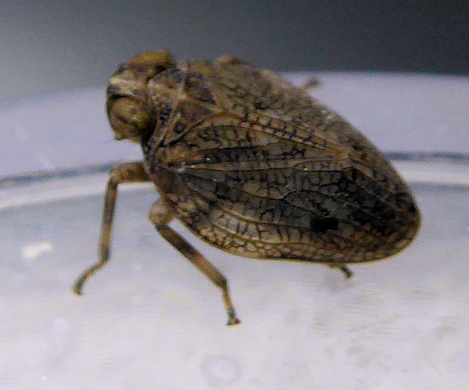
Issus coleoptratusA few days ago I had a strange little bug in the house. It turned out to be the planthopper Issus coleoptratus. And I found out the nymphs of this insect are incredible as they have the only known mechanical gears ever found in nature. Here’s a piece about these gears.
[That’s my photo on the right.]

While we’re on strangenesses … What happens when octopus are give MDMA? Does it affect their distributed brain the same way it does ours? Well naturally scientists had to find out!

Many people don’t like termites (and for good reason) but they’re incredible insects which can actually teach us a lot. [VERY LONG READ]

Scientists have realised that they can mine twitter for observations of nature.

Fungi are another of the fascinating orders of nature.

Leaving the natural world behind, scientists have developed artificial genes which demonstrate that life does not have to be based on DNA. [£££££]

But then again, if there are dead civilisations out there in the cosmos, how are we going to conduct cosmic archaeology to search for them?

Health & Medicine

It seems that we dream even when under general anaesthetic. [£££££]

We all know that 98.6°F (37°C) is our normal body temperature. Except when it isn’t, of course.

So what is going on in our guts? And do probiotics actually make any difference?

The vagina is self-cleaning – so why does the ‘feminine hygiene’ industry exist?

100 years on from the Spanish flu and the disease still stalks us.

Many older people have been advised to take an aspirin a day, even if they don’t have symptoms of cardiovascular disease. Medics now think this is risky.

Men and women experience migraine attacks differently due to both physiology and sociology.

A new UK study of depression is recruiting 40,000 volunteers to find if there are genetic markers for the disease.

Sexuality

So what are the secrets to fulfilling sex in a long-term relationship? Seems like there’s no really special magic but lots of being.

Environment

Beavers are amazing creatures and it appears that they could have a role in combating climate change. (But you don’t ever want to have to sex one!)

How would you like a wolf living near you? Personally I’d rather like to have a wolf living in my area. How about you?

The National Trust in South Wales are experimenting with a return to medieval strip farming, and it sounds like an environmental win.

Finally someone has had the courage to call out what I’ve been suggesting for a long time: abandoning nuclear power could increase carbon emissions.

Art & Literature

Apparently the male nude is back in fashion in art circles.

History, Archaeology & Anthropology

Archaeologists were initially puzzled by the skeleton of a 3,000 year old ancient Greek female. But it turns out she was a master ceramicist.

A couple of years ago IanVisits went to Broughton Castle near Banbury. I went there recently during a conference in Oxford, and it is every bit as spectacular as IanVisits says.

In his late 17th century journal sailor Edward Barlow confessed to a rape. But he then covered it over and the evidence lay hidden until modern conservators got to work uncovering an intriguing tale.

Christopher Kissane in the Irish Times blows the lid on the historical nonsense which underpins UK’s Brexit floundering.

Lifestyle & Personal Development

From the annals of the unexpected … Many of us lack a degree of self-control, but researchers have shown that having a simple ritual can help.

We in Britain are losing our shared spaces (pubs, clubs, libraries, churches) and becoming more isolated and cliquey.

So how do you win friends and then keep them for years? Emma Beddington has some ideas.

Food & Drink

Britain’s Food Standards Agency has been testing meat products, and worrying they find 20% contain the DNA of animals they aren’t supposed to, and that it appears to be deliberate.

Shock, Horror, Humour

Finally this years Ig Nobel Prize winners were announced a week or so ago. DIY colonoscopy anyone? Or just the need to use a voodoo doll to get revenge on your boss?

Work: Sortition

Sortition

The casting or drawing of lots; selection, choice, or determination by lot.
An act or instance of determining by lot.

And thus by extension: The ancient art of choosing members of government by lottery, as practised by the ancient Athenians and still in our modern jury system.

Derived from the Latin sortitio, from sortiri to cast lots.

The OED tells us the first recorded use in English was in 1597.

Book Non-Review

Kate Bennett (Editor)
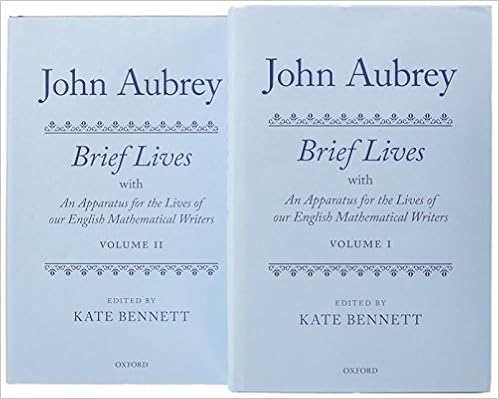
John Aubrey: Brief Lives with An Apparatus for the Lives of our English Mathematical Writers

(OUP; paperback, 2vv, £50, 2018; hardback, 1vv, £250, 2015)

I’ve been dipping into the paperback edition of this enormous work over the last few weeks. It is so massive – the two volumes are together almost 2000 pages! – that dip into it is all one realistically can do, hence my reluctance to write proper review.

No, almost 2000 pages is not an exaggeration. Amazon quotes the work as being 1968 pages. So no wonder OUP have split the paperback edition into two volumes.
Volume I is 900+ pages and contains John Aubrey’s Brief Lives, together with “The Apparatus …” and a 125-page extended introduction. The Brief Lives themselves are, for the first time ever, reprinted entire and complete with Aubrey’s marginalia (often heraldic drawings, but also notes). Volume II is over 1000 pages of scholarly notes and commentary on the content of Volume I plus 50 pages of index.

I really can’t do better than to quote a couple of the reviews (also quoted on Amazon) from two other Aubrey scholars:

It is not an exaggeration to claim that until Kate Bennett came along, no one properly understood what the Brief Lives are … [Her edition] marks a new beginning for Aubrey scholarship … It is fitting that such scholarly devotion, extending over two decades, should have given rise to an edition that is an innovation in its own right. Nothing like it has appeared before, and it will last, if not forever, for a very long time.
[Ruth Scurr, Times Literary Supplement]

This is an outstanding achievement and will undoubtedly be the standard edition of the Brief Lives for the foreseeable future … In its rich and varied content it is of interest … to anyone studying English learned culture in the seventeenth century, particularly historians of the Royal Society, of mathematics and of antiquarianism. Aubrey himself was acutely concerned that his works should be satisfactorily edited and made use of after his death; in this edition he is luckier than he could have hoped for.
[Kelsey Jackson Williams, History]

Having heard Kate Bennet speak at the 2016 Anthony Powell Conference in York, and been fortunate enough to sit next to her at the conference dinner, I can certainly vouch for her enthusiasm, insight and wide-ranging interests. And this is an amazing piece of work.

Womanhood: The Bare Reality

Laura Dodsworth, author of Manhood: The Bare Reality has a new book coming out, but unfortunately not until next February.

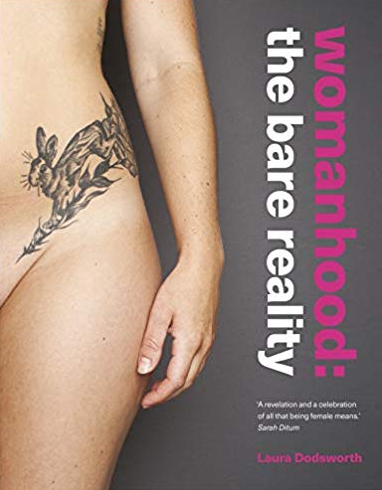
Its title: Womanhood: The Bare Reality.

You can, of course, pre-order it on Amazon or from the publishers Pinter & Martin.

The book promises to do for women, what Manhood did for men: tell of the variety and the stories of man and manhood. As the blurb an Amazon says:

100 women bare all in an empowering collection of photographs and interviews about Womanhood.

Vagina, vulva, lady garden, pussy, beaver, c**t, fanny … whatever you call it most women have no idea what’s ‘down there’. Culturally and personally, no body part inspires love and hate, fear and lust, worship and desecration in the same way.

From smooth Barbie dolls to internet porn, girls and women grow up with a very narrow view of what they should look like, even though in reality there is an enormous range. Womanhood departs from the ‘ideal vagina’ and presents the gentle un-airbrushed truth, allowing us to understand and celebrate our diversity.

For the first time, 100 brave and beautiful women reveal their bodies and stories on their own terms, talking about how they feel about pleasure, sex, pain, trauma, birth, motherhood, menstruation, menopause, gender, sexuality and simply being a woman.

Laura comments further in a recent Facebook post:

“A major issue for women is that men and society are really interested in defining womanhood for us and without us. A lot of the time, women don’t have an awful lot of input into the definition of womanhood, yet we’re judged against it. Women have to make choices that men don’t ever have to make.”
From Womanhood: The Bare Reality

A bold first quote to share from Womanhood. I’ve already been #notallmen-ed on Twitter, so let me say, I love men, this is not anti-men. (I LOVE men.) Remember Manhood?

But this is the point; Womanhood is an exploration of female experience through the embodied stories of 100 women. We define Womanhood on our own terms and in our own words. We reveal ourselves to ourselves and to each other. And it’s about time.

Laura’s previous books (Manhood: The Bare Reality and Bare Reality: 100 Women, Their Breasts, Their Stories) were amazing, revealing and informative, so I’m really am looking forward to reading Womanhood: The Bare Reality. My copy is already on order.

Full disclosure: I was one of the 100 men featured in Manhood.

Quotes

So here we are again with this months collection of quotes weird and wonderful!

VESPERS
Hush! Hush. Whisper who dares!
Little boy sits at the foot of the stairs.
Blood on his fingers
And fur on the mat:
Christopher Robin’s castrated the cat!

[John Hein]

Golden-haired boy on the edge of the street
In his tight blue jeans on his lonely beat.
Hush! Hush!
I’m rather afraid
Christopher Robin is looking for trade.

[John Hein]

You cannot overestimate the stupidity of people, yourself especially.
[Robyn Hitchcock]

Fascism is cured by reading, and racism is cured by travelling.
[Miguel do Unamuno]

I believe that when we leave a place, part of it goes with us, and part of us remains. Go anywhere in the station when it is quiet and just listen. After a while, you will hear the echoes of all our conversations, every thought and word we’ve exchanged. Long after we have gone, our voices will linger in these walls.
[unknown]

Faced with a choice between contributors offering an honest and considered assessment or mendacious buffoons with a talent for attracting attention, the BBC will consistently choose the latter. By this means it systematically distorts national life.
[George Monbiot]

Way down deep in the middle of the Congo, 
A hippo took an apricot, a guava and a mango. 
He stuck it with the others, and he danced a dainty tango. 
The rhino said …
‘My testicle was so big, you could play it like a bongo’.

[https://twitter.com/ed_son/status/1038321780010766336]

“History” is not derived from “his story”. It’s from the Greek ἱστορία, historia, which means “inquiry”.
[Rose Eveleth]

Wellness uses terms that sound like a dog whistle for the patriarchy. Pure. Clean. Natural. This could easily be advertising for America’s next virgin bride, not a pathway to health.
[Dr Jennifer Gunter]

If we’re not supposed to have midnight snacks, why is there a light in the fridge?
[Stephen Rodda]

If people can’t face up to the fact of other people being naked … then we’re never going to get anywhere.
[John Lennon]

“I’ve often been asked, ‘What do you old folks do now that you’re retired?’ Well … I’m fortunate to have a chemical engineering background and one of the things I enjoy most is converting beer, wine and vodka into urine. I do it every day and I really enjoy it.”
[unknown]

The Need for Cosmogony and Ceremony

One of our favourite Zen Masters, Brad Warner, recently wrote the ridiculousness of religions, what he called “religulous belief”. As regular readers will surmise, these are views with which I have much sympathy. However along the way Brad did explain why liturgy remains important to me despite my lack of belief in deities.

Here is an editied version of Brad’s article, as it partly explains something which has long puzzled me:

Bill Maher and like-minded people such as Richard Dawkins always make the same complaints about religions. They attack the religion’s cosmogony – its myths, its creation story, its ideas about heavens, hells, angels and all that. They point out that this stuff is ridiculous. Then they figure the job is done.

Most religions have pretty dopey stories attached to them … Even mainstream religions have ideas that sound pretty silly when you examine them; virgin birth, parting of seas, swallowings by whales, people rising from the dead, and so on. Some Buddhist ideas … are just as weird.

I don’t think most people join religions because they are convinced by their cosmogony. People don’t say, “You guys teach that God lives on planet Kolob? That sounds reasonable. Sign me up!”

Being without faith is a luxury for people who were fortunate enough to have a fortunate life. You go to prison and you hear people say, ‘I got nothing but Jesus in here.’ If you’re in a foxhole you probably have a lot of faith. I completely understand that. But how can smart people believe in the talking snake and people living to be 900 years old and virgin birth? …

The answer is that we’re all in a foxhole. We’re all in prison. Maybe not literally, but metaphorically. We’re all going to get sick and die. We’re all imprisoned by society to one extent or another. Even “fortunate” people have to suffer misfortune. It’s inevitable …

People will cling to anything that makes the sadness of life a little easier to take. Being wrong but happy feels better than being right but miserable.

… Buddhism, at least in the Zen school … doesn’t insist that we have to believe in Buddhist cosmogony. Most schools of Buddhism don’t have a strong insistence on belief in Buddhist cosmogony – although some do. But the Zen school is probably the most radical in its rejection of such beliefs.

Yet … Zennies … still retain many of the trappings of Buddhist schools in which such beliefs are held more strongly. They still have ceremonies in which they honour mythological figures …

Nobody ever insists that you have to believe … yet we play along just like people who do believe these things.

… these ceremonies have practical value. They help people get along together. They give them a sense of belonging and community. Their “lies” … ease some of our worries and fears. And they can do this even if we know perfectly well they’re not true …

This is very interesting as it says to me this is (at least partly) how liturgy and ceremony work: by reinforcing community, easing worries, despite our better judgement. Although I still think there is something even deeper, more magic, about really good liturgy like Tridentine Latin Mass.

I think it may be similar to the way it feels good to hear someone you love tell you it’s going to be all right when you’re sick … We all need that …

Some good food for thought!