Now here’s a curiosity. All you have o do is count the black dots.

Errr!
Now here’s a curiosity. All you have o do is count the black dots.
Errr!
Overmorrow
The day after tomorrow.
The OED suggests it is derived from the German übermorgen and Dutch overmorgen.
The first recorded usage was in 1535.
Compare with nudiustertian, pertaining to the day before yesterday.
These have to be a useful words with which to confound the unwary!
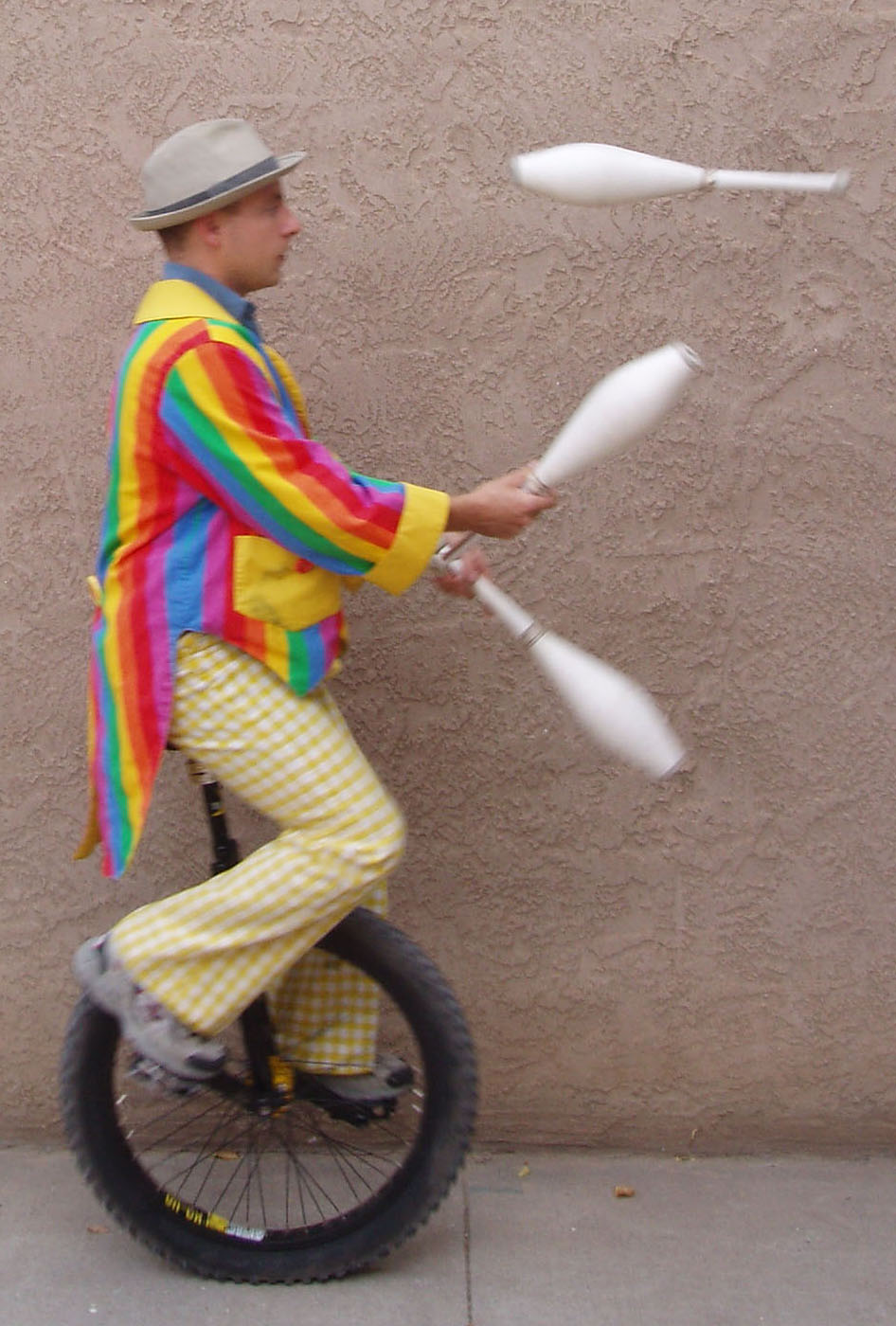 Saturday 15 June is World Juggling Day which is set up International Jugglers Association to help spread the fun of juggling and to bring jugglers around the world together.
Juggling is fun — well so they tell me, I was never any good at it. And it is an ancient art: there are images on a tomb in Egypt show people juggling, and there are references to it in writings from China, Ireland and Rome. Juggling was also popular during Renaissance times, when jugglers would entertain the royal court.
As usual there’s lots more information over at www.juggle.org/wjd.
Bike Week 2013 starts on Saturday 15 June and runs until 23rd.
Bike Week is the UK’s biggest mass participation cycling event with events offering something for everyone; from families, schools and companies, to seasoned cyclists and those who have never cycled before. The idea is to show us just how easy it is to make cycling part of our every day routine.
This year, Bike Week is asking the nation to dig out their bikes, get back on the saddle and fall in love with cycling all over again! Cycling is not only good exercise but is also good for the environment in helping us to reduce our carbon footprint.
There’s lots of information and an events register over at www.bikeweek.org.uk.
This week’s photo is a new one … A young House Sparrow sitting in our front hedge one day last week. Sensibly it was sitting dozing in the sun, probably waiting for its parents to return with food — typical teenager really!
Click the image for larger views on Flickr
Baby House Sparrow
Greenford, June 2013
Pneumonoultramicroscopicsilicovolcanoconiosis
According to the Oxford English Dictionary Pneumonoultramicroscopicsilicovolcanoconiosis is “a factitious word alleged to mean ‘a lung disease caused by the inhalation of very fine silica dust, causing inflammation in the lungs'”. A condition meeting the word’s definition is normally called just silicosis.
Wikipedia adds: “It occurs chiefly as an instance of a very long word. The 45-letter word was coined to serve as the longest English word and is the longest word ever to appear in an English language dictionary. It is listed in the current editions of several dictionaries”.
Facetious or not its coining in 1935 by Everett M Smith appears well documented, and the word does indeed mean what the OED says.
Whatever you want to call the disease, you don’t want it!
Aromatherapy Awareness Week runs from Monday 10 to Sunday 16 June and is promoted by the International Federation of Aromatherapists.
Although like many “complementary” therapies it is much decried by mainstream science, aromatherapy is an ancient therapeutic treatment used in many early civilisations to relieve stress, other ailments and rejuvenate the mind, body and spirit, by the use of pure essential oils from plants, chosen for their therapeutic benefits, specific to the needs of the individual.
Smell is a much more important sense that we often realise. Scents are some of the most powerful triggers for the recall of past events: the smell of the sea bringing back those idyllic childhood holiday memories, for instance. That’s why supermarkets so often use the smell of baking bread, or coffee, to entice us. So why should aromatherapy work too?
The medical sector too have recently started utilising the benefits of aromatherapy — for instance in cancer units as supportive care for their patients and pre- and post-operations — and they have seen benefits to the patients which help to speed recovery.
You can find out more about aromatherapy over at www.ifaroma.org.
This week I thought we’d have something slightly different: a selection of four Osbert Lancaster cartoons from 50+ years ago — all of them before I left primary school. What I love about Lancaster’s pocket cartoons is that some many of them are just as relevant today as when they were first drawn.
Click the images for larger views


Plus ça change!
The week beginning Monday 10 June is Bike to School Week.
The idea is to encourage children to travel to school on their bikes. Cycling is good exercise and reducing car mileage has to be good for the environment; and it teaches children basic roadcraft. Moreover cycling is fun; it’s something I wish I was still able to do.


Yes, if you’re going to start cycling there are a few things you need to think about, but they’re not difficult. Firstly, ensure that your bike is in good working order: check the tyres, lights etc. You should plan your route, so that you know exactly where you are going and what the road junctions are like — and always make sure that someone knows the route you will be taking. And last, not not least, be safe and wear a helmet.
Teachers!? No you’re not excused; you’re expected to join in. Bike to School Week isn’t just for the kids!
Find more information on how to get started over at www.sustrans.org.uk/change-your-travel/children-and-families/schools/bike-school-week.
Another “world day” this week comes around on Saturday 8 June; it is World Oceans Day.
World Ocean Day is the planet’s biggest celebration of the ocean and the theme for World Ocean Day this year (and next) is ‘together we have the power to protect the ocean!’. Yep, we’re all being asked to do our bit to help protect our oceans.

Oceans are incredibly important to the whole balance of the planet. We get most of our oxygen from the sea. They provide us with water to drink and bathe in … fish (and plants too) to eat … not to mention pharmaceuticals etc. The oceans probably also contain more unknown species than terrestrial environments; scientists are discovering hundreds, if not thousands, of new pelagic species every year.
In short, oceans are a bit of a miracle! But a miracle that we are polluting with plastic and chemicals, and whose life (especially fish) we’re raping unsustainably.
There’s a whole raft of small things you can do to help. Find out over on the World Oceans Day website, http://worldoceansday.org/.