
Until as recently as the early 1900s, “&” was considered a letter of the alphabet and listed after Z in 27th position. To avoid confusion with the word “and”, anyone reciting the alphabet would add “per se” (“by itself”) to its name, so that the alphabet ended “X, Y, Z and per se &”. This final “and per se and” eventually ran together, and the “ampersand” was born.
From ‘A’ to ‘ampersand’, English is a wonderfully curious language; Guardian; 15/02/2014
Farming Floods
Yet again George Monbiot has applied his pitchfork to the tender parts of the government’s environmental policy. Yet again it is all to do with flooding. Here is the large part of his article in the Guardian of 17 February — he says it all so much more succinctly than I could.
How we ended up paying farmers to flood our homes
This government let the farming lobby rip up the rulebook on soil protection — and now we are suffering the consequences.
It has the force of a parable. Along the road from High Ham to Burrowbridge, which skirts Lake Paterson (formerly known as the Somerset Levels), you can see field after field of harvested maize. In some places the crop lines run straight down the hill and into the water. When it rains, the water and soil flash off into the lake. Seldom are cause and effect so visible.
That’s what I saw on Tuesday. On Friday, I travelled to the source of the Thames. Within 300 metres of the stone that marked it were ploughed fields, overhanging the catchment, left bare through the winter and compacted by heavy machinery. Muddy water sluiced down the roads. A few score miles downstream it will reappear in people’s living rooms. You can see the same thing happening across the Thames watershed: 184 miles of idiocy, perfectly calibrated to cause disaster.
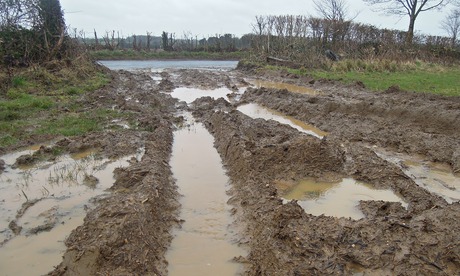
Mud (aka. silt) pours straight off this field near the source of the Thames.
Photograph: George Monbiot
Two realities, perennially denied or ignored by members of this government, now seep under their doors. In September the environment secretary, Owen Paterson, assured us that climate change “is something we can adapt to over time and we are very good as a race at adapting”. If two months of severe weather almost sends the country into meltdown, who knows what four degrees of global warming will do?
The second issue, once it trickles into national consciousness, is just as politically potent: the government’s bonfire of regulations.
Almost as soon as it took office, this government appointed a task force to investigate farming rules. Its chairman was the former director general of the National Farmers’ Union. Who could have guessed that he would recommend “an entirely new approach to and culture of regulation … Government must trust industry”? The task force’s demands, embraced by Paterson, now look as stupid as Gordon Brown’s speech to an audience of bankers in 2004: “In budget after budget I want us to do even more to encourage the risk takers.”
Six weeks before the floods arrived, a scientific journal called Soil Use and Management published a paper warning that disaster was brewing. Surface water run-off in south-west England, where the Somerset Levels are situated, was reaching a critical point. Thanks to a wholesale change in the way the land is cultivated, at 38% of the sites the researchers investigated, the water — instead of percolating into the ground — is now pouring off the fields.
Farmers have been ploughing land that was previously untilled … leaving the soil bare during the rainy season. Worst of all is the shift towards growing maize, whose cultivated area in this country has risen from 1,400 hectares to 160,000 since 1970.
In three quarters of the maize fields in the south-west, the soil structure has broken down to the extent that they now contribute to flooding. In many of these fields, soil, fertilisers and pesticides are sloshing away with the water. And nothing of substance, the paper warned, is being done to stop it …
Maize is being grown in Britain not to feed people, but to feed livestock and, increasingly, the biofuel business. This false solution to climate change will make the impacts of climate change much worse, by reducing the land’s capacity to hold water.
The previous government also saw it coming. In 2005 it published a devastating catalogue of the impacts of these changes in land use. As well as the loss of fertility from the land and the poisoning of watercourses, it warned, “increased run-off and sediment deposition can also increase flood hazard in rivers”. Maize … is a particular problem because the soil stays bare before and after the crop is harvested, without the stubble or weeds required to bind it. “Wherever possible,” it urged, “avoid growing forage maize on high and very high erosion risk areas.”
The Labour government turned this advice into conditions attached to farm subsidies. Ground cover crops should be sown under the maize and the land should be ploughed, then resown with winter cover plants within 10 days of harvesting, to prevent water from sheeting off. So why isn’t this happening in Somerset?
Because the current government dropped the conditions. Sorry, not just dropped them. It issued … a specific exemption for maize cultivation from all soil conservation measures … The crop which causes most floods and does most damage to soils is the only one which is completely unregulated.
When soil enters a river we call it silt. A few hundred metres from where the soil is running down the hills, a banner over the River Parrett shouts: “Stop the flooding, dredge the rivers.” Angry locals assail ministers and officials with this demand. While in almost all circumstances, dredging causes more problems than it solves, and though, as even Owen Paterson admits, “increased dredging of rivers on the Somerset Levels would not have prevented the recent widespread flooding”, there’s an argument here for a small amount of dredging at strategic points.
But to do it while the soil is washing off the fields is like trying to empty the bath while the taps are running.
So why did government policy change? I’ve tried asking the environment department: they’re as much use as a paper sandbag. But I’ve found a clue. The farm regulation task force demanded a specific change: all soil protection rules attached to farm subsidies should become voluntary. They should be downgraded from a legal condition to an “advisory feature”. Even if farmers do nothing to protect their soil, they should still be eligible for public money.
You might have entertained the naive belief that in handing out billions to wealthy landowners we would get something in return. Something other than endless whining from the National Farmers’ Union. But so successfully has policy been captured in this country that Defra … now means Doing Everything Farmers’ Representatives Ask. We pay £3.6bn a year for the privilege of having our wildlife exterminated, our hills grazed bare, our rivers polluted and our sitting rooms flooded.
Yes, it’s a parable all right, a parable of human folly, of the kind that used to end with 300 cubits of gopher wood and a journey to the mountains of Ararat. Antediluvian? You bet it is.
A fully referenced version of this article can be found at www.monbiot.com/2014/02/17/muddying-the-waters/
From www.theguardian.com/commentisfree/2014/feb/17/farmers-uk-flood-maize-soil-protection
Now tell me, please, why there is no need to reform agricultural practices?
More Auction Oddities
Yet another collection of strangenesses from our local auction house. This collection is garnered from two recent sales. Just marvel at the weirdness of it all!
A half mannequin and two busts.
A large lot comprising Technics and JVC hi-fi, a shredder, a workman’s luminous jacket, plastic piping, modern ceiling lights, shelf unit, a mitre saw, a child’s duvet, cushions and tent equipment, etc.
A collection of Dinky model planes, including “Empire Flying Boat”, “Ranger Bomber” and “York”, an Astra model canon, 2 brass combs, a can of American wartime pure Dried Whole Eggs, unopened, and a Dried Machine Skimmed Milk, unopened, 2 bobbins, thimbles, lead soldier figures and a game of peg patience etc.
Why? Just why?
Costume jewellery, a silver-backed dressing table set, Wade rabbit and trough, small books on Freemasonry, two Oxo tins full of cotton reels, etc.
Two decorative portrait miniatures of elegant ladies in piano key frames …
A carton of old leather handbags and a box of old railway track, a tinplate lorry, a racing car, beads, etc.
An interesting accumulation of items including decorative scent bottles, Art Deco glasses, an old French roll of loo paper, cake decorations, a carved box, a crocodile spectacle case, purses, etc.
WTF with old French bog roll?
A carton of old tins and pipes, including Lions [sic] French Coffee, and a Milady tin of mainly bronze coins.
A collection of old boxes including a mirror and brush box, jewellery boxes, a clockwork spit, miscellaneous jewellery, a Robert Held art glass paperweight set with a diamond, an old paste pot the lid entitled ‘A Letter From The Diggings’, a set of weights, large tile, etc.
An album of mint gutters and traffic lights GB 1948-2005.
Very sad, but yes I do know what this means!
Five unused tortoiseshell style handbag frames.
A pair of lorgnettes, two monocles, a folding comb, and a pick.
A quantity of unboxed Matchbox cars and vans including Mercedes 300 SE, Ford pick-up and Lamborghini Mivra, a Ford Consul, Corgi car and a Husky walk-through van, a boxed Matchbox Y-12 1909 Thomas Flyabout, a tribal club and two boomerangs.
A pair of antlers.
A mounted claxton [sic] on a wooden base and a clear bottomed pewter tankard.
A zither by the Anglo American Zither Co.
Guinness ware comprising five jugs in sizes and three flagons in sizes
Two Beswick wall ducks
A substantial and interesting Victorian carved dark oak dresser, the large panelled back carved with an armorial of four rampant lions, dinosaurs and dragons, and biblical scenes and a portrait, supporting display shelves above a carved base with three frieze drawers and cupboard
Word: Haruspicy
Haruspicy
Divination by natural phenomena, especially from inspection of the entrails of animal sacrifices.
They're Beginning to Get the Message!
At last! MPs are beginning to get the message about HS2. According to yesterday’s Observer:
Call to invest in transport infrastructure after sea wall collapse undermines Dawlish railway track
Weekly Photograph
This weeks photo is one I took a couple of weeks ago. We were driving south on the A11 somewhere around Wymondham in Norfolk in the late afternoon, on the way home from seeing my mother; the sun was setting and creating some interesting silhouettes of the roadside trees. This isn’t the best of photos as it was taken through the windscreen from the passenger seat of a moving car — it was a case of snap what’s there and see what comes out; sometime you do get some good and/or interesting images.

A11 Tree Study
February 2014; Norfolk
Something for the Weekend
For everyone going out to dinner this Valentine’s day …
Your Interesting Links
Another catch-up on items you may have missed.
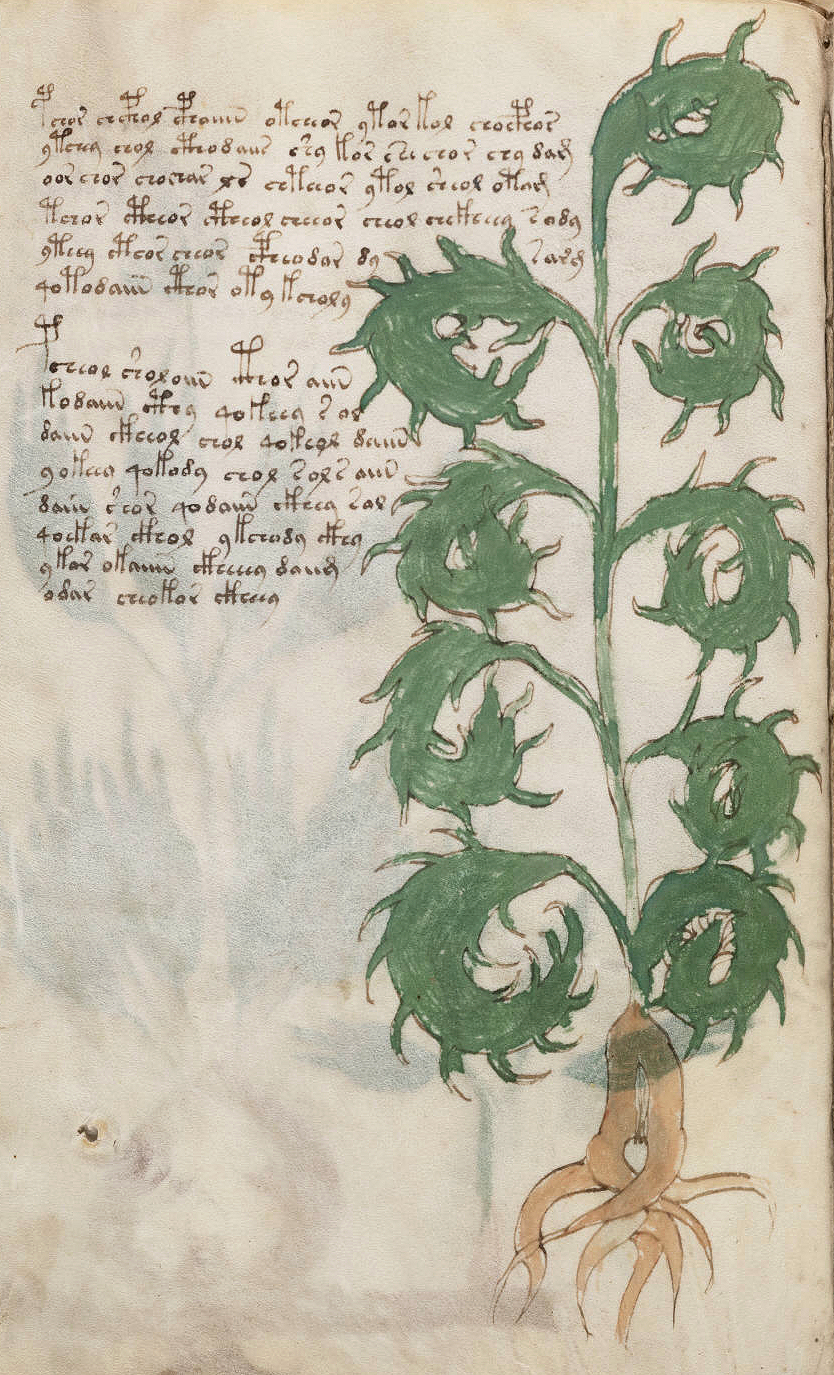 Before delve into the depths of science-y things, let’s start with a mystery … A couple of scientists have come up with a possible way of interpreting the mysterious Voynich manuscript — and it is all based on the illustrations.
Well what a surprise! January was England’s wettest winter month in almost 250 years. December wasn’t far behind and it is looking as if February will follow suit!
So how should you cover your mouth when we sneeze? Hand? Hankie? Or Elbow?
More strangeness of animal genetics. Cells in females shut down one of their two X chromosomes at random.
Synesthesia is a very strange affliction. Here one young lady talks about what it is like.
Confused by all the different ‘flu viruses that appear in the media? Scientific American tries to unmuddle you.
What’s the relationship between what we eat and how well/ill we are? Basically scientists think they know, but actually nobody does.
Why do so many of our best spices come from very low down on the evolutionary tree of plants?
Well who would have guessed? Clearly not scientists. Birds can smell!
Hands up: Who knows what a thylacine is? Who thinks it’s extinct? Who would like to find out?
Just like we trust our doctors, we trust our vets to know what medicines work on our pets. But maybe they often don’t know.
Ever wondered what your cat thinks about you? Maybe you don’t want to know!
Here’s the story of how we get ever more clever at defining the the length of the standard metre.
At long last! Let’s leave all this geeky science stuff behind …
A London cabbie looks at the history and development of Waterloo Station.
English has always borrowed words from other languages. How good is your knowledge of English’s borrowings?
The discovery of a secret Viking message … sealed with a kiss?
Going even further back in time, some 850,000 year old footprints have been uncovered in Norfolk.

So time to relax with a few interesting facts about tea.
And finally as a prelude to Valentine’s Day … Many people no longer expect passion to last a lifetime. And yet some couples stay in love to the last. What’s their secret?
Oddity of the Week: Speed of Chocolate
I’ve been meaning to write about this for some time, and having come across the instructions again the time is now.
It took over 300 years of experimentation and refinement to arrive at the figure for the speed of light which we use as standard today. That being the case, this method for determining that speed yourself might seem more than a little surprising. All you need is some kind of food that can melt (chocolate is good but you can also use marshmallows or cheese), a microwave oven, a microwave-safe dish to put the food in, and a ruler.
- Place the food on the dish.
- Remove the turntable from the microwave — it’s important that the dish can’t move.
- Put the dish in the microwave.
- Cook on a low heat until it’s clear the food is beginning to melt in spots. Begin by trying 30 seconds. These spots relate to the peaks of the ‘wave’ — the distance between two peaks is half a wavelength.
- Once the melted spots appear, remove the dish and measure the distance between the centres of these spots. One distance should repeat again and again.
Now look on the microwave (it might be on the back) to find its frequency — this is typically 2.45GHz.
We know that c = λν, or the speed of light = wavelength multiplied by frequency.
So, ν is the frequency of the microwave. If it’s 2.45GHz then the figure you will use in your calculation will be 2,450,000,000 (whatever the frequency listed is, it will almost certainly be in gigahertz — 1GHz is 1,000,000,000 so make sure your calculation reflects that). You now need to multiply this by λ, which is double the distance you measured in metres (for example 15cm is 0.15 metres). See how close to the true speed of light, 299,792,458 ms-1, you get.
And having done that you can eat the chocolate!
From: Simon Flynn, The Science Magpie (2012).
Beavers
I’m coming to like the idea of beavers. And no, I don’t mean those, I mean the animated furry kind. Oh maybe not that either … the animals what build dams in rivers, m’lud.
I used not to think much of these animals, but research seems to be showing that they really do have a beneficial effect on water management, otherwise known as flood control.
And beavers are back on the agenda (well, maybe) because a large part of southern England is under water thanks to a record breaking deluge over the last 2-3 months. December and January rainfall has been the heaviest in England and Wales since records began 240 years ago — and it looks as if February is about to join them.
According to New Scientist the rains have been exacerbated by the weather in Indonesia and the tropical west Pacific — no I don’t get that either but then I’m not a meteorologist. But regardless, we’ve had several oceans of rain recently and consequently there is much flooding in southern England.
There is an argument going on about whether rivers were dredged sufficiently, and whether if they were it would have made any difference. On the one side we appear to have the UK government who say rivers must be dredged more and they’ll pay — mainly because they’re trying to appease agribusiness. On the other hand every hydrologist being quoted is saying dredging would, at best, have made no difference and would likely have made things worse.

I think I might just trust the hydrologists rather than the politicians.
Joining in with the hydrologists is environmentalist and thinker George Monbiot. His piece in the Guardian at the end of January mocks the politicians’ unseemly positions but also makes many salient environmental points which the politicians appear to have missed (or ignored).
Quoting from an Environment Agency report, Monbiot says:
“Dredging of river channels does not prevent flooding during extreme river flows … The concept of dredging to prevent extreme flooding is equivalent to trying to squeeze the volume of water held by a floodplain within the volume of water held in the river channel. Since the floodplain volume is usually many times larger than the channel volume, the concept becomes a major engineering project and a major environmental change.”
He then says:
Is that not bleeding obvious? A river’s capacity is tiny by comparison to the catchment from which it draws its water. You can increase the flow of a river by dredging, but that is likely to cause faster and more dangerous floods downstream when the water hits the nearest urban bridge … If you cut it off from its floodplain by turning it into a deep trench, you might raise its capacity from, say, 2% of the water moving through the catchment to 4%. You will have solved nothing while creating a host of new problems.
Among these problems, the Environment Agency points out, are:
1. Massive expense. Once you have started dredging, “it must be repeated after every extreme flood, as the river silts up again”.
2. More dangerous rivers: “Removing river bank vegetation such as trees and shrubs decreases bank stability and increases erosion and siltation.”
3. The destabilisation of bridges, weirs, culverts and river walls, whose foundations are undermined by deepening the channel: “If the river channels are dredged and structures are not realigned, ‘Pinch Points’ at structures would occur. This would increase the risk of flooding at the structure.” That means more expense and more danger.
4. Destruction of the natural world: “Removing gravel from river beds by dredging leads to the loss of spawning grounds for fish, and can cause loss of some species. Removing river bank soils disturbs the habitat of river bank fauna such as otters and water voles.”
Yep, that’s right: dredging is a tool for improving navigation not land drainage. If you want to prevent flooding you need to do things like:
• More trees and bogs in the uplands — reconnecting rivers with their floodplains in places where it is safe to flood …
• Making those floodplains rougher by planting trees and other deep vegetation to help hold back the water — lowering the banks and de-canalising the upper reaches, allowing rivers once more to create meanders and braids and oxbow lakes. These trap the load they carry and sap much of their destructive energy.
So how should all this be done?
Well one answer appears to be beavers!
Yes, beavers. The pesky furry critters what fell trees and build dams.
We used to have beavers in this country but they were hunted to extinction here several hundred years ago — they lasted until Tudor times in Scotland but disappeared from England long before that.
Why beavers? Well to quote from a Wild Wood Trust document:
Beaver are considered to be a ‘key-stone’ species because they have the ability to create and maintain wetlands by building dams and digging ditches. They also create coppice, selectively felled areas of woodland. In doing this they provide essential habitat for many other species of plant and animal. Wetland areas and coppice must currently be maintained artificially, at significant cost to the public. Beaver damming activity has also been observed to filter pollutants out of the water, leaving streams cleaner.
Wetlands are … fragile ecosystems, but they can also act as a flood defence and could protect homes across the country. After heavy rainfall, wetland areas and flood plains act as a sponge, holding excess water and releasing it slowly, preventing sudden rises in water level and flash floods …
Beavers have been reintroduced across Europe, and have not caused any serious ecological problems. Reintroductions have been extremely successful as long as the population density is low enough that the beavers do not come into conflict with human activity.
There’s a fuller report, by Natural England and People’s Trust for Endangered Species, on reintroducing beavers to England here.
Sure, beavers likely aren’t going to do a lot of good actually on the Somerset Levels. But they will help if they are present on the uplands which drain into the Levels. One of the keys seems to be the need to manage water flow much higher up the valleys than the actual areas currently being flooded.
But of course that’s counter-intuitive both to the affected residents and to politicians. And of course neither trusts the experts who they employ. If you’re not going to listen to experts — insisting instead on a DIY fuck-up — then don’t waste money employing them.
So the bottom line is we need to reintroduce beavers.
What a great idea!
Meanwhile I’ll leave you with George Monbiot’s final salvo:
Cameron’s dredge pledge is like the badger cull. It is useless. It is counter-productive. But it keeps the farmers happy and allows the government to be seen to be doing something: something decisive and muscular and visible. And that, in these dismal times, appears to be all that counts.