
Xanthophobia
A fear of the colour yellow or the word yellow.
From the Greek xanthos, ξανθός yellow with the Latin -phobia, Greek. -ϕοβία, fear, dread or horror.
Weekly Photograph
This week’s photograph is special. Because yesterday was my mother’s 99th birthday, which makes her the oldest person I know about in the family for some 300 years.
Of course we went to see her. She lives in a really excellent care home just south of Norwich, in a tiny village in the middle of the country. Amazingly she is all there mentally; just very frail and almost totally deaf. What is even better is that she is still doing things: reading, doing little watercolour paintings of flowers, knitting, making soft toys, and watching the occasional bit of television. She is always up to try new things: someone has given her several pieces of board for watercolour painting; and we bought her a needle-felting kit because it is something I think she’s never done — and there’s a good chance she’ll love it. OK her hand isn’t as steady and accurate as it used to be but she still enjoys painting all her own greetings cards!
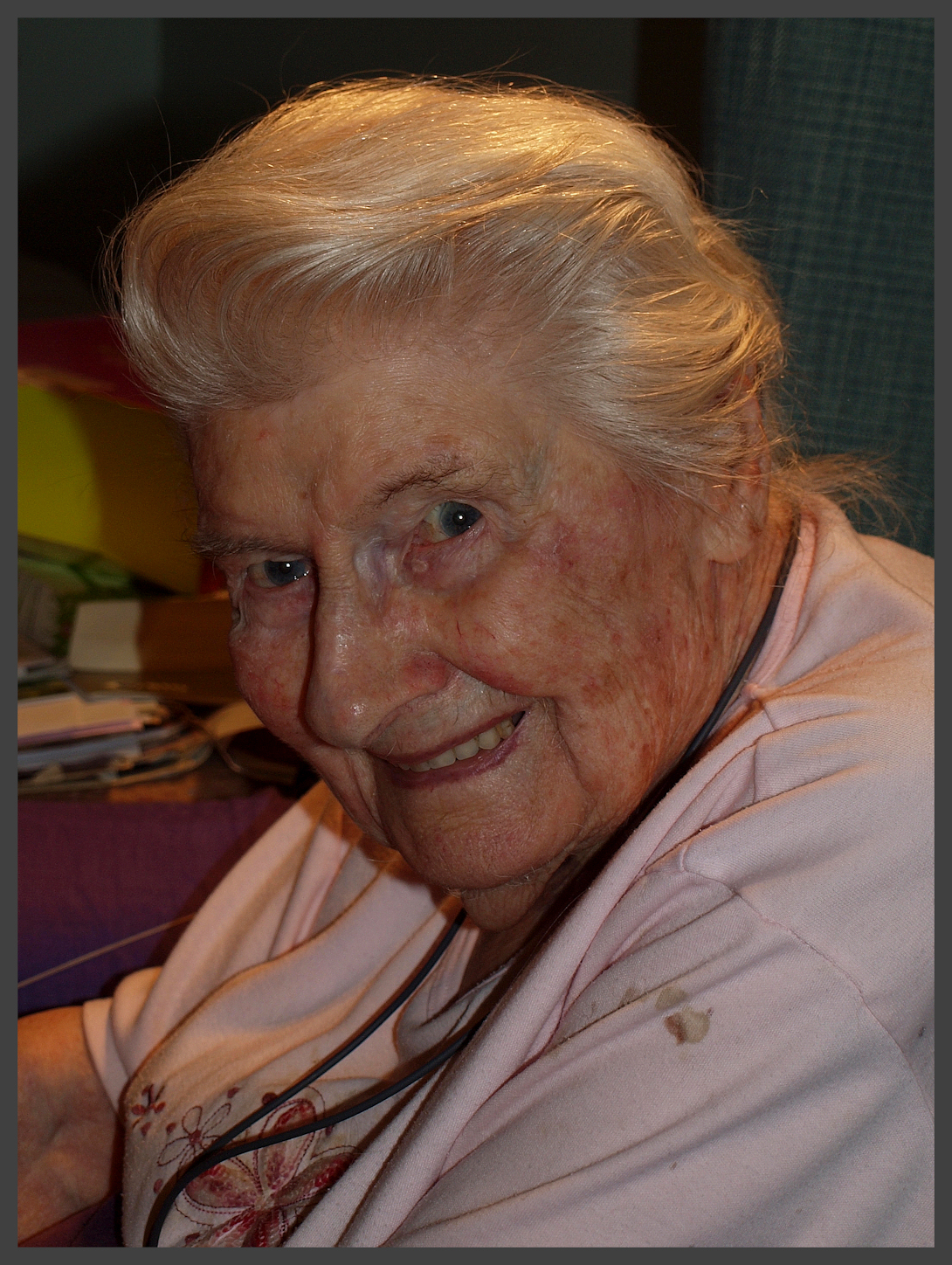
Dora on Her 99th Birthday
East Carleton; October 2014
All the girls in the home love her. They’re always bringing her little things to paint. And yesterday the cook made her a special birthday cake.
I think she’s having a wonderful holiday! And she certainly seems to be enjoying her age; it doesn’t seem to be a burden, although the frailty and deafness are annoying. She still has vivid memories of her childhood and things she’s done through the years.
I just really hope she makes 100 as I think as well as being a huge milestone, she will actually enjoy it, in her own quiet way.
Ten Things #10
A month or so ago my friend Gabriella tagged me in the 10 Books Challenge: to list 10 books that stayed with you in some way. I had been thinking about this for a while, so I was enjoined not to think too hard about it, especially as they don’t have to be the “right” books or great works of literature, just ones that have affected you in some way and stayed with you.
Looking back I find I have done something very similar before. But this time my rather eclectic list is somewhat different …
10 Books that Mean Something to Me
- Like Gabriella I have to start with Anthony Powell’s A Dance to the Music of Time. All twelve volumes. I’ve written so many times before about Dance I’ll say no more here.
- Lewis Carroll, Alice in Wonderland and Alice through the Looking Glass. I remember these from an early age and they started me thinking about language and logic. I especially love the Martin Gardner’s Annotated Alice, first encountered as a student.
- TS Elliot, Old Possum’s Book of Practical Cats. As an 8-year-old I knew “Skimbleshanks” by heart.
- Evelyn Waugh, Black Mischief and Waugh in Abyssinia which might as well be the same book.
- Noreen Marshall, Dictionary of Children’s Clothes, 1700s to Present. How can I not have been influenced by this: I lived with (and still do live with) the author through the umpteen years it was being written.
- Gabriel Chevallier, Clochemerle. Brilliant farce. Read as a teenager.
- John Betjeman, High and Low. I bought this in my teens, when it first came out and for many years it was my go-to book if I had a sleepless night.
- Florence Greenberg, Jewish Cooking. No I’m not Jewish, but I found this when a student and it is such an excellent cookery book. OK there’s no pork or offal but there is just about everything else from the everyday to the special.
- Douglas Adams, Hitch-Hikers Guide to the Galaxy.
- Mervyn Peake, Gormenghast trilogy, especially the first book Titus Groan. I couldn’t finish volume three, Titus Alone; it was just too depressing.
As this is my “Ten Things” I’m not tagging anyone in particular, but you’re all challenged to do this if you haven’t already.
Something for the Weekend
Who would you choose?
I saw this the other day and thought it such a great idea — if only to make one think — it seems worth sharing.
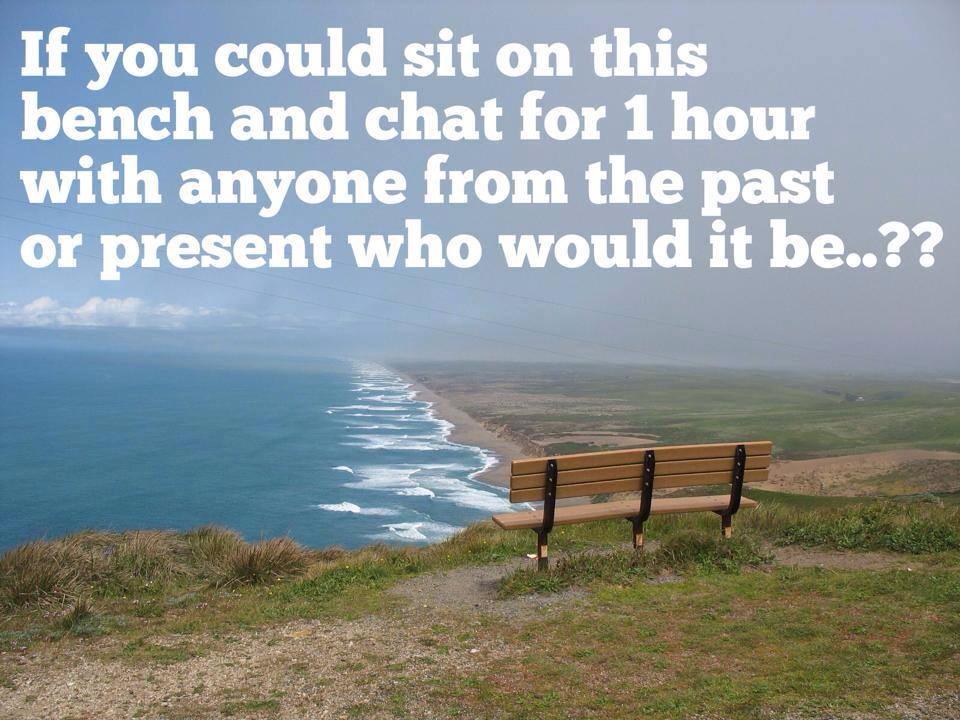
My answer?
My immediate answer when I saw the question was: Prof. Alice Roberts.
But there are just so many great people to choose from. Galileo. Leonardo. William Byrd. Anthony Powell. Richard Feynman. Samuel Pepys. Tony Benn. Dalai Lama. And of course one or two of my ancestors who could unlock some riddles in the family tree.
So who would you choose?
Answers in the comments, or on your blog with a link in the comments, please.
Quotes
Another selection of amusing and/or inspiring quotes encountered in the last few weeks. In no particular order …
Successful psychopaths are going to end up in all the high end jobs, in charge of companies, making millions. The unsuccessful psychopaths are the ones that end up in jail.
[Amy Jones, Liverpool Hope University]
Hope (apathy), is the greatest evil of all. Hope is apathy because hope is doing nothing while hoping that someone else (person, god, chance) will rescue you. The Greeks understood this. Some time in the last 2,000 years, hope stopped being evil, and turned into a good thing.
[unknown]
Don’t underestimate the value of Doing Nothing, of just going along, listening to all the things you can’t hear, and not bothering.
[AA Milne]
[Politicians] talk like the priests of an oriental church, in a Coptic language based on scripture we’re too uneducated to understand.
[Armando Iannucci on the Scottish referendum; Observer; 21/09/2014]
Be very, very careful what you put into that head, because you’ll never, ever get it out.
[Cardinal Wolsey]
Whatever it is you’re seeking won’t come in the form you’re expecting.
[Haruki Murakami]
A mind is like a parachute. It doesn’t work if it is not open.
[Frank Zappa]
I don’t understand why when we destroy something created by man we call it vandalism, but when we destroy something created by nature we call it progress.
[Ed Begley Jr]
The Dalai Lama, when asked what surprised him most about humanity, answered:
“Man. Because he sacrifices his health in order to make money. Then he sacrifices money to recuperate his health. And then he is so anxious about the future that he does not enjoy the present; the result being that he does not live in the present or the future; he lives as if he is never going to die, and then dies having never really lived.”
Facts do not cease to exist because they are ignored.
[Aldous Huxley ]
Where, after all, do universal human rights begin? In small places, close to home — so close and so small that they cannot be seen on any maps of the world … Without concerned citizen action to uphold them close to home, we shall look in vain for progress in the larger world.
[Eleanor Roosevelt]
Oh to be fish again now the nymphs are here.
[unknown]
Oddity of the Week: Currywurst
The Currywurst Museum in Berlin, located just beside Checkpoint Charlie — the most famous crossing point in the Berlin Wall, until it was knocked down in 1989.
The museum’s existence speaks of the astounding success of a very late arrival on the wurst scene, not the heir to proud traditions of an Imperial Free City, but the result of food shortages in post-1945 Berlin. Parodying John Maynard Keynes, who wrote a book about The Economic Consequences of the Peace, you might say that the currywurst is one of The Gastronomic Consequences of the Peace. And it is still very much with us — an essential part of the Berlin experience.
“Currywurst was invented by the help of an unknown British soldier, who sold curry powder on the black market in Berlin in the late 40s. And for these very cheap sausages, they need some sensory contrast, so they decided to sprinkle curry powder on the sausage,” says [Peter Peter, the food correspondent of the Frankfurter Allgemeine Zeitung].

“It was a time when we frenetically discovered foreign dishes, so it was interesting having something Indian, something exotic. It became a symbol of a town that had never had excellent sausages.
“After 1989, Berlin became very popular; a lot of Germans discovered Berlin – so going to a currywurst stall became an experience of a lot of young people. So a dish that in a certain way is a white trash dish became a symbol of visiting Berlin, of young lifestyle.”
From: Neil MacGregor, “The Country with One People and 1200 Sausages”; BBC News Magazine; www.bbc.co.uk/news/magazine-29380144
Human Rights Act II
Just a quick follow-up on my post of a couple of days ago on the Tories proposals to change the UK’s human rights landscape (see Legally Illiterate). As expected this has continued to attract vociferous attacks.
Also as promised the Law and Lawyers blog has posted two further, more in depth, articles:
Human Rights protection in Britain ~ 10 key points
Human Rights ~ the Conservative Party proposals.
Two other pieces worth reading are:
Head of Legal — Full of sound and fury on human rights
UK Human Rights blog — Incoherent, incomplete and disrespectful: The Conservative plans for human rights.
If we care at all about our rights then we all need to be concerned and keep working to halt these appalling proposals.
Weekly Photograph
This week another from the archives … A winter sunrise taken from my study window, and then doctored!
it’s much more impressive seen larger!

Nuclear Sunrise #1
Greenford; December 2007
Your Interesting Links
Yet another selection of amusing, interesting and/or absurd articles you may have missed …
It appears none of us would be here if it weren’t for a virus which invaded a gene which controls the development of the placenta. Carl Zimmer reports.
It’s not every day we find a new mammal. Let alone right under our noses. The Machu Picchu arboreal chinchilla rat (Cuscomys oblativa) was thought extinct, but has been discovered alive and well. How do we lose a cat-sized mammal?
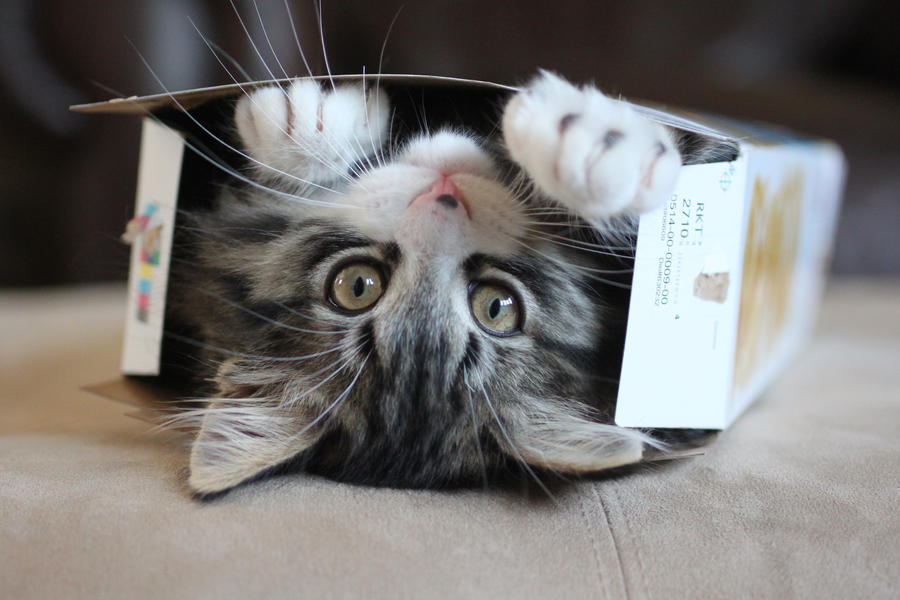
We all know cats love boxes. But cats don’t just love boxes; cats may NEED boxes for their wellbeing.
Arachnophobia is (one of) the most common fears we have. Because all spiders are hairy, scary and lethal, right? But just how dangerous are Britain’s household spiders? Spoiler: not very.
From the journal of “why didn’t we think of this before?” here’s a very simple way to control the spread of invasive plants.
While on plants, another piece on why leaves change colour in autumn.
Peaches. Flavourful but fuzzy. Except when they’re nectarines. It seems the nectarine is a peach with just one modified gene which removes the fuzziness.
While we’re mentioning flavour, and thus taste … Are you a supertaster? Don’t know? Here’s how to find out.
Now, one of the great British arguments … How to make tea: milk first or last? I’m a milk first man, and it seems science agrees. Probably.
Now, at last, we leave science behind for lifestyle …
Nikola Novak on the enjoyment of being naked.
A real-life Romanian prostitute working in Amsterdam’s Red Light District tells us why the Nordic model for eradicating prostitution can never work.

Long before we had browsers we had books. And right from the beginning books needed bookmarks. Erik Kwakkel shows us some medieval bookmarks.
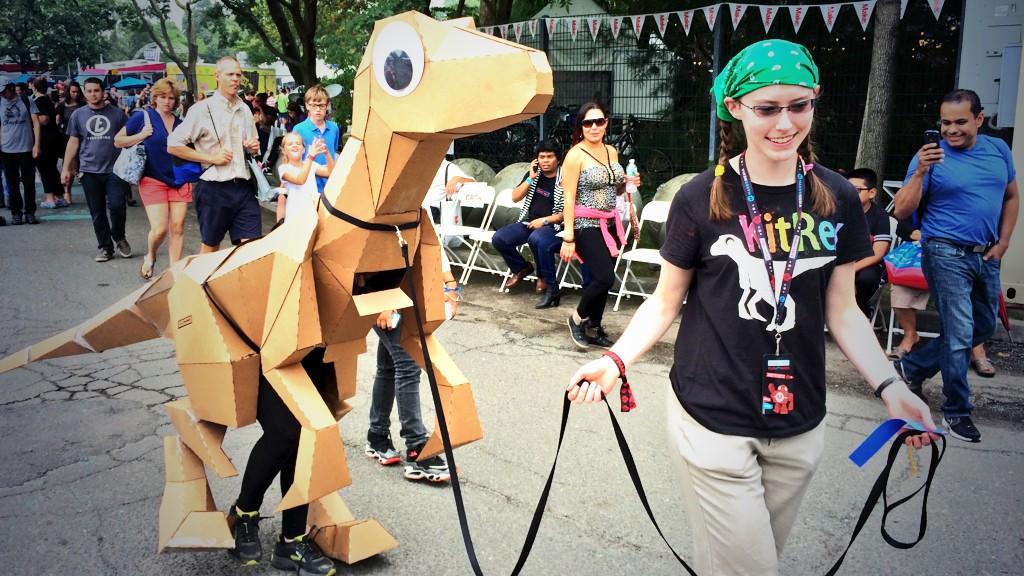
Just for amusement, here’s another paper creation: a life-sized articulated velociraptor.
Finally, Pope Francis has made the most sensible pronouncement by any Pope for a long time: “I believe in guardian angels … and everyone should listen to their advice”.