Apologies for the radio silence over the last week; let’s try to get this show back on the road.
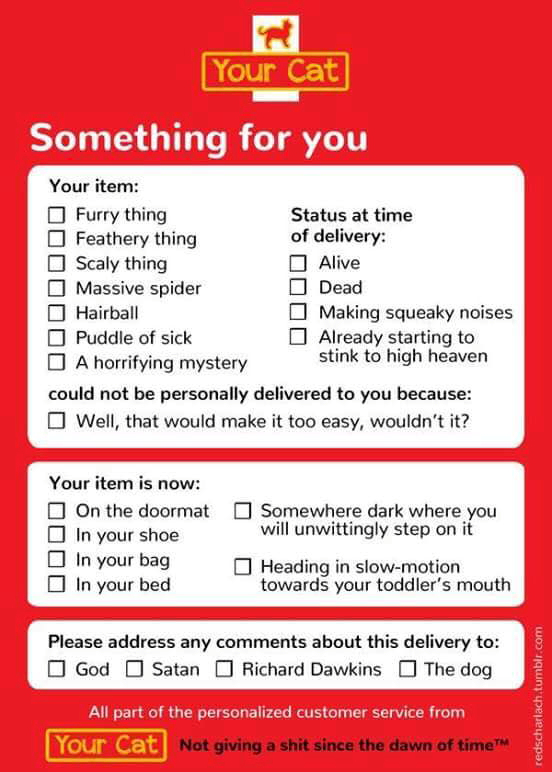
This will be appreciated by all those who provide staff services for cats …

Apologies for the radio silence over the last week; let’s try to get this show back on the road.
This will be appreciated by all those who provide staff services for cats …
This week I thought we’d have another “Two Types” cartoon from WWII cartoonist Jon.

So soon already we have another collection of links to items you missed the first time round.
This first item will worry many people. According to scientists there are only three things preventing the world from converting to 100% nuclear energy: money, the political will and public acceptance. And it could be done in about 30 years which would likely be enough to put a big dent in global warming. Despite all the challenges this works for me.
We’ve known for some time that foetal cells hide in the mother’s body (and vice versa, too). But what do they do?
 IanVisits again, only this time another in his irregular series on Unbuilt London. In the 1960s there was a scheme to remove buses from central London and replace them with a monorail. It never happened, which is a shame as we could have had a rival to Wuppertal’s Schwebebahn.
Pope Francis is currently visiting Cuba and the USA. The followning was reported at the end of August by the Wall Street Journal and the Washington Post and summarised by the Weird Universe blog:
Muslim clerics complain of the commercialization of the holy city of Mecca during the annual Hajj pilgrimages, but for Pope Francis’s visits to New York, Washington, DC, and Philadelphia in mid-September, shameless street vendors and entrepreneurs already appear to be eclipsing Mecca’s experience. Merchants said they’d be selling, among other tacky items, mozzarella cheese statuettes of the Pope ($20), a Pope Toaster to burnish Francis’s image on bread, a Philly-themed bobblehead associating the Pope with the boxer “Rocky”, local beers Papal Pleasure and YOPO (You Only Pope Once), and T-shirts (“Yo Pontiff!” and “The Pope Is My Homeboy”). The Wall Street Journal quoted a Philadelphia archdiocese spokesman admitting that “you kind of have to take it in stride”.
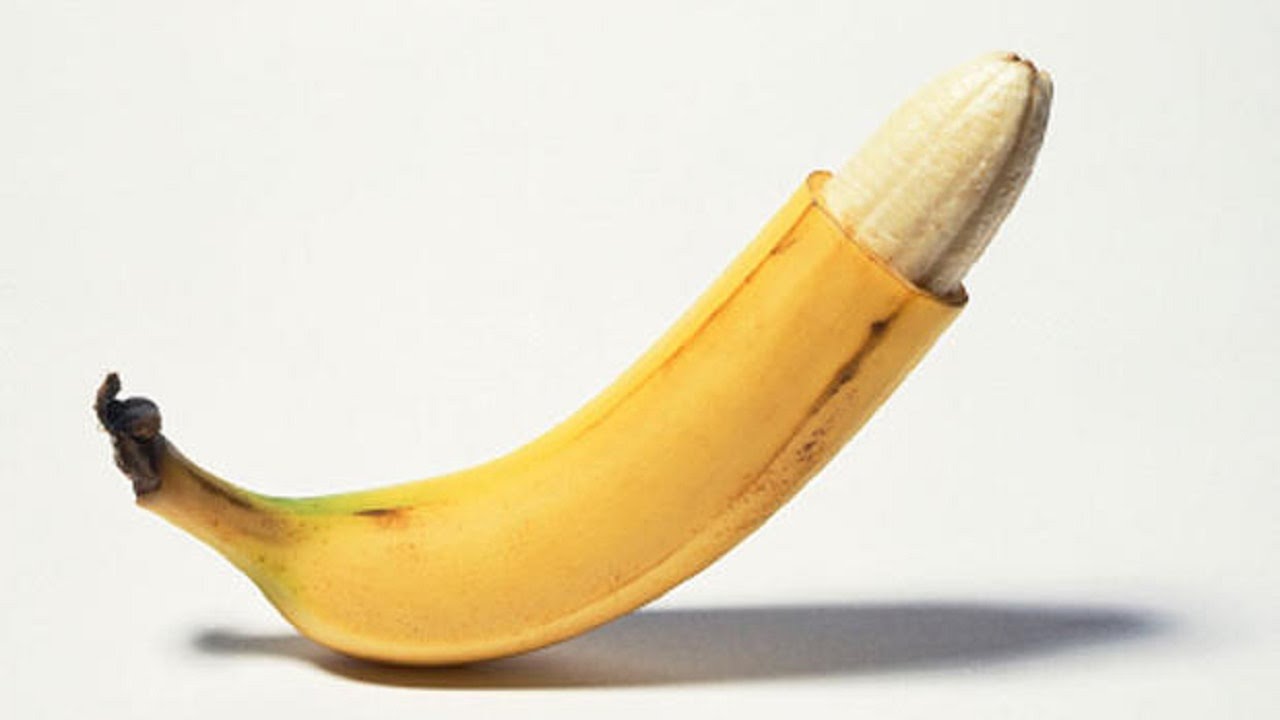
Digging back through my pile of unread articles over the weekend I came across one from earlier this year entitled The Troubled History of the Foreskin [long read].
Common in the US, rare in Europe and now championed in Africa, male circumcision is hotly debated. Author Jessica Wapner looks at the prevalence of male circumcision in America, the way circumcision is being forced onto developing nations (especially in Africa) and the evidence for whether it is actually effective.
After reading the literature, I’m unconvinced by the evidence used to justify circumcision for health reasons. I’ll explain why by means of a thought experiment. Imagine that infant male circumcision had never been a part of American medical practice, but was common in, say, Spain or Senegal or Japan. Based on what we know about the health benefits of the procedure, would American doctors recommend introducing the procedure? And would that evidence be enough for American parents to permanently remove a part of their child’s body without his agreement?
Remember what the evidence tells us. Either the benefits can be obtained by a milder intervention (antibiotics and condoms in the case of urinary tract infections and sexually transmitted diseases), or the risk is low and open to other preventive measures (penile cancer), or the concern is rarely justified (HIV in the United States). Remember also that Western countries where circumcision is rare do not see higher rates of the problems that foreskin removal purports to prevent: not STDs, not penile cancer, not cervical cancer, not HIV. It’s hard to imagine circumcision being introduced on this basis. It’s equally difficult to picture studies on the benefits of the procedure being done.
The main reason we have circumcision in the US today is not the health benefits. It’s because we’re used to it. After all, if circumcision is not definitively preventing a life-threatening issue that cannot be prevented by other means, can removal of a body part without the agreement of the child be justified? We are so accustomed to the practice that operating on an infant so that he resembles his father seems acceptable. I’ve heard many people give this as their reason. It isn’t a good one.
It’s disconcerting to think that circumcising infant boys may be a violation of their human rights. We castigate cultures that practise female genital mutilation (FGM). Rightfully so … removal of the clitoral hood … is anatomically analogous to removal of the foreskin. Some forms of FGM, such as nicking or scratching the female genitalia, are unequivocally deemed a human rights violation but are even milder than the foreskin removal …
Thinking about male circumcision as an unnecessary and irreversible surgery forced on infants, I can’t but hope that the troubled history of the foreskin will come to an end, and that the foreskin will be known for its presence rather than its absence.
Yes, male circumcision should be a human rights abuse just as is FGM.
Footnote: Before anyone wants to ask, no I’m not circumcised. I’m very glad my parents thought as I do that the procedure is unnecessary and thus an abuse. Indeed from memory a majority (maybe 60-70%) of the guys at school and with whom I’ve shared cricket etc. changing rooms were also entire.
This week another from our recent short break in Rye. On the way hope we detoured via Dungeness — such a wonderful expanse of shingle and environmentally hugely important. As might be expected there was a lot of sea kale growing; this is one particularly splendid example. But, yes, I’ve tinkered with the photo to make it even more dramatic!

 Interesting item in last Thursday’s Guardian.
At last someone is beginning to get the message.
Shame it won’t happen — yet.
I was reading the latest on Brad Warner’s Hardcore Zen blog last evening — always worthwhile as Brad is eminently sensible and a Zen master.
He was writing about greed, especially greed for good.
And he nailed why it is that so many of us get frustrated that, while we can make a difference, we can’t make the huge difference that we know is needed. We are being greedy for the goodness we are striving after, and in Zen greed (any greed) is one of the “three poisons”.
Here’s the key extract of what Brad had to say. [My explanations in brackets.]
Greed … does not differentiate between good and bad. We’re used to the term greed being applied to things that are either bad for us or to things that are good or neutral except when over-indulged in … greed doesn’t just get directed towards bad things. You can also be just as greedy for good stuff, for things no one would ever say you shouldn’t want …
Back when I was an employee of Tsuburaya Productions [Japanese company who made the Godzilla films], I found myself getting really frustrated with how things were going. I was very dedicated to the company and I knew we could be doing much better than we were. I saw great opportunities for us internationally that we were just passing by because our management refused to see them or take steps to realize them.
During this time I went and saw Nishijima Roshi [his Zen teacher] and complained bitterly about the situation. Nishijima had been a businessperson most of his working life. He understood that side of things very well. I recall once telling him that Tsuburaya Productions was wasting its opportunities because it had no goals. I caught myself and said that I knew Zen was supposed to be goalless. He said, “Yes. But in business you must have a goal”.
So he got what I was saying that day about my frustrations with the company. But he said I needed to be satisfied with making small changes. Those small changes were important and eventually could lead to greater things. He didn’t exactly tell me not to be greedy, but that’s what he was saying.
The same attitude can be applied to the kinds of noble and important work a lot of people I meet are involved in. A lot of these people are terribly frustrated because they can’t seem to make the sweeping changes they know need to be made in order to fix the problems they’re working on. But many of these problems are global in scale …
It’s unrealistic to expect great changes to happen quickly. Getting greedy for good things only makes matters worse. We start getting angry and depressed, leading us to be unable to be effective in our important efforts to do what needs to be done.
This is something which hadn’t struck me before but on reflection is both correct and important. And it is something I (and probably many others) need to take on board.
Don’t be greedy for change. Yes, have a goal, but be prepared to progress towards it one small step at a time. “Softly, softly, catchee monkey.”
Well yes, of course …
Another selection of interesting and/or amusing quotes encountered …
How amazing it is that we drink water from a tap and never once worry about dying forty-eight hours later from cholera.
[Steven Johnson, How We Got to Now: Six Innovations That Made the Modern World]
Our lives are surrounded and supported by a whole class of objects that are enchanted with the ideas and creativity of thousands of people who came before us: inventors and hobbyists and reformers who steadily hacked away at the problem of making artificial light or clean drinking water so that we can enjoy those luxuries today without a second thought, without even thinking of them as luxuries in the first place … We are indebted to those people every bit as much as, if not more than, we are to the kings and conquerors and magnates of traditional history.
[Steven Johnson, How We Got to Now: Six Innovations That Made the Modern World]
Johannes Gutenberg’s printing press created a surge in demand for spectacles, as the new practice of reading made Europeans across the continent suddenly realize that they were farsighted; the market demand for spectacles encouraged a growing number of people to produce and experiment with lenses, which led to the invention of the microscope, which shortly thereafter enabled us to perceive that our bodies were made up of microscopic cells. You wouldn’t think that printing technology would have anything to do with the expansion of our vision down to the cellular scale, just as you wouldn’t have thought that the evolution of pollen would alter the design of a hummingbird’s wing. But that is the way change happens.
[Steven Johnson, How We Got to Now: Six Innovations That Made the Modern World]
If we lie to the government it’s a felony. But if they lie to us it’s politics.
[Bill Murray]
The door of a bigoted mind opens outwards so that the only result of the pressure of facts upon it is to close it more snugly.
[Ogden Nash]
You cannot perform in a manner inconsistent with the way you see yourself.
[Zig Ziglar]
He was a man of middle age and, to judge by his bowler hat and frock coat, of the official class, and his umbrella had caught alight. I do not know how this can have happened. I passed him in a taxicab, and saw him in the centre of a small crowd, grasping it still by the handle and holding it at arm’s length so that the flames should not scorch him.
[Evelyn Waugh, Labels; hat-tip Stephen Holden]
By default, any good book that is more than 10 years old is filled with life-changing ideas. Why? Because bad books are forgotten after a decade or two. Any lasting book must be filled with ideas that stand the test of time. Meanwhile, the news is filled with fleeting information. We justify paying attention to the media because we think it makes us informed, but being informed is useless when most of the information will be unimportant by tomorrow. The news is just a television show and, like most TV shows, the goal is not to deliver the most accurate version of reality, but the version that keeps you watching. You wouldn’t want to stuff your body with low quality food. Why cram your mind with low quality thoughts?
[James Clear in “Overrated vs. Underrated: Common Beliefs We Get Wrong” at http://jamesclear.com/overrated-underrated]
We love status. We want pins and medallions on our jackets. We want power and prestige in our titles. We want to be acknowledged, recognized, and praised. It’s too bad all of those make for hollow leaders. Great teams require great teammates. Nowhere is that more true that at the top. No leader ever became worse by thinking about their teammates more.
[James Clear in “Overrated vs. Underrated: Common Beliefs We Get Wrong” at http://jamesclear.com/overrated-underrated]
Learning, growth, and improvement are undervalued in the name of getting faster results.
[James Clear in “Overrated vs. Underrated: Common Beliefs We Get Wrong” at http://jamesclear.com/overrated-underrated]
Life has no meaning. Each of us has meaning and we bring it to life.
[Joseph Campbell]
The propagandist’s purpose is to make one set of people forget that certain other sets of people are human.
[Aldous Huxley]
One of the biggest and most important tools of theoretical physics is the wastebasket.
[Richard P Feynman]
 Muslim clerics complain of the commercialization of the holy city of Mecca during the annual Hajj pilgrimages, but for Pope Francis’s visits to New York, Washington, DC, and Philadelphia in mid-September, shameless street vendors and entrepreneurs already appear to be eclipsing Mecca’s experience. Merchants said they’d be selling, among other tacky items, mozzarella cheese statuettes of the Pope ($20), a Pope Toaster to burnish Francis’s image on bread, a Philly-themed bobblehead associating the Pope with the boxer “Rocky”, local beers Papal Pleasure and YOPO (You Only Pope Once), and T-shirts (“Yo Pontiff!” and “The Pope Is My Homeboy”). The Wall Street Journal quoted a Philadelphia archdiocese spokesman admitting that “you kind of have to take it in stride”.