This week’s photograph is one I took on Saturday. It shows the commemorative plaque to General Sikorski who was leader of the exiled Polish forces in WWII. The plaque is on the (astonishingly expensive) Rubens Hotel, right opposite the entrance to Buckingham Palace Mews, which was the Polish forces GHQ for most of the War. This is not just a piece of history for it will resonate with Anthony Powell fans. Powell spent most of his war years as Military Intelligence (Liaison) and for much of that time was the officer responsible for liason with the Polish Allies — so he would have known the Rubens Hotel well.
Click the image for larger views on Flickr to read the lettering Rubens Hotel, Polish Plaque London, 2 May 2015
I’m sorry the image isn’t brilliant, but the hotel’s display board is at comfortable reading height, so the plaque is a couple of feet above my head height and I’ve had to correct the verticals in the image.
This week’s photograph was taken as an experiment. Yes, it really is the sun partially obscured by cloud. I took it when I was playing around testing out exposure settings on my small camera so I could photograph the partial solar eclipse of 20 March 2015. (As it turned out there was no chance of seeing the eclipse due to cloud.) This is the best of several shots, taken at varying exposures, I wanted to see how it really would stand up as an actual image. Experimental, but I think quite interesting.
Cloudy Sun Greenford; March 2015
Click the image for larger views on Flickr
So there I was in Uxbridge a few weeks ago, sitting waiting people watching while for Noreen to emerge from M&S, when these three beauties happened along. They seemed to be about to enact Act 1, Scene 1 of Macbeth.
Macbeth Act 1, Scene 1 in Modern Dress Uxbridge, March 2015
Click on the image for larger views on Flickr
This week’s photograph is another from the archives and is specially for all those who know and love Dungeness — and especially for Katy! Dungeness is just such a wonderful place: open, bright, wind-swept, desolate and isolated. As one of the largest areas of natural shingle habitat in Europe it is also ecologically important.
This is Prospect Cottage, the late Derek Jarman’s cottage in the middle of Dungeness, with the minimalist garden he laid out amongst the shingle.
Prospect Cottage, Dungeness Dungeness, August 2010
Click on the image for larger views on Flickr
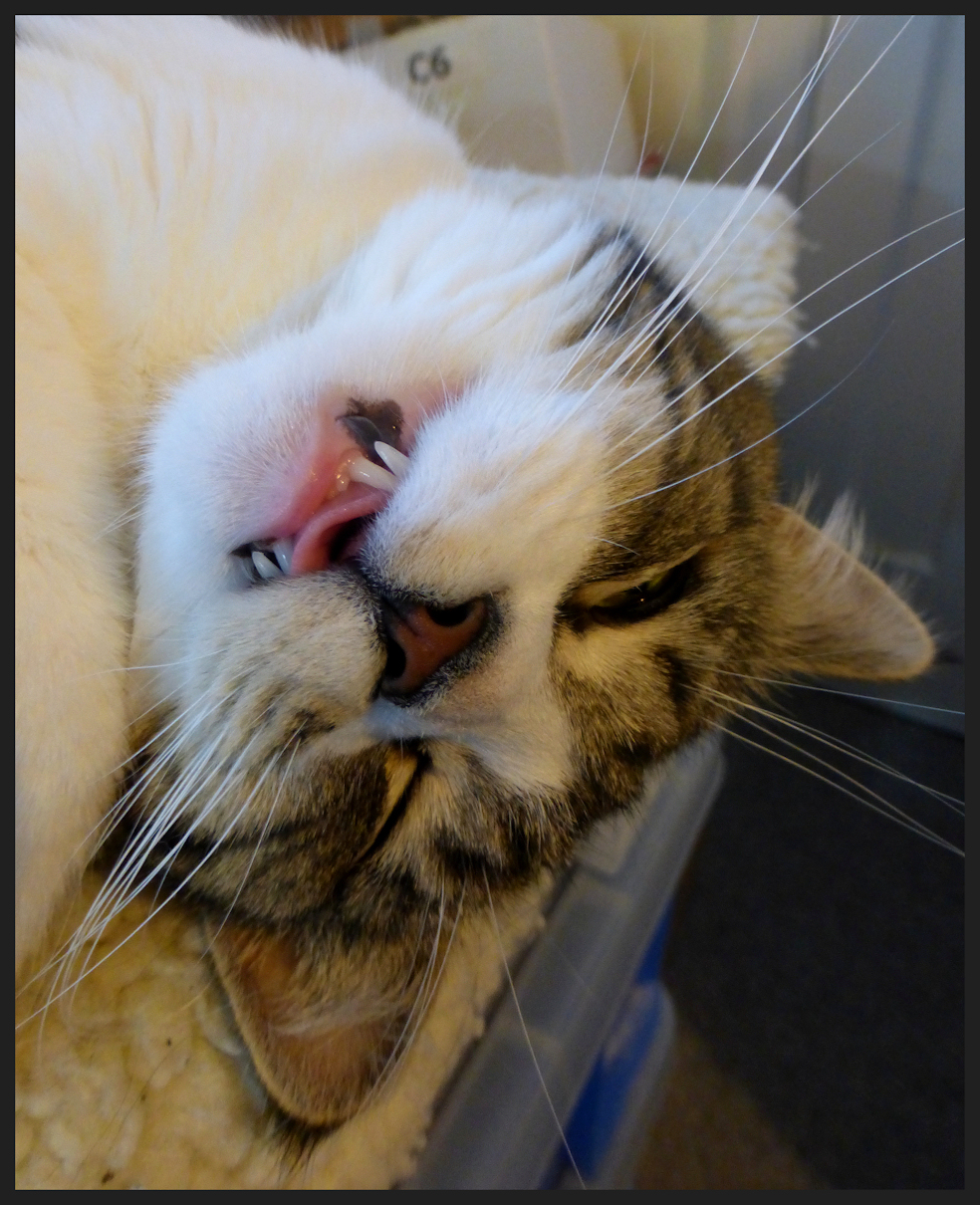
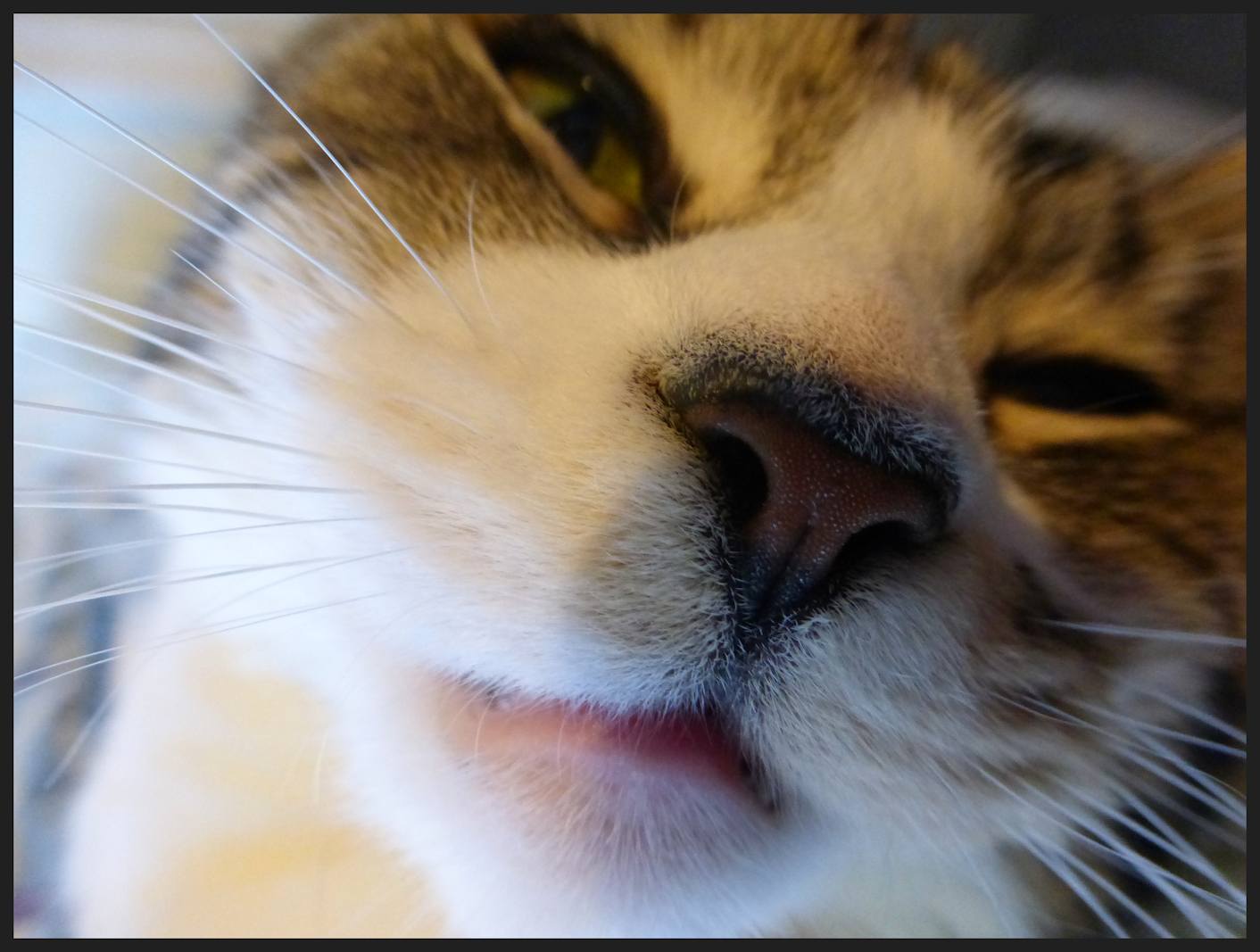
This week another round of pussy porn, with another couple of Tilly being cute — she does it so well when she isn’t being a turbo-charged varmint. Both shots were taken last week.
More pussy porn again this week. Here’s Tilly doing her Miss Cute act, which she is very good at when she’s not running about being a varmint and trying to knock the cat door off its hinges.
Click the image for larger views on Flickr Cute Little Me? Greenford; February 2015
Meteorologically, at least for the UK, yesterday (1 March) was the first day of Spring. Which means Summer must surely be not far behind. This week’s photograph is another from the archive to remind us what Summer is like and what we have to look forward to.
Click the image for larger views on Flickr Hollyhock Pinner; July 2011
Bats roost in big groups in caves. Wrong! If you’re a Hardwicke’s woolly bat, you prefer to sleep in a more luxurious — and private — place.
Kerivoula hardwickii roosts inside tropical pitcher plants. These carnivorous plants usually attract insects, but Nepenthes hemsleyana lacks the scents that others have, so few bugs are lured in. Instead, it benefits from the faeces of this tiny bat, which provides more than a third of its nitrogen and may be crucial to the plant’s survival.
These bats found a niche that no-one else was occupying; they are the only bat species known to roost in pitcher plants.
To take [the image above, and others] Merlin Tuttle waded through tropical forest peat swamps on Borneo. Once he had found an occupied plant, he would spend a few hours taming a bat before snapping it from his portable studio, which provided protection from heavy rains. “It only takes a small fraction of a second for a bat to either enter or emerge, so capturing the action at just the right moment is a real challenge,” says Tuttle. Within a few days, the bats had learned to bump against his nose when they wanted him to give them some mealworms. “We were quite amazed at the intelligence of such tiny animals,” Tuttle says. “Contrary to common misconceptions, bats in general are gentle, highly intelligent and trainable.”
It is the fact that wild bats are so easily trainable that really struck me!
From New Scientist, 21 February 2015 and at www.newscientist.com/article/mg22530090.100-tiny-bat-makes-home-in-a-carnivorous-plant.htm.
This week a self-portrait from several years ago. Taken, with a fisheye lens, in our hotel room when away for the weekend — I was actually going to a school reunion.
Click the image for larger views on Flickr Self-Portrait with Chair Cheshunt; June 2008
Eccentric looks at life through the thoughts of a retired working thinker