This week a self-portrait from several years ago. Taken, with a fisheye lens, in our hotel room when away for the weekend — I was actually going to a school reunion.

Self-Portrait with Chair
Cheshunt; June 2008
This week a self-portrait from several years ago. Taken, with a fisheye lens, in our hotel room when away for the weekend — I was actually going to a school reunion.
This month in “Ten Things” I thought we should have a look at my weekend. I won’t claim this is typical although many of the activities are far from unusual.
10 Things I did Last Weekend
So how was your weekend? Did you do anything other than nothing?
This week I bring you two photographs of magnificent memorials from Goudhurst church in Kent, taken at the end of the day after we had been round some of the nearby villages in search of my ancestors.
[You really do need to click the images and look at larger versions on Flickr!]
The first, which dates from around 1616, is to William Campion and his wife Rachell:


This month’s “ten things” list is suitably topical for the beginning of the year.
To quote my friend Katy:
Regular readers will know that I do no do punitive resolutions. I don’t believe in forcing myself into a miserable cycle of activities I really don’t want to do, but feel in some spartan way would be ‘good for me’, and which I torture myself with before inevitably giving up, because they’re hateful and things that are good for me in that way are usually about as much fun as sitting on a spike and eating raw turnips.
However here is a list of 10 things I am going to try to do in 2015, in no special order:
Some of those are going to be a lot harder than others, and not all are ultimately within my control, so it remains to be seen how successful I shall be, but we’ll give it a go and not be disappointed if we fail.
As last year here is a survey to summarise my engagement (or lack of it) with 2014.
 1. What did you do that you’d never done before?
Yoga
Have a full body massage
Got hearing aids
Injected myself with drugs (legally!)
2. Did you keep your new year’s resolutions, and will you make more for next year?
I don’t make New Year resolutions (see here); but I did have some goals most of which I failed to achieve.
3. What would you like to have in 2015 that you lacked in 2014?
£2M
Good health
4. What dates from 2014 will remain etched upon your memory?
None that I can think of.
5. Did you suffer illness or injury?
I had an awful respiratory virus which floored me for over a month in February/March and again in October/November.
And then there’s the ongoing diabetes and depression.
6. What was the best thing you bought?
Gin and champagne
7. Where did most of your money go?
As far as I can tell absolutely nowhere, and certainly nowhere very worthwhile (unless you count gin and champagne!).
8. What did you get really, really excited about?
Nothing; I don’t waste effort on excitement or panic.
9. Compared to this time last year, are you:
a. happier or sadder? — sadder, ‘cos I haven’t kicked the depression hard enough in the gonads.
b. thinner or fatter? — fatter, but not by very much.
c. richer or poorer? — poorer, if only due to expensive dental treatment.
10. What do you wish you’d done more of?
Sex
Sit in the garden in the sun
11. What do you wish you’d done less of?
Been stuck to a desk
12. What was your biggest achievement of the year?
Survival
13. What was your biggest failure?
Yoga
14. How many one-night stands?
None
15. What was your favourite TV program?
I’ve just not watched anything like enough TV to be able to make any sort of judgement.
16. What was the best book you read?
Two books by Alice Roberts come out top of the heap: Evolution: The Human Story (Dorling Kindersey, 2011) and The Incredible Unlikeliness of Being: Evolution and the Making of Us (Heron Books, 2014)
17. What did you want and get?
An immense amount of help and support, in all sorts of ways, from Noreen, for which I am far more grateful than I think she realises.
18. What did you want and not get?
£2m
Sanity
19. What one thing would have made your year immeasurably more satisfying?
Choose between better health and a couple of holidays.
20. How would you describe your personal fashion concept in 2014?
Nude when possible, clothed when necessary.
21. What kept you sane?
Did anything keep me sane?
22. Who did you miss?
I’ve no idea! I’m not conscious of having specifically missed anyone.
23. Tell us a valuable life lesson you learned in 2014:
Quality of life is more important than stressing yourself to conform to society’s expectations. But then I failed to live up to it.
24. A quote or song lyric that sums up your year:
It’ll pass, Sir, like other days in the Army.
[Anthony Powell, A Dance to the Music of Time]
25. Your hopes for 2015
Society normalises sex and nudity rather than criminalising it
Any office block which is less than half occupied for more than 3 months has to be converted into flats, or demolished and homes built on the site
Drink more champagne
Be painted or photographed nude
Have at least one 2 week holiday
My mother makes her 100th birthday
So how was your 2014? And what are you hoping for in 2015?
Yes, we’ve had a nice relaxing day of presents, drink and food but without over-indulging.
Had a bit of a lie-in and got up about 9.30. Two mince pies and mug of tea for breakfast.
I rang my mother and had a quick chat with her; she’s in a care home 120 miles away so although we aren’t there she isn’t on her own.
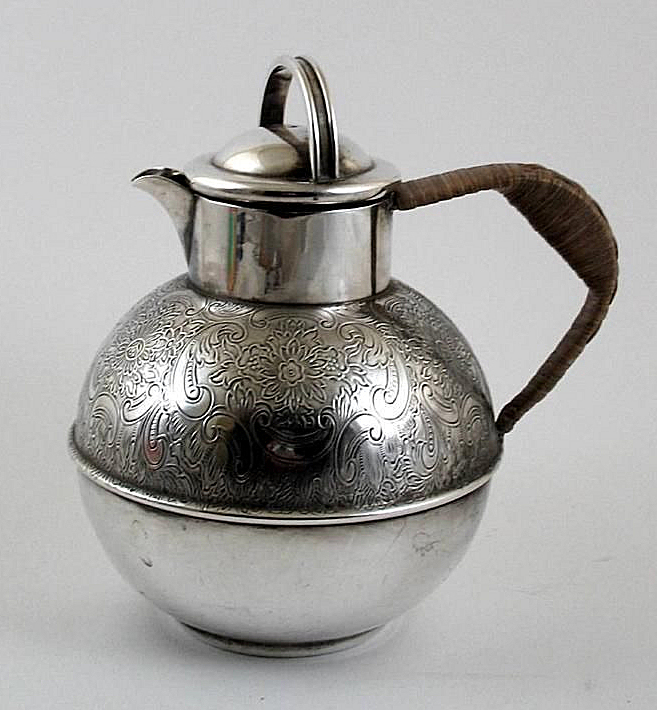 About 11.30 we sat down with an extra large G&T (Noreen had a similarly large Bacardi & Coke) and opened our main presents. As always there was a fair amount of alcohol and quite a few books. But we always manage to find each other something unusual: this year I got Noreen a Jersey milk/cream jug — silver plate, pre-WWII and probably made for the tourist market, but a nice thing nonetheless.
After clearing up a bit we had our traditional Christmas Day lunch of smoked salmon sandwiches at about 1.30 (we have Christmas Dinner in the evening).
At 3-ish Noreen put a large leg of pork in the oven to roast; while I had a nap she went to see the old lady across the road (who is 90+ and on her own) for an hour or so.
Just after 5 we both got to work in the kitchen on the rest of dinner. Somehow we managed to avoid any alcohol in the process!
Dinner at about 7: Roast Pork, sausage, garlic potatoes, roast parsnips, sprouts, chestnut stuffing and apple sauce. Accompanied by a bottle of pink champagne (which also now one of our traditions). No need for starters or pudding; just a good main course.
After dinner we sat and opened presents part two which I accompanied with a glass of an unusual, rather nice and delicate rosé port Noreen had given me. The tradition from my family is to have small presents, from under the tree, in the evening — really just a little something to unwrap like a few chocs or a paperback book.
After that we sat reading for a bit and abhorring the available choices of TV viewing.
And shortly to bed, perhaps to read some more, maybe with another glass of something.
I think we’ll call that a good Christmas!
This month’s “Ten Things” has a predictably seasonal theme: Christmas.
 Christmas Things I Enjoy
This is number five in my series of articles on depression — my depression. They are written from a very personal perspective; they are my views of how I see things working and what it feels like on the inside. Your views and experiences may be vastly different. My views and experiences are not necessarily backed by scientific evidence or current medical opinion. These articles are not medical advice or treatment pathways. If you think you have a problem then you should talk to your primary care physician.
 Questions & Answer
In the course of writing these posts I’ve collected a small number of articles which throw some interesting lights on various aspects of depression. I’ve already mentioned some, but this post is to try to gather some of the others together.
The first is a quote from The Body Keeps the Score: Brain, mind, and body in the healing of trauma by Bessel van der Kolk
If your parents’ faces never lit up when they looked at you, it’s hard to know what it feels like to be loved and cherished.
Now that’s a fairly telling statement and if, like me, it fits your childhood then any wonder we get depressed.
This next is a link to a cartoon, about just how badly we treat the mentally ill (not just the depressed but I guess it happens to us more as our illness isn’t always so apparent). So what would it be like if physical illness were treated as we treat depression.
And now a short animated video which explains a little of the science behind depression but also highlights, perhaps, how little we really know.
Unfortunately research into depression struggles to attract funding in a way which would not be tolerated for, say, cancer. This Scientific American article demonstrates how important it is to change this especially now that useful technologies are becoming available. For those who don’t want to read the whole article here are a few key comments.
If the extent of human suffering were used to decide which diseases deserve the most medical attention, then depression would be near the top of the list.
[…]
[A]lthough depression is common, it is often ignored. Three-quarters of people with depression in the United Kingdom go undiagnosed or untreated — and even if the disorder is diagnosed, today’s medications will work well for only about half of those who seek help.
[…]
Research into depression … seems to have floundered.
[…]
Although … extra money would have solved some challenges earlier, the technology needed to crack others — by probing the brain and analysing its circuits, for example — is only now emerging.
[…]
[A]nother major factor is the long-standing stigma associated with depression. Many people still do not acknowledge that it is a legitimate condition … A large proportion of people believe depression is just something that we all feel … They think you should pull your socks up and get back to work.
One thing which seems to be common to most depressives is sleep disruption in some form, whether that is a disrupted or inappropriate sleep pattern or just plain old insomnia. But there may be some distant hope as scientists seem to be homing in on disrupted circadian rhythms being the underlying cause.
Disrupted sleep is so commonly a symptom of depression that some of the first things doctors look for in diagnosing depression are insomnia and excessive sleeping … scientists have observed for the first time a dysfunctional body clock in the brains of people with depression.
[…]
People with major depression … show disrupted circadian rhythms across brain regions.
[…]
[G]ene activity in the brains of depressed people failed to follow healthy 24-hour cycles. They seem to have the sleep cycle both shifted and disrupted.
The article goes on to explain how looking at the brains of dead but non-depressed people the scientists could pinpoint the time of death from how various genes were switched on or off. This was impossible with depressed subjects whose clocks were both shifted and disrupted. It isn’t simple as there are many genes involved, but variations in the gene expression could potentially cause all sorts of different sleep pattern disruptions.
Here are two more articles on sleep and depression. This first Sleep and Depression is a fairly simple explanation of the sleep disruption you may encounter and some pointers to what you can do to try to alleviate it. The second by David Nutt & Louise Paterson is an academic review from 2008 of what was then known; needless to say it contains lots of data.
Finally in this short round-up we must return to the question of body clocks, because another aspect is Season Affective Disorder (SAD) which affects many people during the darker winter months probably because we don’t get enough light to reset our clocks every morning. A very recent article by Katherine Hobson on Nautilus summarises some of what is known about high intensity light therapy to treat not just SAD but potentially other disorders too.
Light therapy has become standard for treating seasonal depression … light has a benevolent influence on mood during the dark days of winter instinctively makes sense: As hazardous as sunbathing is, it certainly feels good … research into the circadian underpinnings of chronic depression, bipolar disorder, Alzheimer’s disease, and fatigue suggests that light could help these patients readjust too.
[…]
Exactly how light works isn’t known, but many researchers suspect that bright lights help SAD sufferers by regulating their sluggish circadian clocks.
[…]
[C]ircadian rhythms appear to be disturbed in non-seasonal maladies too, which means there is a potential for light therapy beyond SAD.
[…]
In general, bright light therapy is a low-risk and low-cost option for treatment … it may speed up patients’ responses to antidepressants.
[…]
[T]he elderly might be particularly susceptible to the benefits of light therapy because their light perception declines with age, which might be throwing their internal clocks out of sync.
While SAD is one of the factors in my depression — and I know I feel much better on bright sunny days — it is far from the only one and is not the most crippling. I have tried light therapy two or three times over the years and never had much success with it. But it doesn’t work on everyone: while it doesn’t work for me it might work for you.