I haven’t done an ABC meme for a long time, so when Andrew Baker posted one on Facebook last week, well how could I resist. So here goes …
A — Age: 64
B — Biggest Fear: Poverty
C — Current Time: 11.11
D — Drink You Last Had: Tea
E — Easiest Person To Talk To: Noreen
F — Favourite Song: Pink Floyd, Learning to Fly
G — Grossest Memory: Finding a stillborn foetus on the front garden path a few years ago. About 3 inches long it looked dog-like; definitely not human (thank heaven).
H — Hometown: Waltham Cross
I — In Love With: Noreen
J — Jealous Of: (Assuming you mean jealous and not envious) my money
K — Killed Someone: Not that I know of
L — Longest Relationship: 37 years
M — Middle Name: Cullingworth (my mother’s maiden name — it’s from the village in Yorkshire)
N — Number Of Siblings: Zero
O — One Wish: Three more wishes
P — Person Who You Last Called: Tom
Q — Question You’re Always Asked: When is the next meeting?
R — Reason To Smile: Pretty girls, especially in summer
S — Song You Last Sang: Hymn “All People that on Earth do Dwell” (at my mother’s funeral)
T — Time You Woke Up: 0700 hrs
U — Underwear Colour: Nude
V — Vacation Destination: What’s a vacation?
W — Worst Habit: Procrastination
X — X-rays You’ve Had: Left hand, right foot, sinuses (at least twice), full dental and lots of run of the mill dental, large intestine (twice, and a scan), stomach, both knees (scan), kidneys
Y — Your Favourite Food: Curry
Z — Zodiac Sign: Capricorn
And no, I’m really not going to nominate anyone for this; but play along if you want to — just leave a link to yours in the comments so we can all laugh along!
Category Archives: personal
Weekly Photograph
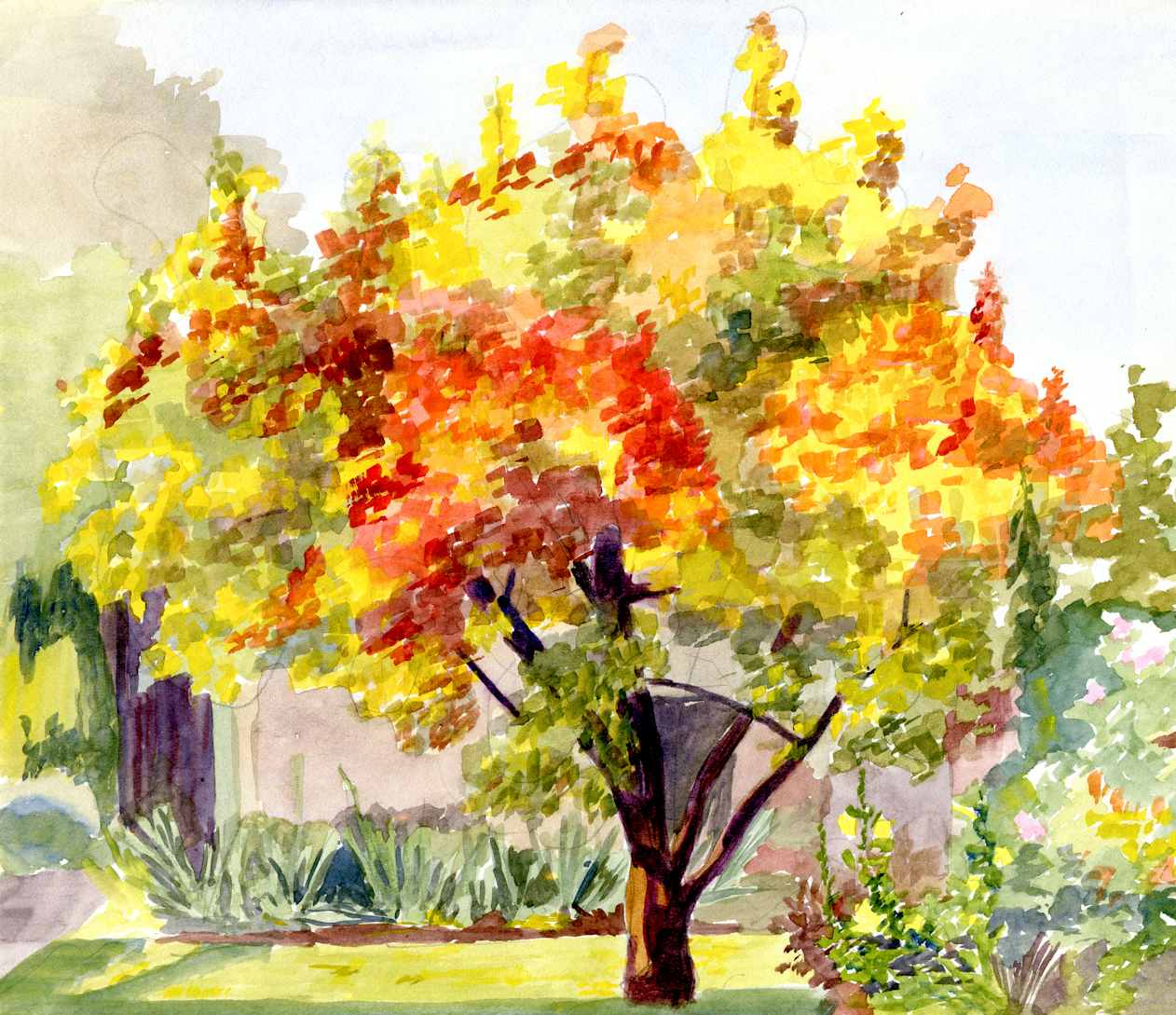
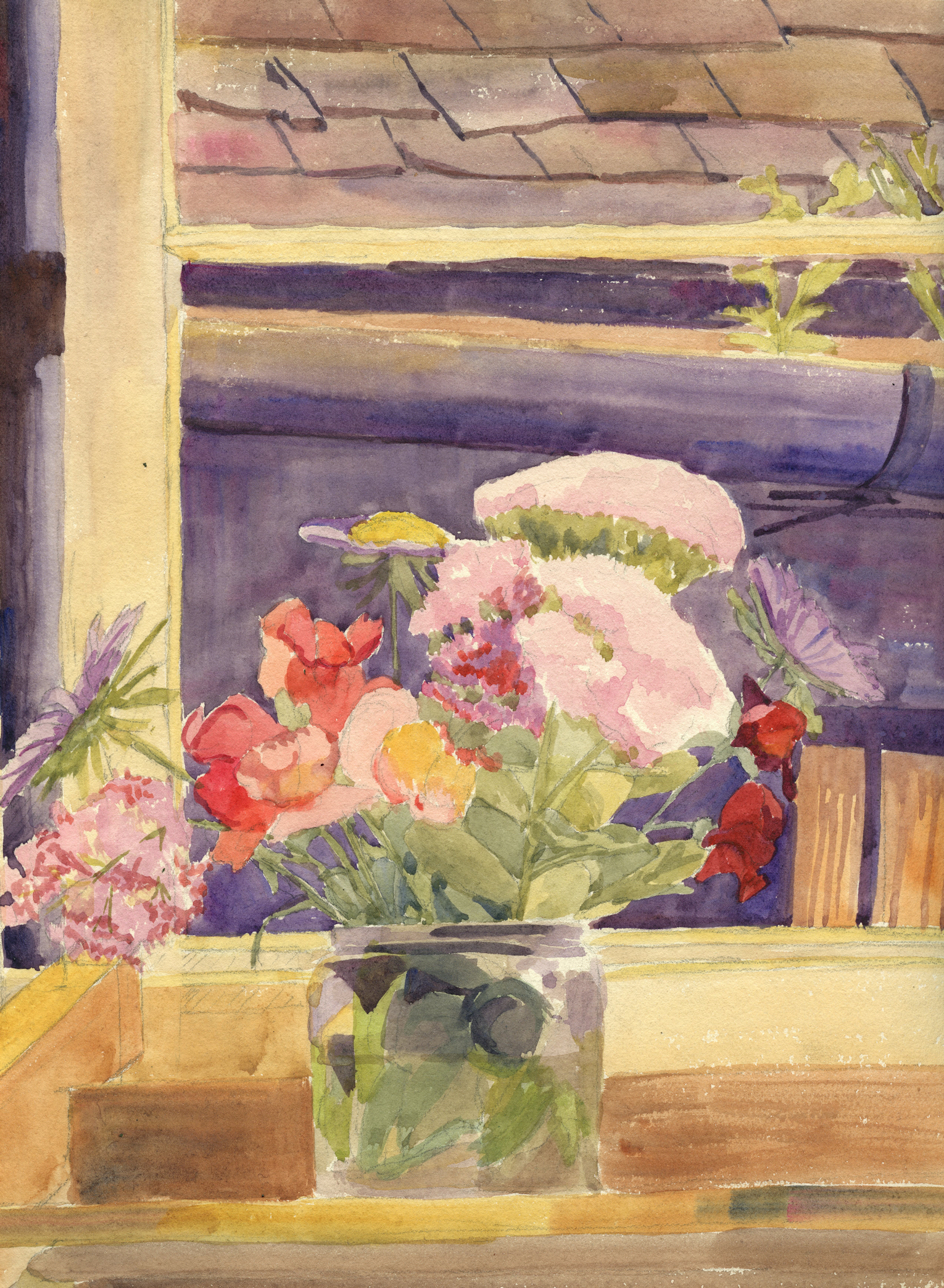
This week I’m going to cheat a bit for my weekly photograph. What I give you is a scan of one of my mother’s watercolours: one painted during the war when she was Warden of Leatherhead YHA. It’s interesting to compare this with her later work, as shown in my earlier post about Dora’s funeral, and see how her technique and style changed over the years.

Dora Marshall, Bedroom Window, YHA Leatherhead (The Old Rising Sun)
Watercolour, 30×22.5cm, ca. 1944
Click the image for a larger view
Painting © Dora Marshall, 1944
4 Daily Poems #4
And so to the last of my poem a day for four days challenge.
The Rolling English Road
(GK Chesterton)
Before the Roman came to Rye or out to Severn strode,
The rolling English drunkard made the rolling English road.
A reeling road, a rolling road, that rambles round the shire,
And after him the parson ran, the sexton and the squire;
A merry road, a mazy road, and such as we did tread
The night we went to Birmingham by way of Beachy Head.
I knew no harm of Bonaparte and plenty of the Squire,
And for to fight the Frenchman I did not much desire;
But I did bash their baggonets because they came arrayed
To straighten out the crooked road an English drunkard made,
Where you and I went down the lane with ale-mugs in our hands,
The night we went to Glastonbury by way of Goodwin Sands.
His sins they were forgiven him; or why do flowers run
Behind him; and the hedges all strengthening in the sun?
The wild thing went from left to right and knew not which was which,
But the wild rose was above him when they found him in the ditch.
God pardon us, nor harden us; we did not see so clear
The night we went to Bannockburn by way of Brighton Pier.
My friends, we will not go again or ape an ancient rage,
Or stretch the folly of our youth to be the shame of age,
But walk with clearer eyes and ears this path that wandereth,
And see undrugged in evening light the decent inn of death;
For there is good news yet to hear and fine things to be seen,
Before we go to Paradise by way of Kensal Green.
My final three nominees to perpetuate the meme are: Keeley Schell, Sue Lubkowska and Peter Kislinger.
4 Daily Poems #3
And so we come to the third of my four daily poems challenge. Today I thought we’d have a couple of Limericks.
The Limerick packs laughs anatomical
Into space that is quite economical,
But the good ones I’ve seen
So seldom are clean,
And the clean ones so seldom are comical.
There was a young queer of Khartoum
Took a lesbian up to his room,
And they argued all night
As to who had the right
To do what, and with which, and to whom.
To his bride, said the lynx-eyed detective,
“Can it be that my eyesight’s defective?
Or is your east tit the least
Bit the best of the west?
Or is it a trick of perspective?”
And today’s three lucky nominees are: John Potter, Jill Weekes and Kevin Bourne.
4 Daily Poems #2
So for the second of the four daily poems I’ve been challenged to post.
Kubla Khan
(by Samuel Taylor Coleridge)
In Xanadu did Kubla Khan
A stately pleasure-dome decree:
Where Alph, the sacred river, ran
Through caverns measureless to man
Down to a sunless sea.
So twice five miles of fertile ground
With walls and towers were girdled round;
And there were gardens bright with sinuous rills,
Where blossomed many an incense-bearing tree;
And here were forests ancient as the hills,
Enfolding sunny spots of greenery.
But oh! that deep romantic chasm which slanted
Down the green hill athwart a cedarn cover!
A savage place! as holy and enchanted
As e’er beneath a waning moon was haunted
By woman wailing for her demon-lover!
And from this chasm, with ceaseless turmoil seething,
As if this earth in fast thick pants were breathing,
A mighty fountain momently was forced:
Amid whose swift half-intermitted burst
Huge fragments vaulted like rebounding hail,
Or chaffy grain beneath the thresher’s flail:
And mid these dancing rocks at once and ever
It flung up momently the sacred river.
Five miles meandering with a mazy motion
Through wood and dale the sacred river ran,
Then reached the caverns measureless to man,
And sank in tumult to a lifeless ocean;
And ’mid this tumult Kubla heard from far
Ancestral voices prophesying war!
The shadow of the dome of pleasure
Floated midway on the waves;
Where was heard the mingled measure
From the fountain and the caves.
It was a miracle of rare device,
A sunny pleasure-dome with caves of ice!
A damsel with a dulcimer
In a vision once I saw:
It was an Abyssinian maid
And on her dulcimer she played,
Singing of Mount Abora.
Could I revive within me
Her symphony and song,
To such a deep delight ’twould win me,
That with music loud and long,
I would build that dome in air,
That sunny dome! those caves of ice!
And all who heard should see them there,
And all should cry, Beware! Beware!
His flashing eyes, his floating hair!
Weave a circle round him thrice,
And close your eyes with holy dread
For he on honey-dew hath fed,
And drunk the milk of Paradise.
I love the opening of this poem and the “damsel with a dulcimer”.
And today I’ll nominate: John Monaghan, Steve Olle and Laura Jane Stamps.
4 Daily Poems #1
I’ve been tagged by my friend Julia over on Facebook to post a poem for four consecutive days and each day to nominate three others to do likewise. OK, the poems I will do, but I’m not going to promise to nominate people every time. So here is the first poem, which I knew by heart as a kid long before it appeared in a musical.
Skimbleshanks: The Railway Cat
(from TS Eliot’s, Old Possum’s Book of Practical Cats)
There’s a whisper down the line at 11.39
When the Night Mail’s ready to depart,
Saying ‘Skimble, where is Skimble, has he gone to hunt the thimble?
We must find him or the train can’t start.’
All the guards and all the porters and the stationmaster’s daughters
They are searching high and low,
Saying ‘Skimble, where is Skimble, for unless he’s very nimble
Then the Night Mail just can’t go.’
At 11.42 then the signal’s nearly due
And the passengers are frantic to a man —
Then Skimble will appear and he’ll saunter to the rear:
He’s been busy in the luggage van!
He gives one flash of his glass-green eyes
And the signal goes ‘All Clear!’
And we’re off at last for the northern part
Of the Northern Hemisphere!
You may say that by and large it is Skimble who’s in charge
Of the Sleeping Car Express.
From the driver and the guards to the bagmen playing cards
He will supervise them all, more or less.
Down the corridor he paces and examines all the faces
Of the travellers in the First and in the Third;
He establishes control by a regular patrol
And he’d know at once if anything occurred.
He will watch you without winking and he sees what you are thinking
And it’s certain that he doesn’t approve
Of hilarity and riot, so the folk are very quiet
When Skimble is about and on them move.
You can play no pranks with Skimbleshanks!
He’s a Cat that cannot be ignored;
So nothing goes wrong on the Northern Mail
When Skimbleshanks is aboard.
Oh it’s very pleasant when you have found your little den
With your name written up on the door.
And the berth is very neat with a newly folded sheet
And there’s not a speck of dust on the floor.
There is every sort of light — you can make it dark or bright;
There’s a button that you turn to make a breeze.
There’s a funny little basin you’re supposed to wash your face in
And a crank to shut the window if you sneeze.
Then the guard looks in politely and will ask you very brightly
‘Do you like your morning tea weak or strong?’
But Skimble’s just behind him and was ready to remind him,
For Skimble won’t let anything go wrong.
And when you creep into your cosy berth
And pull up the counterpane,
You are bound to admit that it’s very nice
To know that your won’t be bothered by mice —
You can leave all that to the Railway Cat,
The Cat of the Railway Train!
In the middle of the night he is always fresh and bright;
Every now and then he has a cup of tea
With perhaps a drop of Scotch while he’s keeping on the watch,
Only stopping here and there to catch a flea.
You were fast asleep at Crewe and so you never knew
That he was walking up and down the station;
You were sleeping all the while he was busy at Carlisle,
Where he greets the stationmaster with elation.
But you saw him at Dumfries, where he summons the police
If there’s anything they ought to know about:
When you get to Gallowgate there you do not have to wait —
For Skimbleshanks will help you to get out!
He gives you a wave of his long brown tail
Which says: ‘I’ll see you again!
You’ll meet without fail on the Midnight Mail
The Cat of the Railway Train.’
OK, yes, so I’ll nominate: Katy Wheatley, Robin Bynoe and Gabriella Waldridson
Dora Marshall (1915-2015)
Last Wednesday (17 June 2015), on a beautiful sunny day, we interred my mother at Colney Wood Burial Park on the outskirts of Norwich, in a plot in the wood which she had chosen when my father died in 2006. This is what she wanted, and what a delightful place it is: mature English woodland, filled with wild flowers (magnificent foxgloves over 1.5m high) and birdsong.
The short, simple, secular service which preceded the burial was a celebration of my mother’s life — including a small display of her artwork — for she packed much into her 99 years. I promised a number of friends I would post here a copy of my address. So give or take an inevitable ad lib or six this is what I said, interspersed with tiny reproductions of a few of Dora’s watercolours (click the images for larger views).
Welcome, everyone and thank you for joining this small celebration of my mother’s life. And a small celebration is appropriate as Dora was a small, quiet lady, but someone who did everything her way and never gave up.
I was reflecting a few days ago and realised that for most of our lives we see our parents as being normal, ordinary people; and it is only looking back, at times like this, one comes to realise just how amazing and talented they really are. And as many people have said over the last few weeks, Dora certainly fits the category of amazing and talented.
Dora Cullingworth (a rare surname, it’s from the village in Yorkshire) was born on 12 October 1915 in Highgate, London where her father had a wood yard. However within two years they moved to Canvey Island — where her grandmother already had property — to escape the then new-fangled bombing of London by the Germans.
Dora always talked fondly of Canvey and clearly enjoyed her childhood there, where her three younger sisters — Olive, Vera and Joan — were born. The family remained there until around 1924 when they moved to Twickenham and her father took up employment as a saw doctor and foreman with the family firm, Alsford’s the timber merchants (which is sadly no longer in the family) — the Alsfords were her aunts, uncles & cousins by marriage via her father.
It must have been at this time, when Dora changed schools, that she was forced to change from being naturally left-handed to write right-handed. She became ambidextrous and was just as able to write and paint with either hand.
In those days girls often didn’t get much by way of education and Dora left school on her 14th birthday to start work as a shop assistant at the Scotch Wool Shop in Teddington. She must already have been able to sew and knit, but here she would have developed those skills.
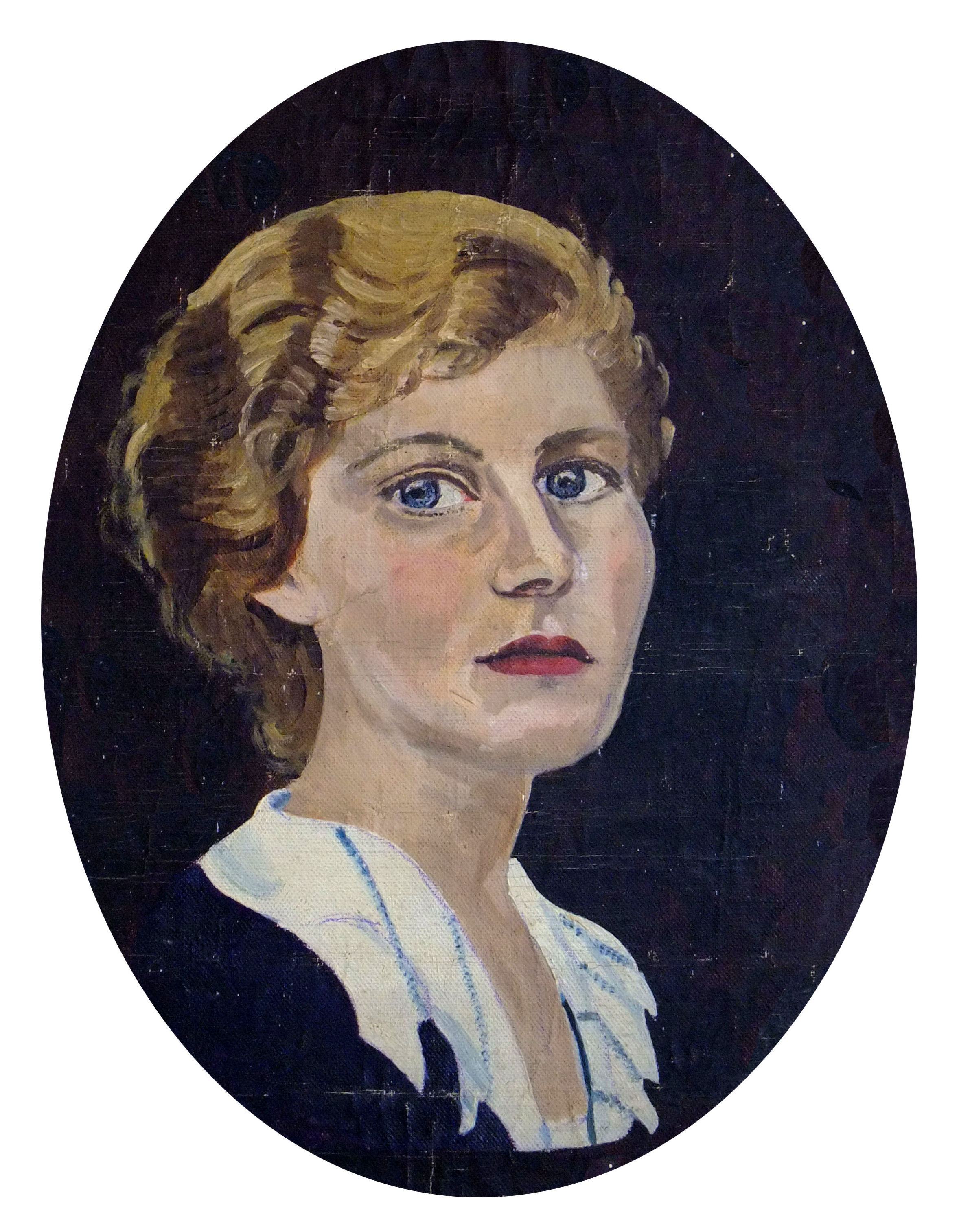
She developed other skills too: in her late teens and early twenties she took herself to art school in the evenings — learning calligraphy, pottery, drawing and painting — both watercolour and oils. Among her artwork we still have an oil self-portrait of her from when she was about 21 — not here today as it is currently being restored and reframed.
Dora must have been especially meticulous, neat and precise — something she never lost — as in 1936 she went to work at the National Physical Laboratory (The Lab) in Teddington as a draughtsman’s tracer. Remember in those days every engineering or architectural drawing was drawn — and redrawn, and redrawn, and redrawn — by hand; there being no modern computer-based CAD systems. Dora was obviously good at her job as one of her bosses later described her as “a princess among tracers”.
It was at The Lab that Dora met Noel David George Vincent, an engineer. They married in May 1939 and, as young married women did then, Dora stopped work … that is until the outbreak of war, when in November 1939 she was one of the first married women to be re-employed at The Lab.
During the late 1930s Dora spent several holidays cycling in Europe; she talked fondly of summers in France, Switzerland and southern Germany. Indeed I still have her passport, issued on 1 June 1939, when she was newly married, which contains an illegible border stamp from later that same month — and we have found a small watercolour of the roof-scape in Orange, France dated Summer 1939.
She and Vincent must also have spent time Youth Hostelling in this country, for in 1943, after a lot of string-pulling, she left The Lab and became Warden of the YHA hostel in Leatherhead.
Here she met my father (Bob; who is also buried here), and at the end of the war they were living together, as man and wife, in Camden. Needless to say Vincent petitioned for divorce, citing my father as co-respondent; this was granted in August 1947 and a month later Bob and Dora married.
In the autumn of 1950, with yours truly well on the way, my parents turned themselves inside out financially to buy a small terraced house at Waltham Cross (just in Hertfordshire). I appeared in the January.
Despite being hard up and struggling to pay their mortgage, my father wouldn’t let my mother work after I was born. But always being her own person she made the best of a bad job. Yes, her days were organised to support my father (and me) but she ensured that on most days she had finished housework by lunchtime and had the afternoon to spend as she pleased.
At various times in the 50s and 60s I remember Dora going to art classes at the local technical college, to pottery classes and even an odd hairdressing course. In the summer she would spend her afternoons sitting in the garden, in the sun — something which would catch up with her in old age as skin cancer.
Or her afternoon would be spent making jam, bottling fruit, making wine or beer, or tending the small vegetable plot in the garden.
As the years wore on Dora became more interested in natural history. The interest had always been there and I recall many weekend cycling trips; there were walks in the woods, across the marsh and to the park; all the while being taught about the natural world, churches and history. There were picnics too; and summer trips to the local outdoor swimming pool. All of which gave me a wonderfully bohemian and eccentric upbringing.
Dora started taking afternoon walks round a local lake (actually a pre-war abandoned gravel pit) — birdwatching, hunting flowers and insects — which led to her nature diaries. Along with this there were the forays into photography — including developing and printing her own films, and even building a simple photographic enlarger! — plus picture framing and book binding.
Dora was all this time sewing and knitting (she made most of my clothes until I was about 10), doing embroidery, painting — mostly small watercolours — and reading. The art, of course, flowed across into the nature diaries which she wrote in her small very neat hand, and illustrated with little watercolours and photographs. We have some 30 volumes of annual nature diaries — all written, illustrated and bound by Dora!
She was happy doing her own thing, as and when she wanted. She was never very sociable or demonstrative, something which irked my father as it stopped him getting on in local politics. But he irked her too: it would have needed a big adjustment when my father was working from home for the last 2 or 3 years before he retired; having him under foot all the time must have been some species of purgatory for Dora. But in true style she said little and just got on with what she wanted to do.
In 1988 Bob and Dora felt they had outgrown Waltham Cross and moved here to Norwich. They bought a bungalow in Bowthorpe where Dora continued doing what she loved: gardening, observing nature, painting and photography — aided and abetted by walking their small dog.
Dora cared for my father in his last few years and after he died in 2006 — when she was already 90 — she stayed in the bungalow, on her own, doing essentially everything for herself, for another four years. Luddite to the last she never had a washing machine, freezer or microwave — she didn’t even have a spin-dryer until she broke her arm in 1980!
Finally at the age of 94 she admitted everything was too much, and she chose to move to Carleton House. There, with everything being done for her, she had a wonderful 5 year holiday, with time to do whatever she wanted, when she wanted: reading, sewing, knitting, drawing, painting or just watching nature go by. I remember her telling me a couple of years ago about sitting in the garden at Carleton House one Spring afternoon watching a couple of hares gambolling around the lawn. She was in the country, which is what she wanted. Right until the end she would read almost anything we brought her, she was making soft toys — special line in Humpty Dumpty — and painting all her own greetings cards!
Sadly her independence and stubbornness eventually let her down: a fall resulting in a broken hip. Despite Dora’s frailty she was still relatively fit and had some mobility, so the medics decided to operate to fix the hip and hopefully get her mobility back. We all knew it was a risk and it turned out to be a risk too far. At 99 the fall and the operation proved just too much for Dora’s body and she faded over a period of a week.
Which is as she would have wanted it: in full control of her mind and active until the last, then a peaceful end.
Well Dora always did say she wanted to “wear out” rather than “rust out”.
And having finally worn out, that small, quiet lady has left a huge hole in all our lives.
May your god go with you.
For anyone who is interested I have uploaded a copy of the Order of Service to my website.
Images © Dora Marshall, 1980-2015
Ten Things #18
Just for a change, this month’s ten things are quite ordinary.
Ten Things which are Mundane but Pleasing

- Sunny but frosty mornings
- New April tree leaves
- Fresh fruit
- Clean bed linen after a shower
- Bare feet on grass or warm sand
- Cold side of the pillow
- Warm cuddly cat
- Glass of cold squash at bedtime
- Sleeping nude
- Large mug of tea
Sorry Sadness
Apologies to all my readers for my absence for the last couple of weeks. Unfortunately my mother died on the afternoon of 26 May in the Norfolk & Norwich University Hospital. So as well as trying to keep all the usual balls in the air, I’ve been dealing with the inevitable fallout.
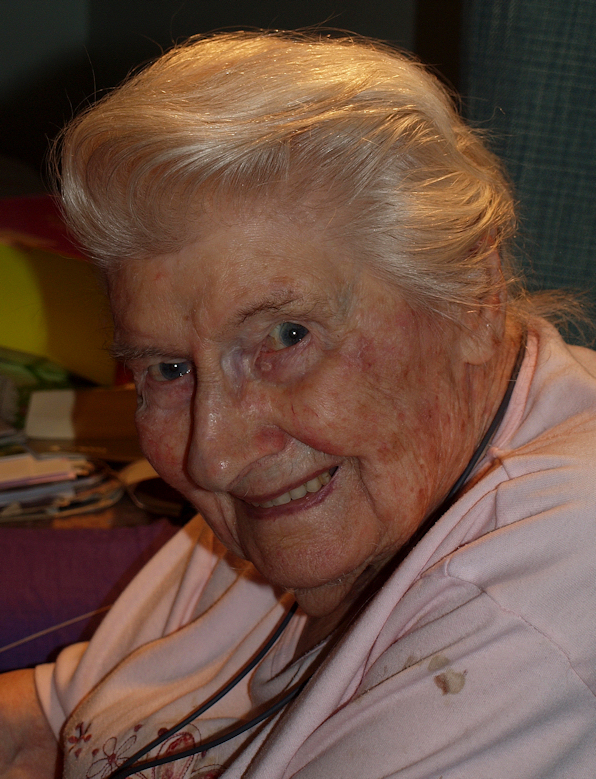
This is the last photograph I have of my mother, taken last October on her 99th birthday.

Dora at 99!
Norwich; October 2014
Yes, mum was 99! But as with so many old people, she had a fall in the early hours of Sunday 17 May, resulting in a broken hip. Magnificently the medics decided, with Dora’s and my agreement, that although frail, as she was pretty fit and had some mobility, they would operate to pin the fracture and try to get her mobility back. The operation itself seems to have been successful, but although Dora came through it OK she never picked up properly after the op and gradually slipped away over the following week.
I feel sure this is as Dora would have wanted it; she would have so hated being immobile, incontinent, incapable or bed-ridden. Until the fall she was alert and active (just very frail and very deaf). She was still reading almost anything we took her, sewing, knitting, making stuffed toys for her care home to sell, drawing and painting. Right up to the last she was still painting all her own greetings cards. Whenever we visited her we tried to take flowers for her to paint, and all the girls at the care home would also bring her things to paint. In fact we were with her the day before her fall and spent the afternoon going through some of her old artwork as the care home were planning a small exhibition of her work (and indeed they may still do it). This is exactly how Dora would have wanted it: she always said she wanted to wear out rather than rust out!
It is amazing to think that Dora had been in the care home for over five years — it certainly didn’t seem that long! This was the home she chose, in the country, just outside Norwich. It is a small home and excellent in every way; they gave Dora a wonderful five year holiday at the end of her life. Everyone there loved Dora and they are going to miss her just as much as we are. For a small quiet lady she has left a huge hole!
Dora’s funeral is on Wednesday 17 June.
Normal service here will be resumed as soon as possible, but it may still be a bit patchy for the next two weeks.
Onward and upward!
Ten Things #17
For some time I’ve been collecting fun things one can do which shouldn’t be either especially scary (so no bungee jumping) or outrageously expensive (so no world cruises). I now have a list of 50 which don’t quite form a bucket list for me, although it is interesting to see which ones I’ve done and which I haven’t. When I get round to it I shall put the list on my website, but meanwhile I thought this month we would have a selection, just as a taster.
Ten Fun Things To Do (which shouldn’t cost a fortune).
- Have a summer picnic and remember to take the champagne
- See a lunar or solar eclipse
- Take part in a performance of Messiah (or any other choral piece) from scratch
- Every time you go more than 25 miles from home, buy a postcard and send it to a friend or relative
- Have something named after you (eg. new species, park bench, cocktail)
- Do some guerilla gardening: find a small piece of neglected public land, plant some flowers there and tend them
- Visit a different museum every month for a year
- Take a trip on the London Eye (or an equivalent large Ferris wheel) at sunset
- Have your fortune told (just don’t take the result too seriously)
- Buy yourself some flowers, just because