Category Archives: current affairs

Milking the Farmers

Does anyone else find this charade about the price dairies pay farmers for milk somewhat curious?

According to today’s Telegraph the four largest dairies — Robert Wiseman, Arla, First Milk and Dairy Crest — have all now cancelled a 2p/litre cut in what they pay farmers for milk.

Isn’t it curious that they all planned essentially the same cut, at the same time? And have now all rescinded it?

(OK, the latter is supposedly in response to the farmers’ protests.)

They’re still paying the farmers below production cost. So GOK how the farmers make ends meet. Presumably they have to find a way to cross-subsidise their milk production. But it beats me why anyone would want to produce a product on which they can’t make a profit. By rights the UK farmers should not be producing milk at all. But then I’m not a farmer.

Does this whole thing have the smell of a cartel amongst the dairies, because it certainly looks that way? And that makes one wonder what role the farmers (despite all their quite justified protest) and the supermarkets have in this.

Hmmm … Dirty tricks in agri-business again? It certainly wouldn’t be the first time.

Railways

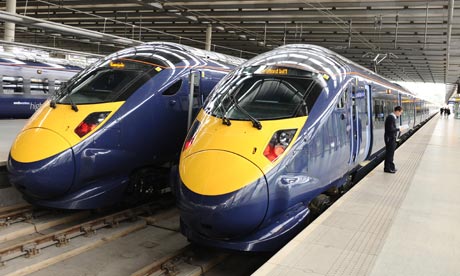
So the government is allegedly** going to spend £9.4bn to upgrade chunks of the railways infrastructure.

Now that’s more like it! That is the infrastructure investment the country needs. Forget HS2 and airport expansion. Let’s get the rail infrastructure we have modernised and working efficiently first. Then we can see if we really do need expensive, environmentally damaging, new lines. Much better to realign and widen existing rail routes and streamline operation than built completely new — at least in my book.

Sadly there is a lot more to be done to get the railways in shape. For instance there’s a major need for new freight routes around London; a whole swathe of infrastructure upgrades and modernisations; and the need for all the train companies and Network Rail to actually work together and cut out duplication of effort thereby finding some significant efficiency savings. And frankly that would be best done by running the railways as a single entity not a myriad of companies with their own vested interests. What’s more I feel it should be possible without further major fare increases.

But this is a start. We need a lot more of it, please!

** I say “allegedly” because (a) it hasn’t yet happened and (b) there is some doubt as to how much of this is actually new money.

Heathrow Runways Reprise

Oh dear god! They just don’t get it do they.

After all the farrago a year or two back about London’s Heathrow Airport needing a third runway the idea was canned because (a) it was too expensive, (b) there was huge opposition and (c) frankly the business case was fragile.

But the idea has now reared it’s head again, in spades! A group of MPs is promoting the idea that Heathrow needs not just a third but also a fourth runway. Moreover they are suggesting that the third runway should be built to the south and west of the airport over the villages of Bedfont and Stanwell thus destroying even more housing than the previously suggested site to the north. (GOK how this would be done as where there isn’t housing in the way there are a couple of humongous great reservoirs!)

When are these people going to wake up and realise that there is no necessity, and I suggest no good business case, for expanding London’s airports? Just as it has now emerged that there is no persuasive business case for the proposed HS2 rail link.

Yes Heathrow runs close to capacity in terms of flights. But I know from experience many of those flights are far from full. And Heathrow’s passenger numbers have been stable at around 66.5M a year (plus/minus 5%) for the last 12 years. (The Olympic blip in volumes excepted; but that is a one-off, hopefully never to be repeated.)

London does not need airport expansion — and that doesn’t just mean Heathrow, it means all of them. Indeed I suggest that few places really need airport expansion. There are a number of factors mitigating against the expansion of air travel:

1. Business doesn’t need air travel as much as it used to. In the last 10 years I worked I travelled very little despite running teams of geographically spread project managers and technicians on million dollar projects. Unless you need to physically have your hands on something, just about everything can be accomplished by telephone- or video-conferencing, instant messaging and email. Yes it may need some companies to invest in a small bubble of technology, but their savings in travel expense (and remember it isn’t just air fares, it’s hotels, taxis, car hire, meals, non-productive time …) will likely pay for that in the first year. By constraining travel my former employer saved many multi-millions of pounds a year just in the UK. This is money industry cannot afford to spend in a recession when there are acceptable alternatives available.

2. Air travel is an environmental cost the planet cannot afford. It is a major polluter which can, and to my mind should, be reduced. And that’s aside from the environmental damage which would be caused by any expansion of the huge areas of tarmac.

3. How many people in these constrained times really have the money for significant amounts of (especially long-haul) air travel? Few airlines are managing to make useful profits from air fares. And it is going to get worse as the recession bites harder.

Airport expansion is not the answer. Sound business and financial judgement and management is. Isn’t sound and honest judgement what we pay our leaders for?

Banning Circumcision

So a German court has found a legality upon which to effectively ban the circumcision of baby boys — but only because it leaves doctors open to prosecution on a fairly general charge of “mistreatment”. That at least is the way I read the BBC News report.

My immediate reaction is that this is about time. In my view, as regular readers will know (see here and here), circumcision of boys is as much an abuse as circumcision of girls. It is forcible removal/mutilation when the “victim” is not able (not of an age) to give consent. And at least some parts of the German media agree.

The judgement is right — all protests to the contrary. The circumcision of young boys just for religious reasons is a personal injury. Muslims and Jews should decide themselves — but not before the age of 14.
[Matthias Ruch, FT Deutschland]

The circumcision of Muslim boys is just as heinous as the archaic custom of the genital mutilation of little girls. It is an instrument of oppression and should be outlawed.
[Die Welt]

Unfortunately because of the niceties of the case the judgement is not open to being tested in a higher court. That’s shame because such a legal precedent should be tested. So German medics are left in limbo: unable to perform the operation (unless, one assumes, as a medical necessity, which is rare) for fear of prosecution but unable to test the validity of the precedent. Highly unsatisfactory.

Needless to say both the Jewish and Muslim communities are up in arms. At least the German Muslim leader who is quoted in the BBC report is being sensible: I do not want my people to (have to) go abroad and/or to backstreet surgeons to have this done; I would prefer it done under proper medical supervision. The Rabbis quoted seem to be able to say nothing except wail “we’ve always done it this way” and “it’s our right”. Hmmph.

German Chancellor, Angela Merkel, appears to be of the opinion that circumcision is a part of freedom to practice religion. I disagree, and not because I am areligious. In my book no religion (no person) should be able to mutilate someone who is unable to freely give informed consent. If any religion chopped off the left hand, fingers or nose of every baby boy (or girl) this would soon be outlawed, as it would if the children were permanently tattooed at a few days old with a cross in the middle of their forehead. After all the Baptists were established (as antipaedobaptists) precisely because they were opposed to infant baptism when the child was unable to give consent.

But where does one draw the line? Should parents be prohibited from cutting a child’s fingernails or hair on the grounds that this is abuse? Probably not as these regrow; foreskins don’t, just as female genitals don’t regrow nor scarification scars heal fully. That seems, at least on the face of it, to be a sensible test and place to draw the line.

Medical necessity excepted, of course, which is legally testable if necessary.

While I don’t like the way this has been done, I think the German decision is the right one.

Greecing History

Well, well, well. This blog gets more and more like the 38 bus. Nothing for ages and then three come along at once. But to the point …

There was a super article in the comment columns of the Daily Telegraph written by Mayor of London, Boris Johnson: Dithering Europe is heading for the democratic dark ages.

Whether you like the guy, or whether you think he’s a dangerous buffoon, the article is extremely well written. He makes his case that “A Greek economy run by Brussels will ignore the lessons of history, leading to more misery“.

But it also contains some lovely touches. Just his opening sentences are a masterpiece:

It is one of the tragic delusions of the human race that we believe in the inevitability of progress. We look around us, and we seem to see a glorious affirmation that our ruthless species of homo is getting ever more sapiens. We see ice cream Snickers bars and in vitro babies and beautiful electronic pads on which you can paint with your fingertip and – by heaven – suitcases with wheels! Think of it: we managed to put a man on the moon about 35 years before we came up with wheelie-suitcases; and yet here they are.

He goes on:

Aren’t they grand? […] Isn’t that what history teaches us, that humanity is engaged in a remorseless ascent?

On the contrary: history teaches us that the tide can suddenly and inexplicably go out, and that things can lurch backwards into darkness and squalor and appalling violence. The Romans gave us roads and aqueducts and glass and sanitation and all the other benefits famously listed by Monty Python; indeed, they were probably on the verge of discovering the wheely-suitcase when they went into decline and fall in the fifth century AD.

History teaches us many things and we fail to learn most of its lessons.

Boris concludes:

If things go on as they are, we will see more misery, more resentment, and an ever greater chance that the whole damn kebab van will go up in flames. Greece will one day be free again […] for this simple reason: that market confidence in Greek membership is like a burst paper bag of rice — hard to restore.

Without a resolution, without clarity, I am afraid the suffering will go on. The best way forward would be an orderly bisection into an old eurozone and a New Eurozone for the periphery. With every month of dither, we delay the prospect of a global recovery; while the approved solution — fiscal and political union — will consign the continent to a democratic dark ages.

As it happens I agree with him. But that’s not the point. I was struck, first and foremost, by Boris’s excellent and amusing prose. Silver spoon or not, he’s well educated, intelligent, amusing and can look at the world from a fresh perspective. The world needs more like him, and in positions of power and influence, just without the party political agenda.

We don't need no Edukashun

My friend Katy had a couple of rants yesterday (here and here) about the current education system and the damage that politicians are doing. This is by way of a comment to those posts, so maybe you want to read them first?

Essentially I’m with Katy. Teaching kids has been f***ed up since Harold Wilson abolished Grammar Schools. (It’s odd how so many things in this country which are buggered up go back to Harold Wilson as the root cause!)

I remain of the view that kids have to learn the basics to be able to go on and understand the next level. And with times tables the best way to do that is by rote — it has to be got into heads first. Yes, it’s boring (but so is much of life; deal with it) and it doesn’t mean you can’t engage the kids along the way. Once the basic tables are being established the kids can start to understand the patterns in numbers etc. as well as have the ability to do mental arithmetic. The problem is that no-one ever explained why mental arithmetic was useful — like have you got the right change?

Phonics as a reading system sounds like an absolute load of horse shit to me. Just as phonetic alphabets and so on were before it. Why teach the kids one stupid language only to get them to learn something else when they want to read a book? Just do it properly the first time! They need the rudiments of punctuation and sentence structure as they get older, but early on (under 10?) they need to be able to express themselves with the right words — so vocabulary and spelling are important. Yes, to achieve that you have to engage them. Then as they are older they can start to understand the need for punctuation etc. But WTF does it matter about subjunctives and whether chairs have gender? It doesn’t unless you’re going to be a “professional linguist”. This is where school lost me with French and Latin — I just did not see the point of all these arcane complications, nor the point of learning “something foreign”.

I just wish that politicians would stop meddling in things they don’t understand and listening to half-baked theories. If they spent half the time they spend on useless “initiatives” on sorting out the economy etc. etc. we wouldn’t be in half the mess we are. Government keeps changing what is taught and the way it is taught. But industry tells us the kids coming out the other end aren’t fit for purpose. Maybe there’s a connection?! Because it’s all “Emperor’s new clothes”. This is why I didn’t go into teaching (I saw what my friends were doing and knew I’d fail because I’d tear it limb from limb) and it’s why I won’t be a school governor again.

The education I received in the 50s and 60s wasn’t perfect by a long way. But even for the less able it was a damn sight better than most kids seem to get now. Schools then were far too good at finding our what you couldn’t do and playing on it. They mostly still are. Try engaging with the kids, find out what they can do — and I don’t care if it is maths or music or sport — and help them build on it. But at the same time you do have to give them the basic “3 Rs”, otherwise (a) how do you find out if they’re any good at them, (b) they have to be able to function, at least minimally, out in the world, and (c) it’s no use having good ideas if you can’t communicate them accurately to other people.

Let teachers teach. They know what they have to teach and they know how to adapt their methods to different types of child. They know what the kids should be achieving at various ages. It isn’t an easy balancing act and the fewer wobbles (aka. politicians) the less likely you are to fall off the tightrope.

Fukushima Follow-ups

Just a quick note of a couple of follow-up pieces on the Fukushima accident which appeared this week.

First off there is a WHO report looking at the likely long-term health effects of the accident. I’ve clearly not read the whole report but there is a good summary of the main findings on Nature News here and here. The main thrust is that, as has always been said, the radiation effects on the affected citizens are likely to be negligible and far outweighed by the psychological trauma.

Secondly Robert Cringely in his blog I, Cringely writes about what he sees as the inevitability of a further major accident at Fukushima — and one which may be far worse. Basically his contention is that a further large earthquake is inevitable before the Japanese manage to clean up the exposed fuel rods from Reactor 4. No only is this a huge project in its own right but Cringely maintains it will be made worse by the totally dysfunctional way in which Japanese business works (or rather doesn’t work). It makes chilling reading; let’s just hope he’s wrong.

Get out of jail free?

Now here’s a fascinating idea to play with …

The UK could be handed a “Get out of jail free” card by the Scots.

A senior Scots constitutional lawyer has suggested that “Scottish independence could see the UK kicked out of the European Union”.

Rejoining would then require a new referendum (which would likely be lost?) and if we did rejoin we’d likely lose our huge EU payments discount.

One can hope that the Scots might do us a favour, but I suspect the EU would fudge things so they didn’t … so we’ll still need an acrobatic display of pig avionics as well.

Heresy Corner has a fuller report on the speculations.

Whither Now?

I just can’t help feeling we’re living in interesting times. And this last weekend could go down as a tipping point.

France and Germany have stitched up a deal on the Euro financial crisis created by countries living beyond their means. The deal involved banks lending countries even more money to pay for the debts they already couldn’t afford.

Britain and the US have bailed out banks who racked up debts by lending money they didn’t have to people to live beyond their means. Having engendered a debt crisis those same banks are now being berated for not lending people even more money.

But this weekend the French people have said a resounding “Non” and elected an anti-deal, Socialist, President and given the incumbent a bloody nose. The new President basically wants to tear up the deals.

The Greek people, in a parliamentary election, have effectively thrown out the coalition which agreed to their country’s bailout. There will either be a new anti-deal coalition or new elections.

The Irish are tiptoeing towards at least trying to tear up the deals.

And the Italians are expressing discontent with the stitched up deal in their local elections.

Meanwhile …

Britain is again in recession — I personally doubt we were ever out of it — and if you look at the data this is a much longer and deeper (double dip) recession than those of the mid-70s, early-80s or early-90s. (The mid-70s recession felt pretty bad, so heaven knows where this one will end up.)

Shareholders at UK insurance giant Aviva have rejected the boss’s bonuses leading to the resignation of the CEO. Other shareholder revolts look to be on the cards.

The value of the Euro has fallen against the Pound; you can now get at least €1.20 to the Pound.

All the markets are sharply down on the day largely due to the uncertainty in Greece and the rest of Europe. One thing the markets hate is uncertainty.

And of course Angela Merkel, the German Chancellor, is behaving like a petulant child and throwing her toys out of her pram to try to blame and bully everyone, because her chickens are coming home to roost and her knicker elastic has perished.

It’s a harsh reality, but all of this could probably have been avoided if (a) the rigid structure of the Euro had been stillborn, (b) the regulations on budget deficits in the European Treaties (and they were there regardless of the Euro regulations) had been adhered to and (c) a few banks had been allowed to fail because of their bad debts.

What of this could not have been foreseen?

Who said we don’t live in interesting times?!

Vote Lizard

So today is the four-yearly London mayoral voting jamboree. Whoopee! Vote for the lizard of your choice! Or not! Maybe!

Nevertheless we have just returned from doing our civic duty for the year.

And what a farce it is!

I don’t mind walking round to the local scout hut, which has been our local Polling Station for some years. Or the local school (which was used before they started using the scout hut when the school was rebuilt). Or the church hall. What I mind about is the daftness of the voting system.

We are voting for (a) the Mayor, (b) a constituency member of the London Assembly and (c) party list members of the same Assembly.

The Mayoral vote is easy. You have a first choice vote and a second choice vote. If, when the votes are counted, the first choice votes give anyone over 50% they’re elected. If not, all but the top two are eliminated and the second choice votes of those eliminated are (re)distributed. The one with the most votes then wins. It’s a sort of buggered up Single Transferable Vote system. I don’t have a problem with this; I’d prefer STV but that’s too hard for Joe Public (it taxed the brains of students when I was an undergraduate!).

The London Assembly however is different; and in my view a shambles. There are just 25 Assembly members. That’s less than one for each of the 33 London Boroughs and one for roughly every three of London’s 73 parliamentary constituencies. That’s leaving aside the fact the the Assembly has no real power: what the Mayor wants done, gets done.

First one has a single vote for a (named) constituency member. There are 14 constituencies, where “constituency” means two or three London Boroughs. What sort of constituency is that!? It is the equivalent of dozens of local councillors and some five or so parliamentary constituencies. As such the Assembly constituencies are so big as to be meaningless.

Lastly there is the party list. Here you vote for which of the list (of about a dozen) parties you like; you have one vote. Eleven party members are elected to the Assembly from a prioritised list provided by each party for the whole of London. Seats are allocated to parties pro rata to the number of votes received, with any party getting 5% or more of the votes guaranteed seat(s).

All three of these ballots are counted separately, so that’s three A4-sized ballot papers in different pretty colours all of which go in the same ballot box.

I agree with having an elected Mayor for London and a London Assembly. But in God’s name who thought up this shambolic way of doing it?

In my view the Assembly (or whatever you want to call it) has to have some teeth to actually control the Mayor’s possible excesses. And it has to have a sensible number of members elected directly to represent people; that probably means a member for each parliamentary constituency perhaps arranged as two or three “members” per Borough. And the voting system needs to be simple: “first past the post” will do, but STV would be better.

Whether Londoners — well at least the small number who bother to vote — return the current Mayor, Boris Johnson (Conservative), for another term or re-elect the previous Mayor, Ken “the Newt” Livingstone (Labour), remains to be seen. It is very unlikely to be any one of the other five candidates. We’ll probably know sometime tomorrow. It’ll be close.