
I love the expressions on the faces of Glasbergen’s cats!
I love the expressions on the faces of Glasbergen’s cats!
Really major life-changing events (marriage, an influential chance meeting) aren’t common but we all have them and usually several in a lifetime.
What I suspect is more common, at least of those of us who read, is to realise that one has a series of books which have been sufficiently influential that they’ve significantly changed the tone or direction of one’s life.
And reading Mrs Worthington’s entry “Books that shaped my life” in Tara’s Gallery this week I realised that I too had such a list. So I thought I’d document it. Here are some of them in roughly chronological order; I’m sure there are others.
Lewis Carroll, Alice in Wonderland and Alice through the Looking Glass. I remember these from an early age. They started me thinking about language. Later re-reading it as a student I saw and became fascinated by the unexpected logic, something which has stayed with me. This was later enhanced by Martin Gardner’s The Annotated Alice.
TS Eliot, Old Possum’s Book of Practical Cats. This is something my father used to read to me at bedtime when I was probably about 7 or 8. I especially remember, and still love, Skimbleshanks: The Railway Cat. I knew it off by heart and I still remember chunks of it. This was in the late 1950s, long before Cats, the musical. To this day I love cats and I love railways.
WE Johns, Biggles books. I read as many of these as I could get my hands on, probably from the time I was about 9 or so right into my teens. Yes, they were fantasy adventure, but they were also a world into which a repressed (even depressed) child could retreat from the world.
Boy Scout Association, The Chief Scouts’ Advance Party Report. This was the 1966 set of proposals for modernising the scouting movement at the time I was transitioning from Scouts to Senior Scouts. I realised it was important and read it. I didn’t agree with it. I saw it for what it turned out to be: the beginning of the emasculation of the Scout Movement as I knew it and as I believed then, and still believe, it should be. It was thus one of the 3 or 4 straws which directly led to me leaving Scouting; somewhere I would have liked to remain.
John Betjeman, High and Low. I don’t recall what impelled me to buy Betjeman’s latest slim volume of verse in 1966, but it soon became a firm favourite. As a late teenager it lived by my bed and if I awoke, sleepless, I would dip into it until sliding into slumber again. Why would a teenage boy in the late ’60s find a volume of poetry comforting? Isn’t that rather worrying? It didn’t so much kindle in me a love of poetry but an awareness of the changing world of architecture and railways.
Havelock Ellis, The Psychology of Sex. My parents had a copy of this and it was openly available to me on the shelves from a very early age. I read it, and learnt a lot from it, as a teenager. It kept me one step ahead of my girlfriend in our joint exploration and development of our sexuality.
Florence Greenberg, Jewish Cookery. No I’m not Jewish. I picked this up as a student because it is such a great cookery book. It covers all the basics and provides a wealth of interesting recipes. It wasn’t the only cookery book I had as a student, but probably the one I used most often. And I still have it and use it!
David Hockney, Photography. I’m unable to remember now which of Hockney’s books on photography it was that I recall seeing, but it was one of the early ones where he was experimenting with “joiners”. The book was probably his Photographs (1982) or just possibly Cameraworks (1984) although I had thought it was a late-70s book. But whichever it was I found the “joiner” technique fascinating and it is still something I experiment with from time to time. It has definitely been a factor in the development of my photography.

Anthony Powell, A Dance to the Music of Time. If there’s one work (it’s actually a series of 12 novels) that changed my life this is it. There are comments elsewhere herein (for instance here) about how I was recommended to read Dance by our friend Jilly, and how that simple recommendation led to what is now the Anthony Powell Society and such a large part of my life.
Long time readers will know that I rather like wasps (yellow-jackets to you Americans) and I’ve written about them before (for example here and here). They are extremely good predators of creepie-crawlies and without them we’d be knee-deep in caterpillars and spiders. They are also adept at reducing dead wood to nothing: they scrape off pieces of wood which they chew into paper to make their nests.
This Autumn we seem to have a plethora of wasps. Not really surprising as we obviously have a wasps’ nest somewhere in our eaves. They come and go through the end of our guttering, a few feet from the bathroom window. And they are still very active; there’s a constant traffic of wasps in and out. That’s fine; it’s as it should be.
But what I have noticed is that we have an extraordinary number of queen wasps this Autumn. They are obviously emerging now, leaving the nest and are off to mate and find somewhere to hibernate. And they are mostly queens (although I think some of what I’ve seen are probably males); they’re far too large to be workers. At about twice the size of the workers (which is what we normally see about) they’re quite impressive.**
But why so many this year? It’s probably partly because we don’t so often see them and I’m seeing more now as they are so close (and they can now escape through the hatchway into our loft, which was previously not possible). But it is probably also partly because it is still mild and they haven’t been killed off in the nest by early frosts.
Vespula vulgaris
We have mostly two species of wasp in the UK, the common wasp, Vespula vulgaris, and the German wasp, Vespula germanica. I don’t know which species my wasps are, but I think probably the former; we do have both species here. I need to catch one and interrogate it; you can mostly tell the species from the face and body patterning, and the gender from size and body morphology as these illustrations show.
Vespula germanica
And these queens buzz. Very loudly but with a lower pitch than workers. I know this because the queens are getting into the house. Lots of queens. Yesterday we evicted three before lunch. But boy is that buzzing annoying: I guess it is designed to be. Like their colouring it could well be a defence mechanism; a warning: Don’t mess with me!
You can hear them coming. Standing in the bathroom this morning I could hear a faint, low buzzing. Alert! Wasp! But where was it? After a few minutes it appeared from the direction of the trap door. They’re attracted to light (I guess that, like moths, artificial light partly dazzles them) so putting out the bathroom light it was easy to shepherd the creature out of the window. Sorry dearie you ain’t hibernating in my house if I can avoid it — if nothing else the house is too warm for you to hibernate.
It’s interesting to watch them. They’re really only a pest when you can’t catch them or cajole them out. And they’ll be gone as soon as we get a couple of good frosts. Generally with wasps in the UK if you leave them alone they’ll leave you alone.^^ Let them be — they are such superb predators.
** No, they are NOT hornets. Hornets (Vespa crabo) are very large, quite scarce, more likely to be found in wooded areas, and distinctly yellow and brown.
^^ The only excuse for obliterating them is (a) if they are nesting somewhere totally unsuitable (like your kitchen) or (b) if you have someone you know to be seriously allergic to their sting as my late mother-in-law was, but that is not common.
I’ve not partaken in Tara’s Gallery for a couple of weeks. This has been partly due to the lack of available hours in the day and partly as the last couple of subjects haven’t grabbed me.
But I have to do this week’s Gallery as the subject is something dear to my heart: books!
And yet I find I have no photos of books. Except for this one.

This was my home office, my desk, about three years ago.
For the last several years I was working I was lucky enough to be able to work from home much of the time. Despite being a project manager much of what I was doing could be done remotely: I had email, a mobile phone, a fax, a laptop. And because my teams were geographically spread meetings were held by teleconference. It actually worked well, and saved the company huge amounts of cash and travel time.
A couple of years into retirement it doesn’t look a lot different. The laptop isn’t there so often, and the fax machine has gone.
The books have been reorganised but are largely the same. These are my working books; the ones I use every day; just a couple of hundred of the thousands in the house.
Here it is today; when I was in the middle of writing this and even with the image above on the screen!

See still lots of books, bigger geraniums and chillies creeping into the top right corner — not a whole lot different!
So yesterday six internationally respected scientists, plus a government official, were convicted by an Italian court of manslaughter for not issuing a warning of the magnitude 6.3 L’Aquila earthquake of 2009 which killed 309 people. They were each sentenced to 6 years in prison.

For what? Yes, that’s right: doing their job to the best of their ability.
On the basis of the best evidence available to them, these experts didn’t issue a warning about the imminence of the earthquake because that evidence didn’t indicate there would be one; because predicting earthquakes is (still) effectively impossible. It’s a decision which most of their colleagues around the world apparently support.
They made an honourable scientific decision based on the evidence. So how can they be culpable?
Now I’m no expert on earthquakes, but my friend Ziggy Lubkowski is a world leader in earthquake engineering. And he is even more quietly and coldly furious than am I. You can see what he says on his work weblog. I commend it; he says it much better than I can!
It would seem to me that the direct consequence of this is that no scientist should now express any opinion as to any the future happening. Or perhaps the only comments should be either “No comment” or “We don’t know”. Surely to do anything else leaves one exposed. That means scientists — which includes the guys who forecast our weather! — will no longer be able to fulfil their roles in society. It will stifle science, progress and more immediately public safety. Would I blame anyone for taking such such an approach? How can I?!
Surely any legal system which can allow such a prosecution to even get to court is deeply flawed. For everyone’s sake let’s just hope that this travesty of justice gets overturned on appeal.
There was another interesting article in the Autumn issue of BBC Wildlife magazine on the importance of brownfield sites for wildlife.
We all think in terms of brownfield sites being derelict, dangerous and useless. But in fact it provides a whole range iof valuable, and often novel, habitat for wildlife. Indeed often brownfield sites are richer in wildlife than green belt land which tends to be managed and manicured by comparison.
Again the article isn’t online (although there is a short news report) so once more a few pertinent extracts.
Much has been made of the importance of brownfield for wildlife … there’s also an assumption … that it must be the priority for development in order to protect the countryside and the green belt
…
a conflict between the need for economic development and the conservation of wildlife habitats near where people live.
…
Often, though, the ideal solution is neither protection nor redevelopment but natural regeneration. Some of the pollutants in the soil and ground water of former industrial land can be broken down, neutralised and stored by microorganisms, fungi and plants … the environmental value of these natural decontaminants should not be taken lightly.
…
Brownfield land is full of contradictions. On the one hand, many wildlife-rich green spaces in our towns and cities are, ironically, brownfield. They provide the green networks on which these conurbations depend. And on the other, brownfield is far from an exclusively urban phenomenon.
…
There are countless brownfield sites … that may never become protected nature reserves, yet nonetheless are important refuges … landfill sites, scrapyards, car parks, skip depots, industrial estates and gravel pits.
…
in Britain, some species now depend on the ‘surrogate’ habitats provided by brownfield sites … shrill and brown-banded carder bees … both species of bee now depend on brownfield in the Thames Gateway
…
the last outpost of the silver-studded blue butterfly in the Midlands is a disused airfield at Prees Heath Common … the concrete runway, too expensive to remove, protects colonies of black ants that in turn protect the silver-studded blue caterpillars.
…
brownfield sustains as many Red Data and nationally scarce invertebrates as ancient woodland.
Dereliction is not the sole qualification for brown field land. Many other places don’t fit the official definition, because they are functioning as intended: railway-line cuttings and embankments, motorway verges, canal towpaths, retail parks and the open spaces backing onto housing estates and enterprise zones … because they are urban or industrial, they are still lumped together as brownfield, and all are of unintended wildlife importance.
…
Asphalt and piles of bricks are equivalent to heat-retaining heathland for basking slow-worms and common lizards. Warehouses and towers are like cliffs to nesting peregrines and kestrels. Railway ballast supports plants adapted to growing on limestone.
…
disturbance opens dormant seeds in the soil and gives the ‘seed rain’ falling from the air a chance to germinate. Moreover, in brownfield land not used for food production or recreation, there is little or no exposure to herbicides, pesticides, fungicides and chemical fertilisers.
The importance of small, inter-connected wildlife havens is very noticeable, and brownfield clearly contributes much to this.
Here in west London we are lucky. There is a string of open green land running from Richmond north-west through Ealing, Harrow and Watford right out to the farmland beyond the M25. No one piece is more than about half a mile from the next, even if that next piece is only a range of large gardens or a brownfield area. And it is especially noticeable the extent to which birds use these green corridors — a definite SE-NW axis to bird flights is noticeable from my study window.
We do not need more office bocks or airports. We need all the open space we can get, even if that is scrubland, bushes and hedges. Although trees and meadows are just as valuable. Planners please note.
That cheeky chappie of British cities, the House Sparrow is under threat. This much we knew. Numbers have been declining for some years, although the population around us having fallen some years back is now quite healthy again. But scientists are still trying to work out the cause of the decline.
Following up on this, and some recent research, there was an article in the Autumn 2012 issue of BBC Wildlife magazine. The article doesn’t appear to be online, so I bring you a few salient extracts.
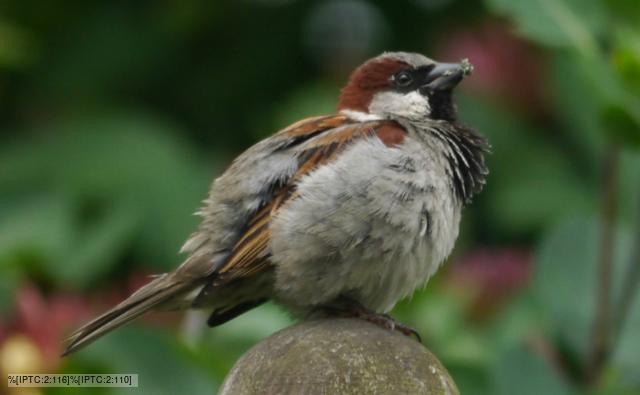

The cockney ‘sparrer’ is falling quiet in our cities — and one problem may be too much noise.
…
a small, but significant, difference in the chances of their chicks fledging — 21 percent tor those in a noisy area, but 25 per cent for those elsewhere.
…
[Research suggests] noise interferes with communication between the patent birds and their offspring, which as a result are fed less often.
…
a shortage of invertebrate food in the sparrows’ diet limits nestlings’ chances of survival.
…
chicks raised in areas with high nitrogen dioxide levels — ie. close to busy roads — fledge at lower weights.
…
Despite its position on Britain’s Red List of threatened species, the house sparrow is not rare — though it has declined, there are about 6 million pairs in the UK.
…
Sparrows connect city-dwellers with nature
…
the downturn has been rapid. Over 15 years between 1983 and 1998 … sparrow numbers dropped by 90 per cent in one Edinburgh park.
…
the drive to renovate buildings and tidy up parks is more significant, depriving urban sparrows of places to nest, feed and take cover. Sparrows and other birds like bits of green space, evergreen cover, bushes … But we have lost a lot of scrub from parks in recent decades.
…
house sparrows are more likely to thrive in areas of high social deprivation, either because buildings are in poor repair or because gardens are less manicured, improving invertebrate and seed productivity
…
lead-free petrol has even been cited, with the additive MTBE being blamed for killing insects. Cats ate significant predators of house sparrows. Rising numbers of feral pigeons could be transmitting increasing levels of disease.
I don’t agree that domestic cats are the problem everyone makes out. Yes they do kill birds — so do sparrowhawks, kestrels, magpies and crows — but in my experience not that many. And in any event they are generally taking the weaker (who may have perished anyway), thus allowing the stronger a better chance of survival.
But the real lesson for me from this is that basically we don’t know. Or perhaps more accurately, there is no one factor for the decline, but many interrelated factors.
Our sparrows have bounced back despite a decrease in the number of easily accessed roofs in which to nest. But it is noticeable that they inhabit a small cluster of gardens, including ours, with a higher than normal number of bushes, hedges and trees. So the point about cover is well made. They like bird feeders too as they provide easy food, when the Greenfinches and Parakeets can be elbowed aside.
I like sparrows. There are days when you open our front door and all you can hear is three dozen sparrows all going cheep, cheep, cheep! Our front garden hedge is their local village pub. And that’s good.
Despite all the business, I have found some time for reading. One of these indulgences has been Letters from England by Karel Čapek, first published in Prague in 1924. Against my expectations it is a delight and pretty nearly a laugh a page — which is likely what was intended. All interspersed with Čapek’s curious little drawings.
Čapek is best known for writing, with his brother Josef, two almost iconic plays: R.U.R. (1920) and The Insect Play (1921). I know the latter as the short scenes were a staple of my school’s “house plays” and we even did a complete staging in my final year at school as that year’s school play. Ants running amok in the auditorium! Dark and malevolent; but great fun.
But Letters from England is Čapek’s reportage on a visit he paid to Britain. First he sojourns in London:
[S]ince I have already been on this Babylonian island ten days, I have lost the beginning. With what should I begin now? With grilled bacon or the exhibition at Wembley? With Mr Shaw or London policemen? I see that I am beginning very confusedly; but as for those policemen, I must say that they are recruited according to their beauty and size: they are like gods, a head above mortal men, and their power is unlimited. When one of those two-metre Bobbies at Piccadilly raises his arm, all vehicles come to a halt, Saturn becomes fixed and Uranus stands still on his heavenly orbit, waiting until Bobby lowers his arm again. I have never seen anything so superhuman.
…
[A]t night the cats make love as wildly as on the roofs of Palermo, despite all tales of English puritanism. Only the people are quieter here than elsewhere.
…
But not as long as I live will I become reconciled to what is known here as ‘traffic’, that is, to the volume of traffic in the streets. I remember with horror the day when they first brought me to London. First, they took me by train, then they ran through some huge, glass halls and pushed me into a barred cage which looked like a scales for weighing cattle. This was ‘a lift’ and it descended through an armour-plated well, whereupon they hauled me out and slid away through serpentine, underground corridors. It was like a horrible dream. Then there was a sort of tunnel or sewer with rails, and a buzzing train flew in. They threw me into it and the train flew on and it was very musty and oppressive in there, obviously because of the proximity to hell. Whereupon they took me out again and ran through new catacombs to an escalator which rattles like a mill and hurtles to the top with people on it. I tell you, it is like a fever. Then there were several more corridors and stairways and despite my resistance they led me out into the street, where my heart sank. A fourfold line of vehicles shunts along without end or interruption; buses, chugging mastodons tearing along in herds with bevies of little people on their backs, delivery vans, lorries, a flying pack of cars, steam engines, people running, tractors, ambulances, people climbing up onto the roofs of buses like squirrels, a new herd of motorised elephants; there, and now everything stands still, a muttering and rattling stream, and it can’t go any further …
Amongst Capek’s perambulations of the country he visits the Lake District and makes this note on the sheep:

Pilgrimage to the Sheep. It is true that there are sheep everywhere in England but lake sheep are particularly curly, graze on silken lawns and remind one of the souls of the blessed in heaven. No-one tends them and they spend their time in feeding, dreaming and pious contemplation.
He also makes numerous observations on the English themselves, including thes delights:

I wouldn’t like to make overly bold hypotheses, but it seems to me that the black and white stripes on English policemen’s sleeves have their direct origin in this striped style of old English houses.
…
Most beautiful in England though are the trees, the herds and the people; and then the ships. Old England also means those pink old gentlemen who with the advent of spring wear grey top hats and in summer chase small balls over golf courses and look so hearty and amiable that if I were eight years old I would want to play with them and old ladies who always have knitting in their hands and are pink, beautiful and kind, drink hot water and never tell you about their illnesses.
…
Every Englishman has a raincoat or an umbrella, a flat cap and a newspaper in his hand. If it is an Englishwoman, she has a raincoat or a tennis racket. Nature has a predilection here for unusual shagginess, overgrowth, bushiness, woolliness, bristliness and all types of hair. So, for example, English horses have whole tufts and tassels of hair on their legs, and English dogs are nothing but ridiculous bundles of locks. Only the English lawn and the English gentleman are shaved every day.
It’s real reportage of the hastily concocted letter home variety. A sort of semi-structured stream of consciousness. And none the worse for that. As I say it is pretty much an amusement a page. A couple of evening’s bedtime reading or something to while away a train journey.
Time for another nice word …
Mendicant
As I said in my previous post, it’s been another busy week when I’ve just not had either the time or the mental energy for blogging, despite there being many things I wanted to write about. So in summary form here are a few that I picked up, would have liked to write more about, and which you may have missed. Let’s start with the the cute …
Berlin Zoo have some adorable new, but very rare, Rusty-Spotted Cat kittens. I defy anyone not to like these kittens.

Squirrels, L to R: Grey, Red, Melanistic (black) morph of Grey, Brunette morph of Red
While in Britain there’s another colour way of our favourite nut guzzler. But don’t be deceived the brunette squirrel is just a colour morph of our now rare red squirrel — just as there are black, grey squirrels.
Still on things biological the Evopropinquitous blog writes about Things I Learned as a Field Biologist. It’s often interesting and sometimes a bit squeamish. One wonders though how these people actually do any work in the field!
Now here’s something for real science geeks. Make your own Particle Detector from things you have around the house. No, I haven’t tried it (I have far too many left thumbs for craft work) but it certainly looks as if it should work.
From particle detectors, to particle generators. Except they weren’t. In interesting short post from IanVisits about the early plans for an underground railway in London which came to naught.

And finally this week for something different. Mr Bean-Blackadder has been throwing the toys out of his pram and probably annoying the righteous in the process. The Daily Telegraph reported a nice tirade from Rowan Atkinson: we must be allowed to insult each other. Joining in the campaign former shadow home secretary David Davis said:
The simple truth is that in a free society, there is no right not to be offended. For centuries, freedom of speech has been a vital part of British life.
Precisely. It’s called freedom of speech.