

All posts by Keith
Buggered Britain 16
A long overdue instalment in my occasional series documenting some of the underbelly of Britain. Britain which we wouldn’t like visitors to see and which we wish wasn’t there. The trash, abused, decaying, destitute and otherwise buggered parts of our environment. Those parts which symbolise the current economic malaise; parts which, were the country flourishing, wouldn’t be there, would be better cared for, or made less inconvenient.
These delightful properties are in the parade of shops next to Greenford underground station. Apparently the boarded up shop has been acquired by Tesco and will be opening as a Tesco Express store — although it’s anyone’s guess as to when this might be as it has already been in this state for most of this year.
Click the image for larger views on Flickr
Buggered Britain 16
Greenford; 18 June 2013
Word: Psittacosis
Psittacosis
A contagious disease of birds transmissible (especially from parrots) to human beings as a form of pneumonia. A zoonotic infectious disease caused by the bacterium Chlamydophila psittaci (formerly Chlamydia psittaci) and contracted from parrots and many other species of bird.
Psittacosis is also known as parrot disease, parrot fever and ornithosis.
The word is derived from the Psittacus genus of parrots of which the African Grey is a prime example, although the genus also includes the New World macaws.
The OED gives the first use of psittacosis as being as late as 1897, but maybe that isn’t surprising as that’s when much of medicine was being codified. By comparison psittac for a parrot is recorded way back around 1400.
Weekly Photograph
One of my photographic interests is just sitting somewhere and quietly photography the people who go by.
Yes, before you ask, this is perfectly legal in the UK — you may legally photograph anything or anybody in public or on a railway station (and this includes children) without asking permission — the only exception is if a police officer considers you are photographing something pursuant to an act of terrorism. Moreover no-one except a police officer with a search warrant has the right to confiscate images or equipment or demand you delete images.
Surprisingly in all the years I’ve been quite openly taking photographs in the street and on stations I have only twice been harangued by a member of the public (both of whom thought I was doing something illegal — I wasn’t) and twice approached by a police officer. Both officers agreed that I was doing nothing illegal, although one (who was armed) wasn’t very happy as I was taking photographs near (but not of) some Arab embassies.
A few days ago I was sitting drinking coffee on London’s Paddington Station and was close to the YO! Sushi bar so I couldn’t resist photographing the chefs …
Click images for larger views on Flickr

Sushi Girl (left) and Sushi Boy
Paddingtom Station, London; June 2013
Culinary Excursions
This weekend has seen three culinary successes hereabouts. Nothing spectacular and nothing which isn’t already known, but a couple of them things I’ve not tried before.
We’ve just had Sunday dinner off a joint of bacon. A collar joint, which in my book is tastier, and cheaper, than gammon. But this time I cooked it in Coca-Cola. I’ve known about this method for years, but never had the nerve to try it. And we never have “full fat” Coke in the house because we both prefer the diet variety.
But somehow we had come by a bottle of Coke. And the supermarket yesterday had large (like 1.5kg) collar joints. [Collar joints should be at least this size; none of the puny rubbish, which cooks to nothing, that’s normally available.]
As a method cooking ham in Coke works brilliantly. OK, I simmered ours for maybe 20 minutes longer than it really needed, but the result was meat you really could cut with a spoon. Easily the best bacon I’ve had in many years. It was served with plain steamed new potatoes and fresh English asparagus (also steamed), plus tarragon sauce.
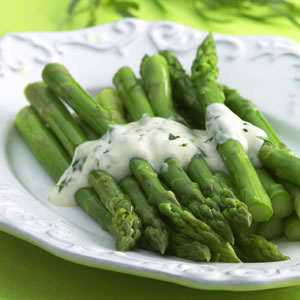
The tarragon sauce was the second success; it is something I’d never thought to try before. We love tarragon but never think to put it in sauce. Basically you proceed as for parsley sauce only use lots of chopped fresh tarragon in place of parsley. It is refreshingly different and herby; and went well with the ham, the potatoes and the aspargus.
And the third success? One of our old stand-bys: mixed fruit crumble, but this time with apple, rhubarb, strawberry and peach. This was made yesterday evening before the strawberries deteriorated. Eight or so sticks of rhubarb, three Bramley apples, a large punnet (plus) of strawberries, all mixed together with half a jar of left-over peach compote and a good slug of apricot brandy; no extra sugar needed. All topped with an oaty crumble mix. Yes, it makes an enormous crumble, but that’s good because it provides an excellent breakfast! Really yummy; and no need for custard, cream or whatever!
How is it that we can eat so well — albeit we probably spend more on food than most people, although we needn’t — whereas the bulk of the populous seems not to know one end of a cucumber from the other?
Speaking Out about Dumbing Down
In an interview by Michael Hogan in yesterday’s Guardian, acerbic art critic Brian Sewell has denounced most factual TV as disgracefully dumbed-down — particularly on the BBC.

I love Brian Sewell. OK, he’s made a career out of being opinionated and often downright rude, but I love the way he isn’t afraid to speak his mind. And so often he is right, too, just as in this interview. For example:
I’m not really talking about the entertaining things. Hateful though I find them, the BBC does those perfectly well. But anything they tackle that is intellectual, historical, biographical, cultural … It all turns into a travelogue of some kind. Whether it’s Andrew Graham-Dixon on the Italian Renaissance or that rat-faced young man [Simon Reeve] wandering round Australia, it’s the same, because this is what the BBC asks for. The channel controllers are of little education and no background. The editors are very technically clever but know nothing about the topic, so they fit everything to this comfortable format. We deserve better. It’s patronising rubbish.
[…]
All those Simon Schama and David Starkey programmes inevitably turn into walking about and arm-waving. Poor Mary Beard, trundling around the ruins of Rome on a bicycle. Why? These devices even creep into news bulletins: some wretched reporter suddenly emerges from behind a car or tree and walks towards the camera. For God’s sake, you have news to communicate. Stand still and tell us what it is. I don’t want to be entertained, I want to be informed.
[…]
Attenborough does very well because he is just there, talking as the omnipotent voice. He’s good at that. That’s infinitely more convincing than Brian Cox with his sibilant delivery, trying to be the sex symbol of science.
[…]
[The BBC is] terrified of being too intellectual. There’s no debate, no critical discourse or differing viewpoints. The BBC has forgotten the tradition of the Third Programme, which was introduced on radio in 1946. It was fundamentally serious: we didn’t talk down to you, we talked to each other as we normally would and you’d better hurry along behind. I taught history of art in Brixton jail for 10 years and one lesson I learnt very quickly is never talk down to people. If you treat them as equals, you’ve got them, they’re with you. But talk down, they smell it a mile off and hate it. That’s what the BBC does all the time.
[…]
I see [Top Gear] as three clowns enjoying themselves and nothing whatsoever to do with motor cars. They never talk about the aesthetic beauty of cars, their history or future. They’re just overgrown schoolboys.
And there’s a lot more in that vein.
The other evening we watched the BBC Horizon programme on the doings of domestic cats in a Surrey village. It actually told you nothing that wasn’t known 25 years ago; there were no new discoveries, no real research and actually little information — basically just a load of Oooo’s and Ah’s backed up by a bit of new-ish technology and a load of waffle. And this despite the programme being better than most of what Horizon pushes out.
Do read the Sewell interview. Whether you agree with him or not (and I have to admit, I do agree) it is a hoot!
Did you miss …?
A further instalment in our irregular series bringing you links to interesting items you may have missed.
First up … Two articles on the pathetic way in which most men think, and (try to) interact with women. KMA Sullivan reports the notion that Women are Bitches. Meanwhile xenoglossy @ literary reference asks why men think all girls are girlfriends rather than accepting simple friendship. If that’s the best men’s intelligence can do then gawd ‘elp us!
What can we learn from children’s writing? Basically not a lot we couldn’t have guessed!
Two articles on the amazing find of a clutch of eight Bronze Age dugout canoes found in a Cambridgeshire fen. The first from the Independent; the second from the Guardian.

While on the historical, Diamond Geezer has visited Headstone Manor (above), apparently the oldest timber-framed building in Middlesex. It isn’t far from me, so looks like a must visit. It should be interesting, especially if they actually finish restoring it.
And now for several items for the scientifically curious amongst you. Desmids are microscopic plants with strange beauty and behaviour.
A rather scary story about people who have fibrodysplasia ossificans progressiva which gradually grows extra bone and freezes the body.
We know that our bodies contain billions of bacteria, which are necessary for life as we know it, but we also contain trillions of symbiotic viruses. Carl Zimmer has the low-down.
Scientists reckon they’re well on the way to a workable vaccine against Delhi Belly.
A UN report says there will be no rise in cancer rates after Fukushima disaster. That seems simplistic to me, although the increase is likely to be very low and as has been reported may times over the last couple of years the psychological effects are likely to be far more damaging.
How do our bodies know where to grow our asymetrically placed organs? Why are hearts (almost) always on the left? And what happens when this mechanism breaks down? It’s a long article (over two pages) but well worth a read.
And finally something on evolution: ten evolutionary wonders of fish. Cod and chips will never be the same again!
Recycle Week
To go along with National Picnic Week, 17-23 June is also Recycle Week sponsored by Recycle Now along with Keep Britain Tidy.
The intent of Recycle Week is to encourage us to recycle more. Recycling is important for the environment not just in conserving our resources but in preventing pollution and damage to wildlife.
We’d all like to be that bit greener, which means taking what we do already and pushing it just a little bit further. You may recycle at home, but do you recycle at work? Do you recycle glass jars as well as glass bottles? Do your kids recycle at school? Recycling for kids can be fun, and these are just a few ideas for steps you can take to recycle even more!
Remember that recycling isn’t just for bottles, drink cans and newspapers. You can recycle many plastics, metal cans and bottle tops, batteries, Tetra Pak containers, leftover food, water filter cartridges, vegetable and garden waste, even used cooking oil. Everything you can do makes a difference.
The Recycle Now website, www.recyclenow.com, has lots of ideas to help you recycle more.
Quotes
A few more quotes encountered, for the amusement of those hereabouts. As usual in no special order.
The only reason some people get lost in thought is because it’s unfamiliar territory.
[Paul Fix]
Every man serves a useful purpose: a miser, for example, makes a wonderful ancestor.
[Laurence J Peter]
The difference between a democracy and a dictatorship is that in a democracy you vote first and take orders later; in a dictatorship you don’t have to waste your time voting.
[Charles Bukowski]
The appellation of Gentleman is never to be affixed to a man’s circumstances, but to his behaviour in them.
[Sir Richard Steele (1672-1729) in The Tatler]
The opposite of a correct statement is a false statement. But the opposite of a profound truth may well be another profound truth.
[Niels Bohr]
Understand that sexuality is as wide as the sea. Understand that your morality is not law … Understand that if we decide to have sex whether safe, safer, or unsafe, it is our decision and you have no rights in our lovemaking.
[Derek Jarman]
Being childfree or childless is a choice for some, a struggle for others. It’s tough to be childfree/childless in our child- and parent-centric society — especially for women. We are questioned, judged, told we’ll change our minds, etc.
[unknown]
An education isn’t how much you have committed to memory, or even how much you know. It’s being able to differentiate between what you do know and what you don’t.
[Anatole France]
I’d add: and knowing how to find out when you don’t know.
Most people are other people. Their thoughts are someone else’s opinions, their lives a mimicry, their passions a quotation.
[Oscar Wilde, De Profundis, 1905]
A family is a unit composed not only of children but of men, women, an occasional animal, and the common cold.
[Ogden Nash]
It’s so much easier to suggest solutions when you don’t know too much about the problem.
[Malcolm Forbes]
National Picnic Week
It’s summer (well, allegedly) so what better time is there for National Picnic Week which runs from 17 to 23 June.
We Brits have always been great picnickers — from the old couple sitting by their car with a sandwich to the magnificent spreads of the Edwardian shooting party — and National Picnic Week celebrates this love of the al fresco lunch.
With the UK’s food preferences changing, why stick to the same old picnic fare? To the egg sandwiches and sausage rolls we can now add pizza, mini-popadoms and kebabs.

So let’s make the most of our, all too short, summer and get out to one of this country’s magnificent picnic spots for a sumptuous snack in the wild.
There are lots of resources, including recipe ideas, over at www.picnicweek.co.uk.