All posts by Keith

I’m a controversialist and catalyst, quietly enabling others to develop by providing different ideas and views of the world. Born in London in the early 1950s and initially trained as a research chemist I retired as a senior project manager after 35 years in the IT industry. Retirement is about community give-back and finding some equilibrium. Founder and Honorary Secretary of the Anthony Powell Society. Chairman of my GP's patient group.

Quotes

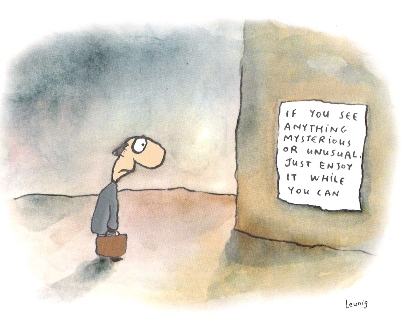
Another small selection of amusing or enlightening quotes encountered recently.
Why do we spend billions of pounds searching for life on other planets, yet we cannot preserve the life on the one we live?
[Seen on Facebook]
If you don’t like gay marriage, blame straight people: they’re the ones who keep having gay babies.
The time will come when men such as I will look upon the murder of animals as they now look upon the murder of men.
[Leonardo da Vinci]
It’s a shame to waste [the uniqueness that is you], by doing what someone else has done.
[Joseph Campbell]
There is a goal but no way; what we call the way is mere wavering.
[Frank Kafka]
A strong conviction that something must be done is the parent of many bad measures.
[Daniel Webster]
Nature does not hurry, yet everything is accomplished.
[Lao Tzu]
You can’t have a light without a dark to stick it in.
[Arlo Guthrie]
Recently, someone asked me if I believed in astrology. He seemed somewhat puzzled when I explained that the reason I don’t is because I’m a Gemini.
[Raymond M Smullyan, Five Thousand BC and Other Philosophical Fantasies]
At all costs, the Christian must convince the heathen and the atheist that God exists, in order to save his soul. At all costs, the atheist must convince the Christian that the belief in God is but a childish and primitive superstition, doing enormous harm to the cause of true social progress. And so they battle and storm and bang away at each other. Meanwhile, the Taoist Sage sits quietly by the stream, perhaps with a book of poems, a cup of wine, and some painting materials, enjoying the Tao to his heart’s content, without ever worrying whether or not Tao exists. The Sage has no need to affirm the Tao; he is far too busy enjoying it!
[Raymond M Smullyan, The Tao Is Silent]
Whatever you do will be insignificant, but it is very important that you do it.
[Mahatma Gandhi]

Beaujolais

We have Beaujolais Nouveau. As every year for the last few we have bought a couple of dozen bottles of Beaujolais Nouveau from Nick Dobson Wines. And today is release day, so our consignment arrived in the middle of the morning. I had to resist cracking open a bottle until this evening.
In fact what we have is a dozen bottles from each of two houses:

  • Domaine Philippe Deschamps, Beaujolais Nouveau
  • Vincent Lacondemine, Beaujolais Villages Nouveau

Over the years these two have produced some absolutely stunning Nouveau — in fact last year’s has matured brilliantly and we are lucky to still have some; it really is rather wonderful a year on, although I think it may not keep another year. Vincent Lacondemine also produces some gorgeous, regular Beaujolais Villages vintages.

Anti-Depressant
This is a photo I took of a Lacondemine bottle a few years ago;
it could just as easily be the one I opened a short while ago

So this evening we have tried the Lacondemine Nouveau. OK, you know immediately it is a very young wine. And maybe this year’s is a bit thinner and less fruity than the last couple of years — hardly surprising considering the appalling start to the summer; it has been a difficult year for wine growers. But it is definitely very, very drinkable.
We’ve just downed a bottle with some smoked duck, bean and pasta salad. But it would go well with something like a spaghetti bolognese, a hearty risotto, cheese, or just on it’s own!
I shall report back when we’ve tried the Philippe Deschamps, probably tomorrow — I wasn’t allowed to open a second bottle this evening. Humph!

Word: Glabrous

Glabrous
Free from hair, down, projections or pubescence; having a smooth skin or surface.
And hence used jocularly for anything smooth.
Now used only as a scientific term.
The origin in the Latin glaber, without hair, smooth, bald.
The OED records the first usage by Wilkins in 1640 who applied it to the orb of the Moon.

Weekly Photograph

More pussy porn this week. Tilly had an interview with the vet on Wednesday and came away without her nuts. It doesn’t seem to have slowed her down any! On Friday I did a major reorganisation of my desk area, installed lots of new filing trays and a couple of plastic crates for holding the build up of filing. Small madam has decided the top crate, which is tucked under a shelf, is a good place to snooze., despite (because of?) the fact that she can only just squeeze in there one leg at a time and that via another stack of filing trays.
The first photo is of her bedding down; in the second she is on ther way out and looking for something to pounce on and destroy.

Click the images for larger views on Flickr
Pussy in a Box
Pussy in a Box
16 November 2013
Pestle Pussy
Pestle Pussy
16 November 2013

National Road Safety Week

18-24 November is National Road Safety Week.
We’re all human: we daydream, get side-tracked, run late and make mistakes. But on roads, distractions can be fatal. National Road Safety Week 2013 focuses on the theme of tuning in to road safety and avoiding distractions.
When using roads, we all need to tune in to road safety and give it our full attention — particularly if we’re at the wheel, but also when we’re walking, cycling, skating, running, you name it — to keep ourselves and each other safe.


And that means not just instilling the awareness into our children — and I remember endless amounts of this when I was a kid — but also remaining alert ourselves and doing the sensible things like not using our mobile phones when on the move.
As always there is much more about National Road Safety Week over on their website at www.roadsafetyweek.org.uk.

Did you miss … ?

Another collection of links to pieces you may have missed. Again this time with rather more of a scientific bent, although most a actually readable and interesting.
OMG! Deja vu! This piece on Jabłoński diagrams takes me back to my post-grad days ‘cos these processes were central to what I was working on. How’s this for a scientific demonstration …


Meanwhile physicists have been exploring the hydrodynamics of urination “splashback”. Should be an IgNobel nominee.
Apparently men stroked in their underpants may illuminate the chemistry that bonds relationships. Don’t get too excited: they were stroked on non-sexual parts of their bodies while wearing only underpants. Another IgNobel nominee?
A little over 100 years since Captain Scott sailed off on his vessel Discovery, there’s a new RSS Discovery about to start oceanographic research.
What happens in the brain when we’re asleep? Looks like it flushes the “neuro trash” out of the system.
And there are several more articles from Nautilus on actual waste …
First up it seems there are so many pharmaceutics leaking into our waterways that some fish are now blissed out on Prozac.
Every part of every one of us is made from something else’s waste. Yes, really! Without waste we wouldn’t be here.
While we bemoan the amount of plastic debris in the oceans, it seems it is providing useful homes for some critters.
So where does all that plastic come from. Indeed, where does your stuff come from? Yeah, OK, the supermarket. And where do they get it? Brandon Keim on Nautilus tries following the backward chain ad infinitum. And fails. Which I find rather worrying.
Moving away from the vaguely scientific to things in my backyard …
Here’s one of those curiosities about London that cab drivers are actually brilliant at: London’s narrowest alley. Should be good for a pub quiz or two!
What were they thinking of? Once upon not very long ago US Ivy League colleges took nude photos of all their first year students.
What is mankind’s greatest invention? String? New Scientist makes the case.

Finally two pieces on what makes Autumn so gloriously colourful. The first from Grrlscientist in the Guardian, the second from Malcom Campbell at SciLogs. Just think, I did my research on analogues of some of those chemicals, hence the Jabłoński diagrams.

Thoughts on Depression

I’ve done quite a bit of thinking recently about depression. Partly my depression but also more generally. This all came about because a couple of weeks ago I had a fairly major down, which dropped me into both depression and panic and caused me to have to cancel a couple of important things I was supposed to be doing.
One of the things I came to realise is that there seem to be two types of depression. Or perhaps more accurately there are two types of depressive, which may reflect two types of depression as I think they may be able to co-exist. There are also essentially, it seems to me, to be two triggers for depression.
Let’s deal with the triggers first. I’ll call them “Despair” and “Overload”.
Despair
This is the classic “I feel useless and inadequate” scenario; “nobody loves me”, “I’m a mess”,” I’m useless”, “what’s the point of anything?”, “let’s end it all now”. We all get this sometimes and I’m not immune, but it generally isn’t the cause of my depression — more usually a result of me having royally cocked up something.
Overload
The alternative trigger, which is also fairly well accepted as a cause of depression, is excessive (for you) change and excessive load. Too many commitments; way far too much to do; bosses buggering everything around, etc. It’s the classic “I can’t cope with any more” scenario.


OK, so what are these types of depression/depressive?
I’ll call them “Do” and “Sit”.
Do
The standard self-help advice for depression seems to go along the lines of “get up, have a cold shower, put on some good brass band music and get on with life”. Which is fine if (a) you’re not too far in and (b) it works for you. It doesn’t work for me and never has. It broadly seems to fit with the Despair model.
Sit
To understand this let me give some background. Some years ago (like maybe 20 years) I read an article by a couple of medics in (I think) Glasgow who noticed that most people who were hospitalised with depression just wanted to sit in a corner and do nothing. This was contrary to the accepted treatment of giving them occupational therapy or psychotherapy (ie. a treatment of the Do type), which, guess what, for these people not only didn’t work but made them worse. The medics hypothesised that this was because the problem was that these people were reacting to an unreasonable (for them) level of change in their lives and that what they needed was stability. So forcing them to do things was just imposing more change, hence making them worse.
So they tested it by allowing a small number (six from memory) of people to sit in the corner as long as they wanted. And they found that they got better. As long as the occupational therapy was there, and the patient could see it was there, they would eventually come out and start joining in — but only after they’d sat in the corner stabilising for some while. Unfortunately I can’t now find the reference to this work and I don’t know if anyone has followed it up with a properly controlled study.
I realised quite a while ago that my depression was almost always of the Overload type and that making me do things didn’t work. The more I have to do, and the more things change under my feet, the more likely I am to drop into depression. So if I’m feeling fraught, I need less to do. I don’t need more to do. I am always loaded up as much as I can take (and more) so woe betide you if you insist I do more. Which is why people insisting I count calories, go to the gym, cut the grass, whatever, don’t get very far and don’t help me. This is why when I first started having hypnotherapy I told my hypnotherapist (a) I don’t count things, and (b) my obesity and my depression are inextricably linked. Nonetheless he had to learn both the hard way.
One of the other things I’ve noticed over the years is that sometimes, if I have a lot on and I’m feeling anxious, I’ll have a five minute panic. For instance, if I’m going out to yet another meeting I don’t want to, I’ll sit on the bed while getting dressed and panic; not cope; quietly go into meltdown. But after a few minutes I can come out (I usually have to as the clock is ticking on), put my shoes on and cope.
If I don’t come out I go into a proper panic attack and depression and then have to start bailing out of doing things, which is what happened a couple of weeks ago. It’s real “I can’t cope with this and this and this and that. What can I bin so I can recover?”.
Now I’m not pretending that Despair and Overload are black and white. Nor that Do and Sit are. Clearly there is a spectrum of greys here; a continuum. But I suspect that most depressives will be predominantly one way or the other. But it does seem to me that Do will tend to align with Despair, Sit with Overload. That looks logical.
I’m also not pretending any of this is necessarily new but it was an interesting voyage of discovery. I’d be very interested if any of this has actually ever been properly tested, in controlled studies.
And there remains too a necessity for appropriate drug treatment as this often provides some initial respite and a gateway to allow recovery to start.

Word: Bandersnatch

Bandersnatch
A fleet, furious, fuming, fabulous creature of dangerous propensities, immune to bribery and too fast to flee from. Later used vaguely to suggest any creature with such qualities.
The word was invented by Lewis Carroll (Charles Dodgson) and it makes its first appearance in Alice Through the Looking Glass (1871). The OED suggests the name is a portmanteau word like its stock epithet frumious.
Needless to say this beast has never been photographed.