
All posts by Keith
Book Review: The Incredible Unlikeliness of Being
Alice Roberts
The Incredible Unlikeliness of Being: Evolution and the Making of Us
Heron Books, 2014
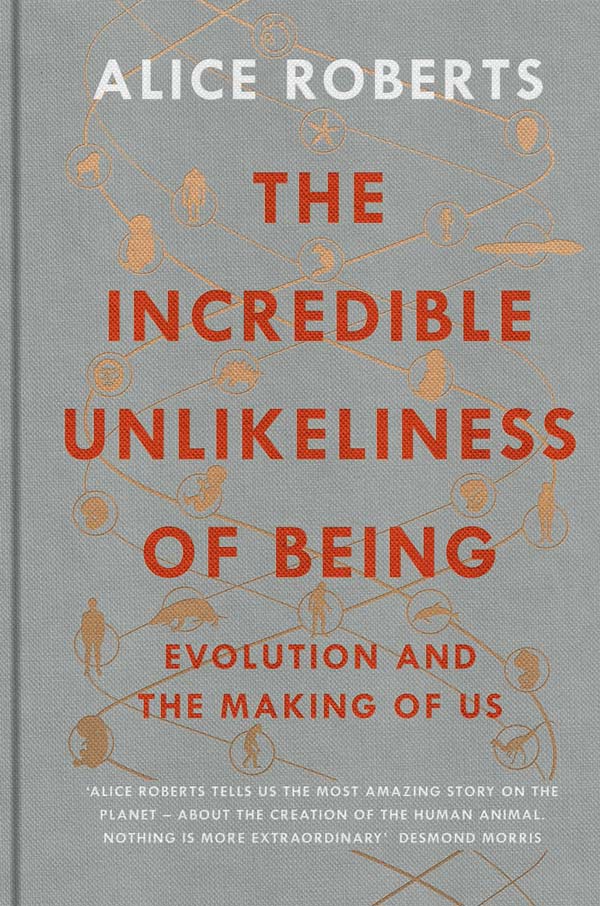 Alice Roberts is Professor of Public Engagement with Science at the University of Birmingham, and is perhaps the outstanding scientific polymath of our age: medic, anatomist, anthropologist, archaeologist, television science presenter and no mean artist. The Incredible Unlikeliness of Being is her latest book and sets out to unfold for us the amazing way in which we develop as an embryo and foetus and some of the ways in which we have probably evolved to this. And what an amazing voyage we are taken on!
I found the book immensely interesting and very readable. Roberts’ style is light, airy and chattily personal, while being scientifically accurate and informative — at times amusing and even ribald: how many authors could get away with a section entitled “Mind the Bollocks”? In fact I found the book so readable I had to ration myself to one or two chapters a night otherwise I would have devoured it in a single all night read.
We are taken on a journey from conception to birth with a look at how all the major systems of the body develop throughout pregnancy from the single egg and the successful sperm to the birth of a baby. Along the way Roberts describes the embryology, including insights from her own two pregnancies and the medical tests she has had done on her in the interests of science.
But more than this, she also discusses the archaeological evidence for how and why evolution has given us the kit of parts we have; how evolution got to produce them; and why they are different from other species. Right at the beginning of the book Roberts discusses the various theories of embryos and how babies are built from Aristotle to the present day. She is at pains to point out that each of these theories was consistent with the state of knowledge at the time so we shouldn’t scoff at them for being ignorant — one day our theories will be considered equally backward in the light of new knowledge.
Yes, I thoroughly enjoyed this book, but that doesn’t mean I don’t have reservations about it. It is a book for the scientifically (specifically, medically) literate layman. Roberts, rightly in my view, calls things by their correct scientific and medical names but I felt too often missed the opportunity to explain those names; what the part is or does. Of course the downside of providing more explanation is that it could disrupt the flow of the text (and make for a larger, more expensive book).
However I think there is a solution, at least in part, to this problem. The book is illustrated by Roberts’ own delightful line drawings — a very real demonstration of her skill as an anatomist! But there are for my money far too few illustrations. There were many occasions where I felt that a drawing (or other illustration) could have made the text much more powerful: especially in cases where the anatomy of different species, or at different stages of development, is being compared. Yes, some of those drawings are there, but for me too few. And drawings could have been used to explain some of the otherwise unexplained. In this respect I wanted more.
My other gripe is one which I all too frequently have to level at modern publishing (rather than authors): the poor quality of the paper used. Yes everyone wants to keep cost down and at £19.99 for almost 400 pages in hardback this is at the cheaper end of the spectrum. But oh that poor quality paper, which will not stand the test of time.
These are, however, relatively minor complaints about a book which I found informative, hugely interesting and immensely readable. I definitely came out somewhere different to where I went in!
So if you are interested in how babies grow in the womb, and how we got to be the shape we are, then I would thoroughly recommend this book.
It really is just so unlikely that we are all here, and as “normal” as we are!
Overall Rating: ★★★★★
Oddity of the Week: Viagra
Israeli and Australian researchers discovered that 1 mg of [sildenafil (Viagra)] dissolved in a vase of water can extend the shelf life of cut flowers, making them stand up straight for up to a week beyond their natural life span. The drug also slows down plant ripening; tests were done strawberries, legumes, roses, carnations, broccoli, and other perishables. Viagra increases the vase life of the flowers by slowing the breakdown of cGMP by cGMP-specific phosphodiesterase type 5. The Viagra acts on the cGMP in a fashion similar to nitric oxide (which also slows down the ripening process), but was found to be easier to use with cut flowers.
The 2007 Ig Nobel Prize in Aviation went to Patricia V Agostino, Santiago A Plano, and Diego A Golombek of Universidad Nacional de Quilmes, Argentina for their discovery that Viagra helps treat jet lag recovery in hamsters.
From Wikipedia
Five Questions, Series 6 #3
Yet again I’ve been ignoring my Five Questions series. Well the last month or so has been quite busy. Anyway here we go with the answer to Question 3.
Question 3: If you had to wear a warning label, what would it say?
Well this has to be one of the easier questions I’ve ever had to answer …
Contains nuts
Weekly Photograph
This week an amusement. Spotted these “health and beauty” offers in my local Waitrose supermarket last Friday!
Health & Beauty
Harrow; September 2014
Something for the Weekend
In anticipation of the Scottish referendum. Oh, and also for my god-parents.
Ten Things #9
So something different for my ten things for September.
10 Curious or Amusing London Bus Stop Names
London has over 20600 bus stops and every one has a name, so there are bound to be a few amusements, including …
- Badgers Mount/Badgers Rise
- Brian Close (if you aren’t a cricket fan you likely won’t get this)
- Crooked Usage
- Ha Ha Road
- Maypole/Bo Peep
- Neasden Underpass (who surely should be a character from Dickens)
- Nutter Lane
- Oval Square
- Popes Grotto
- Stoats Nest Village
- Uneeda Drive which is just down the road from me
And as a bonus I have to add …
Diamond Geezer provides a lot more for your amusement, and there is a full downloadable list of every one of the 20600+ bus stops on the WhatDoTheyKnow website.
Oddity of the Week: Piano
This postcard is being sold on eBay …
Your Interesting Links
Another selection of pieces which you may have missed and will definitely wish you hadn’t.
It’s no wonder that bites hurt and itch when you see the chemical composition of insect venoms.
Now here’s a brilliant demonstration of the way in which evolution happened. Fish adapt to life outside water by learning to walk.
Some truly stunning macro photographs of insects by Yudy Sauw.
Question of the week … Do farts carry germs? Apparently it depends on whether or not you’re wearing pants.
We all have them, we’re not aware of them and they do no harm … mites that live on our faces. And here are three things you didn’t know about face mites.
You have a microbial aura. It rubs off on your house. And when you move house, your microbial aura moves too.
When you shave (or wax) your hair grows back ticker. Right? Apparently not.
So just why is it that fingernails grow so much faster than toenails?
And while we’re on curiosities of the human body … what are those strange things you see floating in your eye?
Oh, and here’s yet another … why do men get erections in the morning?
OK so enough of this ribaldry, let’s move on to food …
Monosodium Glutamate has a bad reputation. But is it deserved? Seems there isn’t too much evidence.
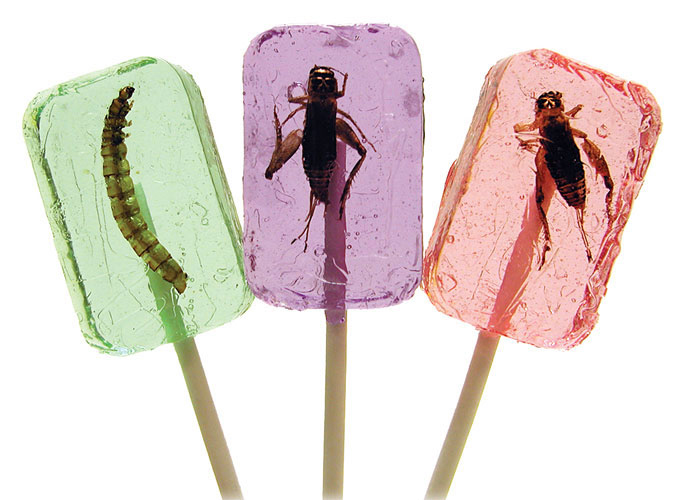
So in 50 years time, will we all be eating insects? Seems like not such a bad idea, though I still might pass on the grubby ones.
One day the medics are going to make up their minds … Now some are suggesting that a bottle of wine a day is not bad for you and abstaining is worse than drinking.
And so to things historical …
Did the historical Jesus exist? It seems a growing number of scholars don’t think he did and that Christianity is a load of myths repackaged by people like St Paul.
Well guess what … Stonehenge was round! Now there’s a surprise.
And here are 44 medieval beasts that just cannot handle it right now. (Well that story about Stonehenge was such a shock!)
Coming more up to date, it appears (and I use that word advisedly) that some DNA evidence has unmasked Jack the Ripper after 125 or so years. Hmmm … I’d be more convinced if this had been submitted to peer review and published in a reputable science journal, rather than in a book and the Daily Mail.
Ever thought of time travelling? Ever thought what you could do if you couldn’t take anything with you? Yep, get some useful information tattooed on. But what would you choose as a tattoo?
And for our final two contributions we descend further into the realms of the banal.
First here are 35 perfect fairy gardens made from usefully broken flowerpots etc.
And finally some hilariously amazing constructions from the National Beard & Mustache Championships.
Weekly Photograph
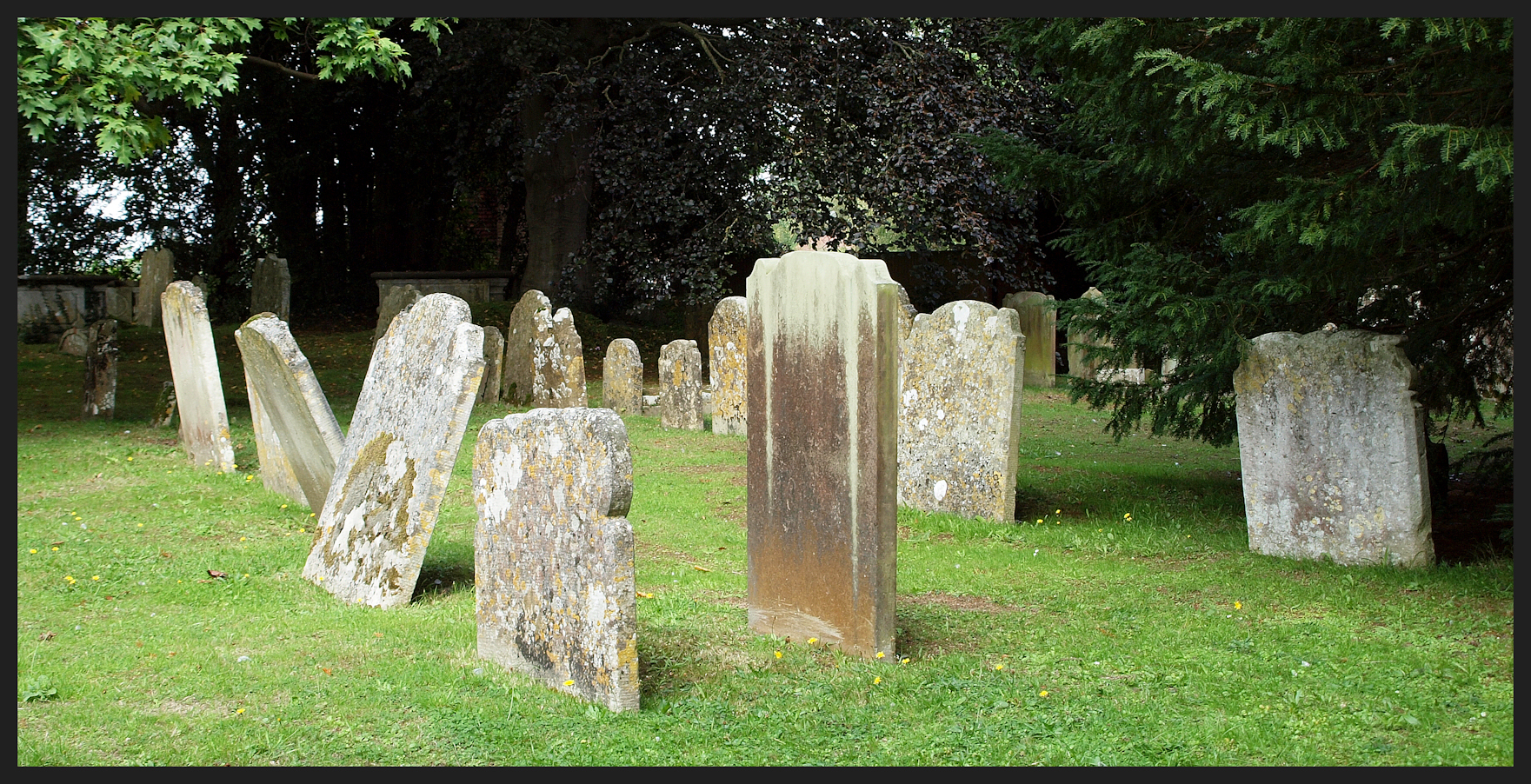
Following on the family history theme from the other day, this week’s photograph is another from our trip to Kent last week: a view of an English country churchyard. Specifically this is the churchyard of St Mildred’s, Tenterden and shows the headstone to my ggg-grandfather, Samuel Austen — that’s the large browner stone in the middle; it’s the back, so you can’t see the inscription.
Samuel Austen in Context
Tenterden; September 2014