Old London in Paintings and Photographs
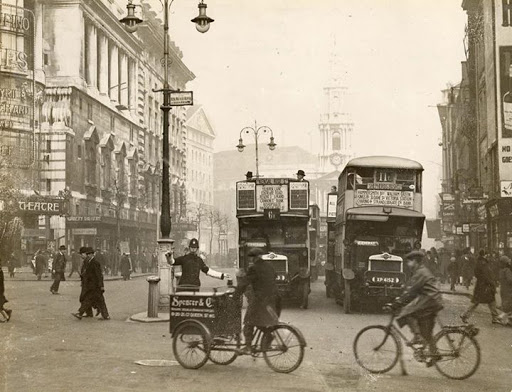
Strand; ca. 1930s
Note: this image is not mine and may be copyright the original photographer/artist;
please click on the image for further information



Does anyone else have the occasional memory spring randomly into their mind about something heard or learnt in childhood but had long forgotten? Of course it usually happens when you’re in the shower or just dropping off to sleep, so you forget about it again even though you would like to investigate it.
Well that happened to me the other night, yes, as I was dropping off to sleep. Luckily I wasn’t so asleep I couldn’t scribble a reminder. (I always have a pad of Post-Its and a pencil by the bed.)
And what was this? Something I got from my mother as a child: dialect numbers and counting used by shepherds in various areas of the UK. I learnt one from my mother, but there are many and they’re all slightly different.
Imagine you’re counting sheep on a hillside. The one I learnt goes like this:
1    Yan
2    Tyan
3    Tethera
4    Methera
5    Pimp
6    Sethera
7    Lethera
8    Hovera
9    Dovera
10   Dick
11   Yan-a-dick
12   Tyan-a-dick
13   Tethera-dick
14   Methera-dick
15   Bumfit
16   Yan-a-bumfit
17   Tyan-a-bumfit
18   Tethera-bumfit
19   Methera-bumfit
20   Giggot
You can just see the old shepherd, who can just count to ten on his fingers, using this to count his flock.
I shouldn’t have been surprised to find that Wikipedia lists a couple of dozen such sheep counting schemes from around the UK. Apparently this one comes from Borrowdale. That would fit as my mother certainly spend time hostelling in the Lakes before the war.
At least it is logical — well as logical as the way the French count above sixty, where for instance 63 is soixante-treize, and 92 is quatre-vingt douze.
Isn’t it just brilliant?!
The fight to get governments to decriminalise sex work (and sex workers) continues. Here’s a piece which highlights the views of Europe’s sex workers — most of whom are (voluntary, not trafficked) migrants.

major human rights organisations such Amnesty International, Human Rights Watch, the World Health Organization and several other United Nations agencies such as UN Women and the UNAIDS Advisory Group on HIV and Sex Work are also calling for the decriminalisation of sex work, noting that decriminalisation guarantees better working conditions, and reduces the social vulnerability and marginalisation of sex workers.
And as that implies many are now warning that the basic human rights — as covered, for instance, by the Charter of Fundamental Rights of the European Union — are being violated; and that those violations are state sanctioned the world over.
When are people going to wake up to what’s going on around us? It’s being done in our name, and yet how many of us agree with it?