
Monthly Archives: October 2017
More Knees Up
[Medical trigger warning]
As today is four weeks since surgery, I thought we should have a progress report on the rehab of my left knee.
Things are now definitely getting better physically; but I’m still feeling very low mentally. Most of the bruising has gone as has almost all the swelling – ice-packs several times a day have helped (the hospital provided a specially designed cuff cooler when I had the right knee done). For some days now I’ve been walking around the house without the aid of crutches or sticks – the exception being the stairs where I still don’t feel entirely safe. I’m still taking crutches if I go out, if only for safety.
When I saw my physiotherapist this time last week I had 110° of flex on the knee, and I know it will be even more by the time of my appointment next Monday. Needless to say the physio was very happy; the flex and function of the knee are good although still painful; he even had me on an exercise bike doing gentle to and fro motion (a full cycle is not yet possible, although I did try). I was given an extra set of exercises to do, which are all about strengthening the muscles as well as improving the range of movement; and the exercises are gradually getting easier and less painful. I’m still being subjected to the torture of the green anti-DVT stockings though.
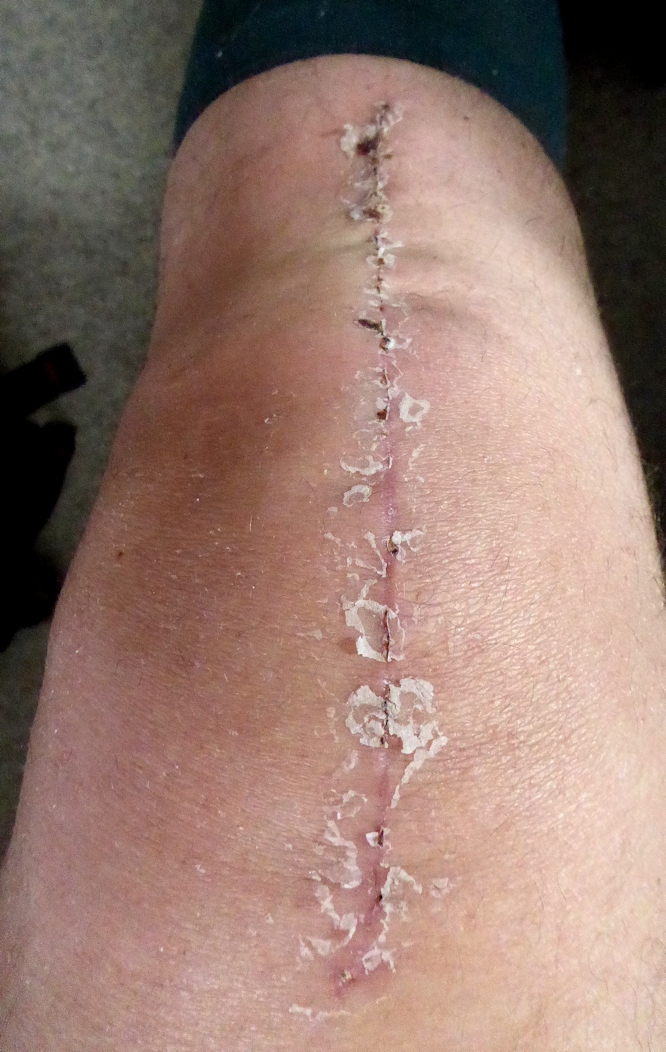 As you can see from yesterday’s photo, the scar itself is healing well and looks as if it might eventually be even less obvious than the one on my right knee. (Incidentally I don’t know if the visible flaking is dead skin, surplus glue from closing the wound or some form of plastic skin which was applied to cover the wound. But the right knee was the same and it seems to be OK.)
The pain is very definitely subsiding. Yesterday was the first day since surgery that I’ve awoken at 6 or 7 AM and not immediately thought “Bloody hell I must have some painkillers”. In fact yesterday I didn’t need to take any painkillers from midnight to lunchtime – although by then the knee was very achy. So with luck I in the next week I can start thinking about tailing off the codeine, if not the paracetamol as well.
Meanwhile I managed to screw up my lower back last week; and yes, on the left side! This entailed two trips to the osteopath. The first on the Monday helped immediately but then the muscles were going into spasm every time I tried to move. This settled down overnight with a couple of small doses of Valium as a muscle relaxant. But by Friday the lower back was giving trouble again, so Saturday saw me back at the osteopath seeing a different guy who comes to osteopathy via a sports training background. I have to say he was brilliant – not just at releasing the back but also at explaining how this was all down to the muscles and joints readjusting to different ways of moving following the operation. His prescription was to walk (do what you can and build up slowly) to get the muscles etc. used to working properly again. I came away walking well and feeling much more at peace mentally. So far I’ve concentrated on walking around the house, but our long back garden is beckoning.
I’m still feeling anxious, depressed and panicky at times but that mostly isn’t the knee but everything else I have piled up getting me down. But with the pain receding, and a more positive outlook for the knee, I am at last managing to catch up on some of the stuff I’ve ignored over the last few weeks.
So the bottom line is: keep going; keep doing what you’re doing; it does get better (even if it doesn’t always feel that way hour-to-hour or day-to-day). Onwards and upwards.
Ten Things
Having just had my second knee transplant (sorry, total prosthetic knee replacement) I thought that for this month’s Ten Things I should maybe write a few of the important things I’ve learnt about knee replacement operations.
Ten Things I’ve Learnt about Knee Replacement
I’m taking as read all the usual stuff about operations, general anaesthetics, etc. (like anti-DVT stockings, morphine causing constipation). This is knee replacement specific things. First of all it is important to realise that no two knee operations are the same, so what follows is based on my experiences; yours may be different.
- There are three key people in a good outcome: a good surgeon, a good physiotherapist and you! Yes, you! A good surgeon and good physio are critical, but it is equally critical that you put in the work at rehab!
- If you can find out who your surgeon will be, check him (or her) out. If you have a choice, ensure you get someone who specialises in knee replacements rather than a generalist. What’s their track record? How many have they done? The more experienced they are the better.
- Anything you can do before your operation to strengthen your legs muscles, specifically the quads at the front of the thigh, is going to be helpful in rehab.
- Before you go into hospital ensure everything is ready at home, especially think about trip hazards: gangways are clear, rugs are stuck down or removed.
- Get a urinal (maybe two) with a lid – something to pee into in the middle of the night. (They’re cheap and many come with a “female funnel attachment”.) Even with a light on, you do not want to be staggering to the bathroom, on crutches, maybe in pain, barely half-awake, in the wee small hours and while trying to avoid the lurking cats and dogs.
- Unless you have a “slave” (aka. a partner) to fetch and carry for you, get a good bag (shopping bag size) which you can put over your shoulder or round your neck to carry things around when you’re using crutches.
- Post-op your #1 enemy is infection. Ensure no-one (and I mean no-one) touches your operated leg without having visibly washed their hands and are preferably wearing disposable gloves.
- Do as much as possible to ensure you get a good physiotherapist. Poor, or no, physio is the fastest way to ensure you don’t recover your mobility. Rehab physio will start in hospital; they’ll likely have you standing with a frame and walking a few gentle paces just 12 or so hours after your operation. You will be given exercises to do. Do them – as much as you can through the pain (but stop when it gets too painful). And keep doing them. Make sure you get as much post-op out-patient physio as you can and that your first session is within 7-10 days of leaving hospital; these sessions will help monitor your progress and adjust the exercises to your needs. The physios are not there to be sadistic (though sometimes it feels like it!) but to get you doing the right exercises, the right way, and at the right time, to ensure the best possible outcome.
- Recovery is painful! Think about what has been done – someone has done around 90 minutes serious carpentry to remove the degraded bone and replace it, very accurately, with some highly engineered metalwork; and that’s all on one of the most complex joints in the body. Discuss pain control with your clinicians; they will prescribe the right analgesics. Although the pain will recede over time, do not expect to be pain-free for several weeks. But a good outcome is well worth the pain.
- You should be provided with elbow crutches and taught to use them in the day or so after your operation. You will need them for several weeks. Go carefully and don’t get over-confident as this will lead to accidents. On the other hand you should be encouraged to dispense with the crutches as soon as you safely can.

There is a lot more I can say, and I do intend to try to write all this up for the benefit of others. But that will do for now!
Written Rules
If you think that good, clear, written English is irrelevant, pedantic or elitist you really need to think again and read this from the Guardian …

Regardless of style (which needs to vary with context) good, clear, factually correct writing which is correct in grammar and spelling, helps engage the reader. And after all, that is what you want, isn’t it!?
And yes, NHS and HMRC, I’m looking especially at you!
Badgers
This is worth reading …
Essentially it drives a coach and horses through the governments ridiculous programme of culling badgers.
Word: Cunctation
Cunctation
Procrastination; delay; tardy action.
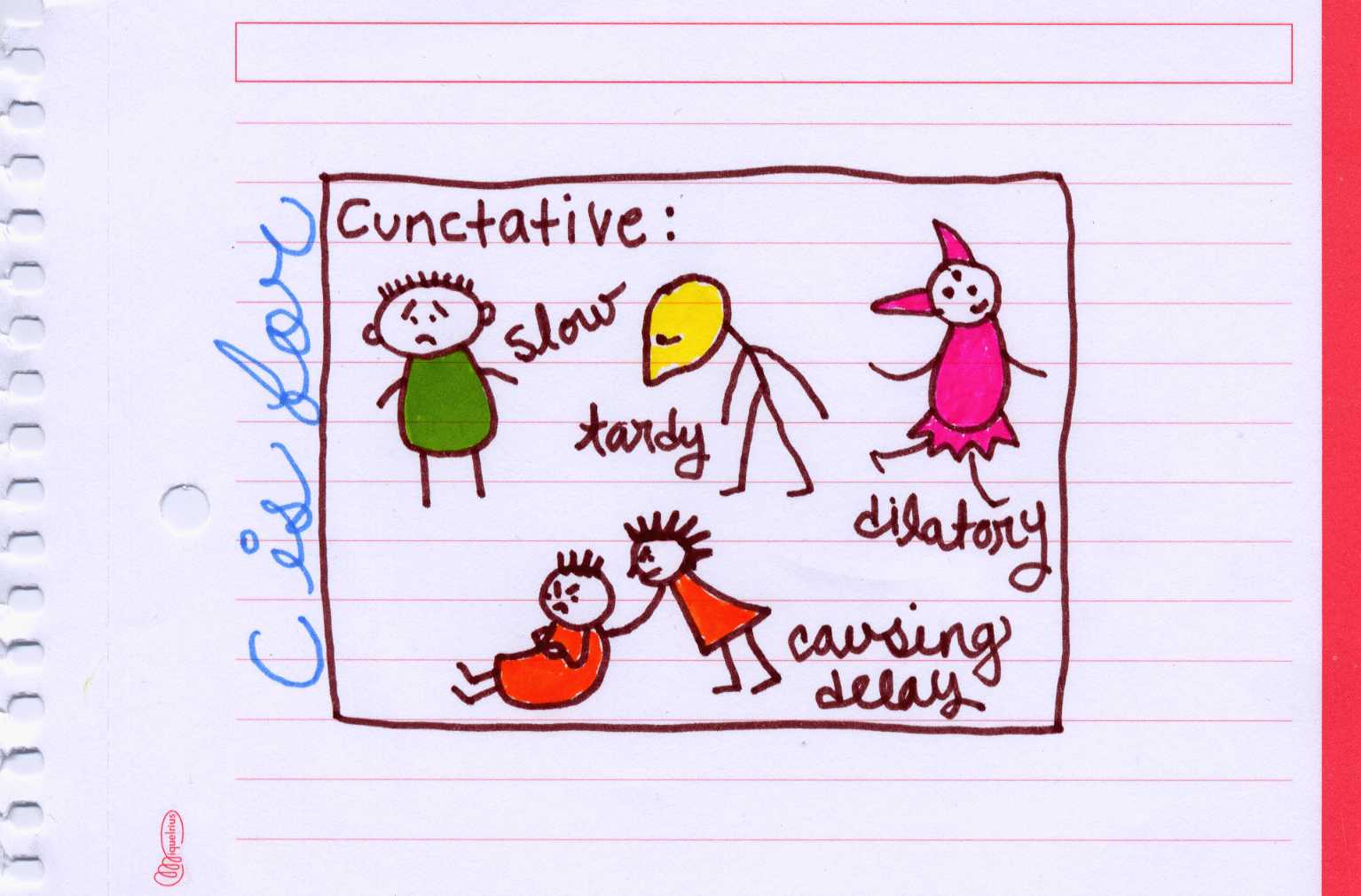
The word is derived from the Latin cunctārī, to delay, and according to the OED was first used in English in 1585.