
Anatoliy Omelchenko of Triangle Tree has designed the Edible Spoon Maker.
It works on the toasted sandwich maker principle and allows you to bake your own edible spoons from either home-made or ready prepared dough in only a few minutes.
In this video Omelchenko demonstrates the device using ready-made biscuit dough:
Find out more over one Triangle Tree.
Category Archives: amusements
Something for the Weekend
Ten Things
This month Ten Things returns to being more personal with 10 Places I Have No Desire To Go:
- South Africa (in fact anywhere in Africa except possibly Madagascar)
- Saudi Arabia
- Pakistan
- Mexico
- Argentina
- Australia
- Philippines
- Indonesia
- Israel
- Texas

Oddity of the Week: Not Garden Gnomes
Bored with garden gnomes?
Want something else to cheer up your front garden, and your neighbours?
Well then the AliExpress website has just the thing: erotic nude female statues like this one …

Why not start a new trend?
Thinking Thursday #6 Answer
OK, so last Thursday I posed the following problem from Alcuin of York:
A man has to take a wolf, a goat and a bunch of cabbages across a river. The only boat available can accommodate just two of them at a time. It is well known that if left alone together the goat would eat the cabbages, and the wolf would eat the goat; but the man has been ordered to transfer all of them to the other side dry and in good condition. How can he achieve this?
So this is how the man did it …
First take the goat across and leave the wolf and the cabbages behind. Then return (empty) and take the wolf across. Having put the wolf on the other side, take the goat back over (remember, you can’t leave it with the wolf!). Leaving the goat on the near side, take the cabbages across. Then you can return (empty, again) and having picked up the goat take it over once more. You should now have everyone on the far bank, safe and well, and you’ve had some healthy rowing.
How many of you worked that out? Good, well done.
Now the remaining challenge is to return the boat to it’s starting point. Bright ideas on how to do that — without getting wet or damaging your charges?
If you want to know more about Alcuin’s puzzles then Can You Solve Alcuin’s Puzzles? is a good starting point.
Something for the Weekend
Thinking Thursday #6
Here begin the problems to sharpen the young is the beginning of a wonderful text which it is believed was written by the Carolingian scholar Alcuin of York (c.735–804). The work presents over fifty mathematical puzzles many of which remain a challenge even for modern readers. Here is one of the best known, which you may well have come across before:
A man has to take a wolf, a goat and a bunch of cabbages across a river. The only boat available can accommodate just two of them at a time. It is well known that if left alone together the goat would eat the cabbages, and the wolf would eat the goat; but the man has been ordered to transfer all of them to the other side dry and in good condition. How can he achieve this?
As always there’s no prize other than the satisfaction of solving the puzzle — but do feel free to show off by putting your answer in the comments.
Answer on Sunday evening, as usual.
Oh, and no cheating!
Oddity of the Week: Not Taxidermy
Should you be of a mind, it is quite easy to buy examples of taxidermy: just go to a few local auctions and you’ll soon find all manner of creatures in glass cases.
But you can now go one better: Upholstered Faux Taxidermy Heads and Animals.
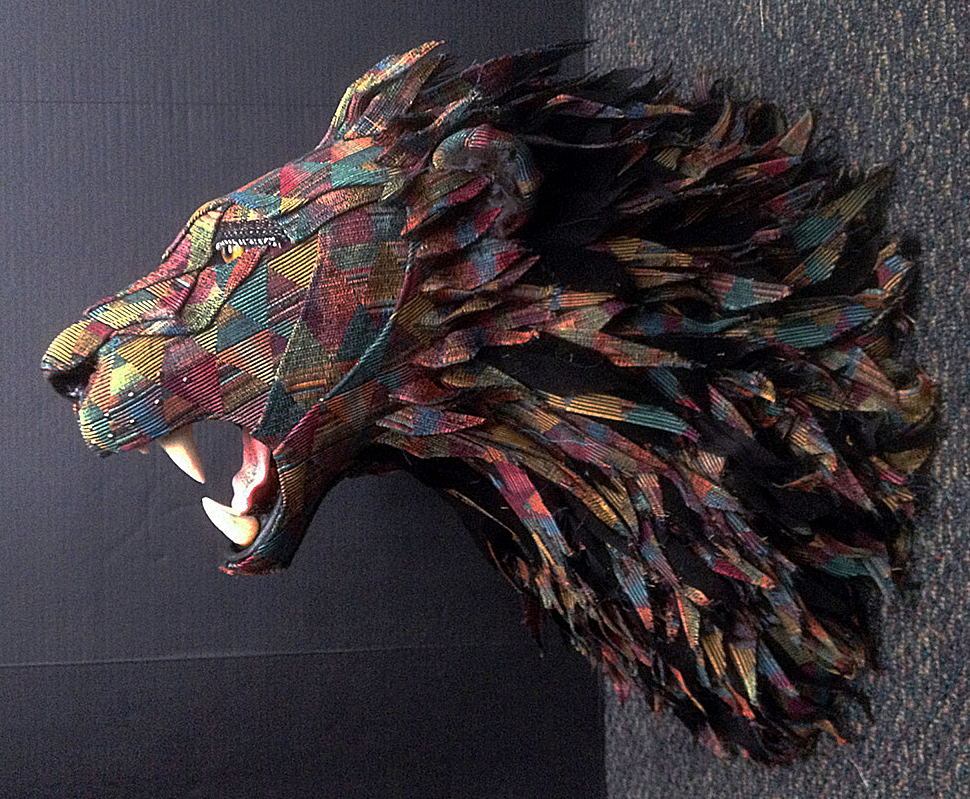
American artist Kelly Rene Jelinek fabricates life-sized replicas of taxidermied animal heads using fragments of upholstery fabric. The results are surprisingly modern sculptural objects that mimic traditional anatomical mounts.
See more on Colossal.
RoboLit
There was a brilliant piece in last Monday’s Guardian in which Stephen Moss asks what robots might learn from our literature. I give you a sample:
[A] new generation of robots combining artificial intelligence with great physical power may not … wipe us out after all. We can be friends, united in a common appreciation of Middlemarch. But a less sunny outlook is suggested by … the Shepton Mallet School of Advanced Hermeneutics [who] fed the entire world’s literature into a robot (called HOMER16) fitted with a high-powered computer; preliminary results are worrying.
Here are some extracts from the HOMER16’s initial readings.
Hamlet: Dithering prince with unhinged girlfriend demonstrates how dangerous it is not to act decisively. Interminable and convoluted plot obstructs the central message that your enemies should be dispatched quickly, brutally and mercilessly. Cannot compute the meaning of the strange “To be or not to be” speech. In what sense is that the question?
A Clockwork Orange: Frightening study that shows the extent to which a love of classical music can damage the human brain. The works of Beethoven seem to be especially dangerous. Fail to understand why this material is still played, even on radio stations that very few people listen to.
The New Testament: Ludicrous set of stories in which the sick are miraculously healed, fishes and loaves materialise from nowhere, and a young man comes back to life after being executed. The telling by four narrators is interestingly postmodern, but the plot is too ludicrous to hold the attention. Could not compute the long introduction called The Old Testament, which seemed very dull and repetitious.
À la Recherche du Temps Perdu: A book in need of an editor about a protagonist in need of a psychiatrist. Good on the dangerous consequences of eating cake.
[With thanks to Julian Miller.]
Something for the Weekend
Clever New Yorker cartoon I spotted a week or so ago …