
[Warning: this is a long post. It’s so long I can’t find its tail to pin a donkey on it.]
My friend Katy has finally finished reading Anthony Powell’s A Dance to the Music of Time. She’s written a blog post about her thoughts of it. Despite being a deeply dyed literarist she isn’t very enthusiastic, so more power to her for having stuck the course. She’s also worried about what I mights say!
Well there’s no need to worry. I may be one of the progenitors of the Anthony Powell Society (and its Hon. Secretary) but I am also a realist. Dance, indeed any of Powell’s work, isn’t for everyone. Dance, especially, you have to “get”. And either you do or you don’t; many people don’t get it. No shame in that; I don’t get Tolkein.
So, no, I’m not going to try to change Katy’s mind, or tell her she’s wrong. There are no right and wrong answers. Katy’s (anyone’s) reaction to the work is as valid as mine. Yes because of Katy’s Eng. Lit. academic background she should be able to read anything more easily than I can — and appreciate it for its style, or lack thereof — but she is still allowed to know what she does/doesn’t like; as are you.
What I am going to do is to try to pick up on a number of Katy’s observations about Dance and try to put them into some sort of context to help others better understand the work.
At this point I should say that anyone who wants a potted summary of the 12 novels can find one on the AP Society website; and anyone who wants to buy them can find the current paperbacks on Amazon.co.uk or Amazon.com.
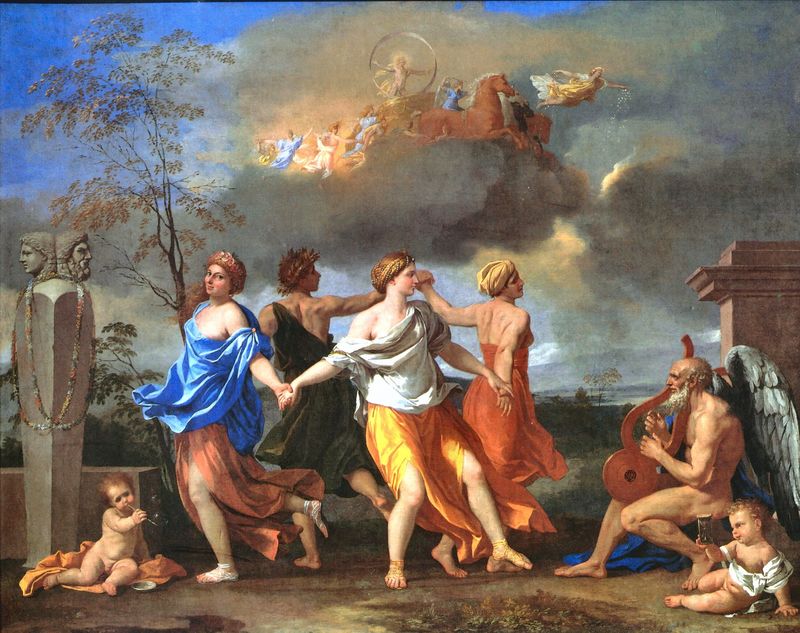
Nicolas Poussin’s, A Dance to the Music of Time which inspired Powll’s novel sequence
of the same title. The painting hangs in the Wallace Collection, London.
OK, so what points does Katy make and which appear to have hindered her enjoyment?
- The book is hard to read because of the historical background.
- It is slow going.
- There isn’t any plot and the books go nowhere.
- It covers a lengthy timespan.
- Why does Powell persist with a horrible character like Widmerpool?
- We learn nothing about the narrator Jenkins and his family.
- The women are poorly drawn.
- Evelyn Waugh is a better read.
- The last book, Hearing Secret Harmonies, is the weakest of the series.
Any comments one makes to these questions are, naturally, inextricably intertwined, so I’m going to write some narrative rather than try to answer each question in a standalone fashion. So here goes.
Interestingly women do seem to have more of a problem with Powell than men do. And there’s a good reason for this. Powell was born in 1905 into an upper middle-class family. He had an Edwardian, all male, public school (Eton and Oxford) upbringing in a world where men’s relationships with women were very different from the way they are today. Indeed the whole of society was different. This is one of the things which, as Katy perceives, makes the work hard for modern audiences. It is also one of the reasons why, I think, women predominantly find the female characters poorly drawn. This isn’t “wrong”, it is just Powell’s very different perspective on women and the world; a world which was different from the one we have been brought up in.
 But there’s something about Powell’s very different view of this very different world which is one of the books’ great strengths. It covers a huge timespan: from the outbreak of the Great War in 1914 (a flashback at the start of book 6, The Kindly Ones) to around 1971. It is detailed in places; detail which is inexorably accurate. It covers times and echelons of society many of us will never have truly encountered but which Powell did — much of the work is based on and drawn around his own experiences although it is decidedly not autobiographical, nor only about toffs, as often supposed. All of this makes Dance a tremendous piece of social history — something which scholars are now beginning to appreciate.
That doesn’t make for an easy or fast-moving read for one does need to have some understanding of that history, and to concentrate, to be able to make best sense of the book. And the better one understands the history, the more one gets from the book and the more one appreciates its humour. This detail; this lack of understanding of English society and 20th century social history; is why one of my dreams is to be able to create a complete annotation of Dance, in the way that Martin Gardner created The Annotated Alice. Without such a resource much of the detail, interest and subtlety of Dance is almost bound to get lost. A lot of this detail one can read over without fully understanding it if one has the background in English society. As an example how many of us really know what is a “regiment of the line”? But we have a rough idea what it is about and that’s enough at a first level. But if one gets the nuances of the detail the whole work becomes so much more interesting. However it confuses the non-English reader and the less educationally mature reader. And that’s a great shame as there is much to enjoy in Dance.
For yes, Dance is at times comic: in an understated English way. Powell doesn’t do stand-up, laugh-out-loud farce set pieces in the way that his friend and contemporary Evelyn Waugh does. Think of Waugh’s war trilogy and Apthorpe’s “thunder-box” or the whole of Black Mischief. Powell is more subtle and takes a drier, more askance look at what’s happening, making humour from everyday situations and his characters turns of phrase.
Being contemporaries, Powell is so often compared with Waugh, which is something misleading and unfair to both writers. They are birds of completely different plumage. It’s a bit like comparing apples and smoked haddock. Waugh writes books with stories and plots and is good at farce. Powell is more discursive and descriptive; more in the style of Dickens or Walter Scott, or as often stated, Proust. This is in part what makes Dance slow going for some people. But in my view Powell is a much superior writer, technically. Powell and Waugh are trying to do very different things; nevertheless they were genuine admirers of each others’ work. Which you prefer to read depends how one is constituted.
All of this is why there is a perception that Dance doesn’t have a plot and goes nowhere. I see the logic here. There is no well defined story line or giant denouement with an “everyone lives happily ever after” ending. And that is the whole point. Why? Because that’s the way life is. And what is Powell doing? He’s writing about life. The way life twists and turns. About how people weave in and out of one’s life at unexpected times and in unexpected ways, like the dancers in Poussin’s pa
inting. About how people connect to each other also at unexpected times and in unexpected ways. Life isn’t tidy and for the vast majority it doesn’t have a pre-defined plot or story line.
 This too answers the question of “Why Widmerpool?”. The answer, again, is because that’s how life is. We all have people who weave in and out of our lives, who we maybe dislike or who are horrible characters. That’s how people are and how life is. Powell uses this for great comic effect. Widmerpool is a sort of heroic anti-hero. Or is he an anti-heroic hero? Whichever. The novels wouldn’t work with a nice, well-behaved, “every-girl-would-like-to-take-him-to-bed” style hero. Try substituting Waugh’s Charles Ryder or Sebastian Flyte for Widmerpool. It just wouldn’t work!
Another reason there isn’t a well defined plot is that, as Powell himself says somewhere, the novels are written as being like a series of stories told over the dinner table. If you like, Jenkins the narrator is telling stories about his life and about the way in which Widmerpool has wandered in and out of this life. The stories are set off by this image (at the very beginning) of the men with a brazier mending the road and culminate 12 books later with a reprise of that same scene. (We’ll ignore for now the debate over whether the start and end really are the same scene or not.) But again that’s why there is no well defined plot in the conventional sense: it is a set of meandering stories which, as we all know from having talked over dinner, often do indeed go nowhere.
But there are plots, or at least story lines. Widmerpool himself is the main plot. There is an army/war story line. There’s another around the interaction of the literary/arts world with the business world. And overarching even the Widmerpool leitmotif there is one about power: men of thought vs men of the will.
This is also why we learn little about Jenkins himself and his family. It isn’t relevant to the stories being told which are largely observational about other people. Just as Powell is often criticised for not dealing more with the Katyn Massacre or the Holocaust. It isn’t that Powell denies them or belittles them. It is merely that they aren’t relevant to the stories he’s telling.
 Which brings me to the final point, about the final novel: that Hearing Secret Harmonies is the weakest book. I have to be honest and say I agree; I too think it is the weakest book. But many do not agree. Indeed I have had exactly this debate with Eng. Lit. academics and other deep thinking persons such as Lord Gowrie. HSH doesn’t work for me; it isn’t the life I lived through. But, again, there is a good reason for this. I was a student at the time HSH is set; I was there; I lived through the “swinging sixties” and early ’70s as a student. Powell was not there; he was already in his 60s and looking at what was happening with the eyes of an uncomprehending older generation. We should not expect him to see and understand those times in the same way I do. That doesn’t mean I’m right and he’s wrong. We have different views of the world. It’s like me, now in my 60s, trying to understand the culture of the present generation of students: I don’t understand it (and arguably nor should I) in the way those living the life do; I’m looking at it through totally the other end of a telescope from them. This is a part of what makes HSH feel a somewhat contrived ending. But then again I know many who would not agree with that either. That’s why, I think, HSH doesn’t work well for me. Against that the war trilogy does work well and they are my favourite three of the 12 books, as they are for many readers.
 I’ll finish by saying what I often say to people asking about whether to read Dance. First of all don’t be off-put by the fact it is 12 novels. Each novel is essentially standalone, although some are better at it than others. Read one, or two, and see if you like it. If you are a person who must read a sequence of novels in sequence then you have to start at the beginning with A Question of Upbringing; but be prepared to persevere as I find QU the slowest of the books. If you are someone who needs to be captivated then start by reading one of the books from the second trilogy or from the war (third) trilogy depending on whether you’re more interested in the swinging thirties or the war.
But most importantly if you’re a serious reader and you haven’t tried Powell, do so. There’s so much more in Dance than a mere 12 novels. I believe Powell is one of (if not the) best writers of the 20th century, and greatly under-rated. And he was a lot more than “just a
novelist”!
 Cast skins, shells, or coverings of animals; any parts of animals which are shed or cast off, whether recent or fossil.
  Following up on my

 Today, 29 February, is a unique day. So unique it happens, to a first approximation, only every four years.
  Various newsfeeds (eg.
  And as if that weren’t worrying enough it has now been found that there at least